The Flock Has Its Own Weather Licence
A short story about a Sardinian shepherd sitting a climate-data exam in 2047, and a boy walking the same transhumance route in 1971, both learning why the sheep refuse the fastest road.
Drafted with AI. This version has not been reviewed by an editor, so it carries no ads — how we work.
Story Time is original short fiction. The characters, places and events in this story are invented.
Nuoro, October 2047
Bonaria had the collar open on the desk before the examiner finished reading the instructions, its solar strip peeled back like the skin of a fig, the temperature probe already out on its lead. Across from her, Matteo Piras watched the timer on his tablet and did not mention that she had started early.
“Recalibrate the humidity sensor,” he said. “Then we review your tracks.”
She had done this a hundred times in the fold at four in the morning, by headlamp, with a ewe leaning on her knee. Here, in the licensing office on the second floor above a pharmacy, under lights that hummed, her fingers were slower. Two hundred sheep, two hundred collars, each one reporting temperature, humidity, pressure and position to the regional climate model every ten minutes. If the licence came through, the region would pay her for every report. If it didn’t, the man from Solaterra would come back with his folder and his offer for the high pasture, and the sheep would go to the abattoir at Macomer in lots of forty.
She closed the collar. The light went green.
Piras turned his tablet toward her. A map of the Barbagia, and over it her flock’s last three autumns in a thin blue line, wandering south and west toward the Campidano like a thread someone had dropped. Beside it, in red, the line the model expected: down the valley roads, along the river floors, the gentle gradients.
“This is the problem,” he said. “The system weights collar data by plausibility. Livestock take efficient paths. Yours don’t. Here, above Sorgono, they climb two hundred metres and come down again. The model reads that as anomalous noise. Noise gets discounted, and discounted data doesn’t qualify for the licence tier.”
“There’s a reason they climb.”
“I’m sure there’s a reason for you.” He wasn’t unkind. He was perhaps thirty, with a pen behind his ear he never used. “The simplest fix is to move them along the valley. Two seasons of clean tracks and you’d qualify.”
“Clean,” Bonaria said.
“Consistent.”
She looked at the blue thread climbing above Sorgono, where it always climbed.
Fonni, October 1971
Gavino carried the radio because Zuanne refused to touch it. It was a transistor the size of a brick, bought in Nuoro with the summer’s cheese money, and it hung from a strap across his chest and knocked his ribs with every step down from Fonni. Ahead, the flock filled the road from wall to wall, three hundred and some, bells clanking, the dogs working the edges.
“Cagliari says fine weather all week,” Gavino said. “High pressure. Clear nights.”
“Cagliari is beside the sea,” said his uncle.
Gavino was fourteen and this was his first time going all the way down. His father had broken his leg in August, so it was Zuanne and the boy and twelve days of walking, sleeping in the open, paying for passage across other men’s stubble with cheese and cigarettes, until the Campidano opened out flat and mild and the winter grass came up. He had imagined it would feel like an adventure. It was mostly feet.
Below them the asphalt ran on into the valley, smooth and kind to the ankles. Zuanne whistled to the dogs and turned the lead ewes off it, up a stony track between cork oaks.
“The road’s faster,” Gavino said.
“The road’s for trucks.”
Fonni, 2047
That evening Bonaria sat at the kitchen table with the tablet, a plate of carasau and pecorino she wasn’t eating, and a message from Solaterra she hadn’t opened because the preview already said our offer remains valid until the 30th.
She pulled up the raw collar logs, not the tidy summary the region showed her, and laid the temperatures over the tracks. On the nights the flock climbed above Sorgono, her collars read four, five degrees. She checked the regional valley station at the river below for the same nights. Minus two. Minus one. Frost on the valley floor, while her sheep slept warm on the slope.
Her father used to say it at the stove, sharpening a knife on the back step, whenever anyone asked why he still walked the flock down instead of hiring a lorry. The cold is heavy. It runs downhill like water and sits in the bowl. He had walked it with her every autumn from when she was eight, and then she had walked it alone, and she had never once written it down because it lived in her legs.
The model had valley stations. It did not have slopes. It did not know that on a clear still night the cold slid off the mountains and pooled on the river floor, and that a warm band lay along the hillside above it like a shelf. Her sheep knew. Their mothers had slept there, and their mothers’ mothers.
She found a roll of butcher paper in the dresser drawer and a carpenter’s pencil, and she began to draw from Fonni, the way her father had told it to her: the cork oaks, the spring with the iron pipe, the ridge above Sorgono, the ford, the stubble fields where the farmer’s wife sold eggs. Beside each overnight stop she wrote the dates and what the valley had done those nights, frost or fog or nothing. It took until two in the morning. The pencil wore down to the wood.
Above Sorgono, 1971
“There’s a hut by the stream,” Gavino said. “With a roof. And flat ground.”
Zuanne was spreading his cloak under an oak on the slope, where the ground tilted and roots pushed through. The sheep had settled around them in loose clumps, chewing, without being told. “Sleep where you like.”
Gavino considered the hut, then the dark, then the dogs, which had both lain down beside Zuanne. He stayed. The radio promised clear skies and he turned it off to save the battery. The stars were thick enough to read by. He was cold, and he told his uncle so, twice.
In the morning he walked to the edge of the oaks to piss and stopped. The whole valley floor was white. The stream steamed. The roof of the hut glittered with frost, and on the road below a truck sat with its bonnet up and a man stamping beside it, blowing into his hands. Up here the grass was wet, nothing more. Gavino put his palm flat on it to be sure.
When he came back Zuanne was cutting bread and didn’t look up.
“How did they know?” Gavino said. “The sheep. They lay down here before you said anything.”
“They’ve slept here before. Ask them.” His uncle handed him the heel of the loaf, which was the good part. “Cagliari is beside the sea.”
Nuoro, 2047
Matteo Piras had never been handed evidence on butcher paper. The submission form had fields for file uploads, sensor IDs and a dropdown labelled Justification category. None of the categories was my father.
The woman unrolled it across his desk and held the corners down with her phone and a ewe’s collar. “Every place the line climbs,” she said, “check your valley station for that night.”
He did it to be polite. Sorgono, 14 October 2045: model forecast plus three, station recorded minus one point eight. Her collars on the slope: four point six. The next night, the same. He went back a year. The same again. He felt the specific discomfort of a man discovering that the noise he had been filtering out had a shape.
“The model doesn’t see inversions at that scale,” he said slowly. “Not on the slopes.”
“No.”
“I can attach this as supplementary evidence. I can’t promise anything. The review panel meets in November, and they may say a hand drawing isn’t data.” He photographed it in four overlapping sections, because it wouldn’t fit in one. “If you rerouted this season along the valley, as a hedge, you’d at least have—”
“We leave tomorrow,” Bonaria said, and rolled up the map.
After she had gone he sat for a while, then pulled up the station archive for the whole Sorgono valley and started a new spreadsheet he didn’t yet have a name for.
Fonni, 2047
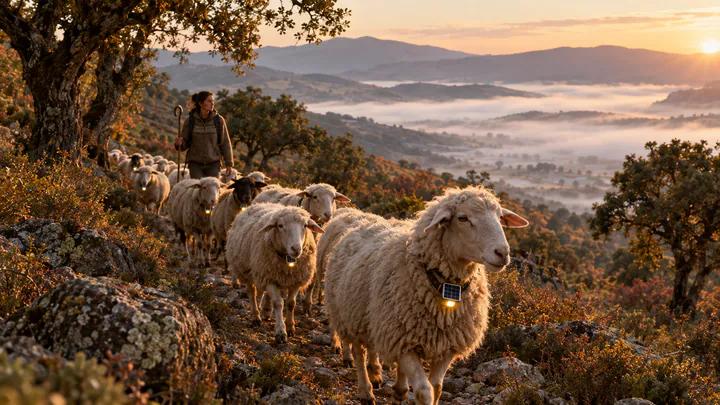
The flock went out at first light, two hundred bells and two hundred small green lights blinking on the collars as the solar strips caught. Somewhere in Nuoro a server was logging every step and deciding what to make of it. Somewhere in a Solaterra office, the 30th was getting closer on a calendar. Her phone was in her bag, and it stayed quiet.
Below the last houses, the asphalt ran on down into the valley. Bonaria didn’t whistle. She didn’t need to. The lead ewe, an old one with a torn ear and a collar that always read half a degree high, turned off the road and up the stony track between the cork oaks, and the rest followed her in a long grey rope.
Bonaria shifted the strap of her bag and went after them. Behind her the road stayed smooth and kind to the ankles, and the flock left it there.