Every Room Booked Under the Ash Cloud
A short story about a Reykjavík housekeeping supervisor, eleven clean rooms, a stranded Faroese children's choir and a manager who counts everything in revenue, on the day the ash cloud grounds Europe.
Drafted with AI. This version has not been reviewed by an editor, so it carries no ads — how we work.
Story Time is original short fiction. The characters, places and events in this story are invented.
The radiator in 304 started knocking at two minutes past two, and Hulda hit the valve twice with the heel of a spare work shoe until it settled into a sulky tick. Room 304 was out of order. It had been out of order since February, when Ármann Steinsson had walked through with his laptop balanced open on his forearm like a waiter’s tray and decided that a room with a noisy radiator was a refund waiting to happen.
She wrote 304 — radiator, shoe on her clipboard anyway, under eleven other numbers with ticks beside them. Eleven clean rooms, in a hotel of sixty-two, on the day every aeroplane in Europe had been told to stay on the ground.
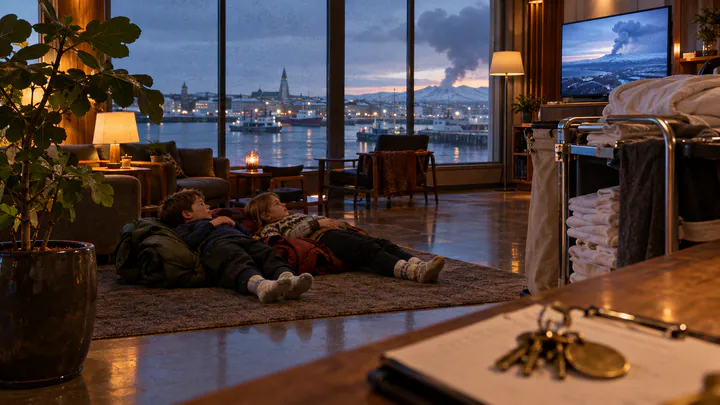
Down in the lobby the television above reception looped the same helicopter footage it had shown since morning: the glacier split open, the grey plume leaning south-east, a newsreader’s mouth moving with the sound off. The windows facing the old harbour had a fine grey film on them that had not been there yesterday. Kristján at the desk had wiped a patch clean with a napkin and then stopped, as if it were rude to the mountain.
And on the floor, between the luggage trolley and the potted fig, lay twenty-two children from the Faroe Islands.
They had come over for a choir festival in Hafnarfjörður, sung on Wednesday, and been due home on the Thursday flight to Vágar. Now they lay in rows on rolled anoraks, some asleep, some playing cards, a boy of about eight eating a bag of liquorice laces one at a time. Their conductor, a tall woman named Turið Joensen with reading glasses pushed into her hair, had been to the desk four times. Hulda had heard all four. Their hostel had given the beds to people who had booked in March. Every guesthouse in the city was full. The coach to the airport was cancelled because the airport was cancelled.
Ármann was waiting by the linen lift.
“Hulda. The eleven are held.” He turned the laptop so she could see a column of green numbers. “Holtvik Engineering. Their people were supposed to fly to Oslo this afternoon. Mr Brekke’s assistant has agreed three times rack rate for all eleven, through Sunday. Arriving at six.”
“Eleven people?”
“Eleven rooms. They pay whether they fill them or not.” He said it the way other men described good weather. “So nobody touches them.”
“They’re not ready,” Hulda said.
He glanced at her clipboard. “You’ve ticked them.”
“I tick when the beds are made. I don’t mark them ready in the system until I’ve inspected. 207 had hair in the drain. 415’s minibar wasn’t restocked.” Both true an hour ago. Both fixed now.
“Then inspect them. By six.” He closed the laptop. “And the children. Kristján says they’ve asked about sleeping there tonight. They can’t. It looks like a camp. The Holtvik people will walk through that.”
He went into his office. The door was glass; she watched him sit, open the laptop again, rest his chin on his fist.
Hulda had worked at the hotel for nineteen years, under four managers. The one before Ármann had called her the building’s memory, and she had liked it more than she let on. Ármann, at a staff meeting in March, had called her a cost centre with very good instincts, and she had understood him perfectly: that the other hotels in his group used agency housekeepers, and that she was fifty-four.
She went down the back stairs to the lobby.
Turið Joensen was crouched beside a girl whose face was blotched from crying. “She wanted the window,” Turið said in Danish, and Hulda answered in her own slower Danish. “At the hostel. She was promised the bed by the window, and then there was no hostel. Sunneva. Sunneva, it’s all right.”
“How many adults with you?”
“Me and two parents. Twenty-five altogether.” Turið looked at her properly then, at the clipboard, the lanyard of keys. “Are you going to tell us to move?”
“What can your choir pay?”
“The municipality gave me a card for emergencies. I don’t know the limit. I’m afraid to find out.”
Twenty-five people. Rollaway beds in the basement: nine, two with a bad hinge she knew how to lock with a cable tie. Eleven rooms. Holtvik: an unknown number of bodies.
She went to Kristján.
“What did we charge the Germans on Thursday morning? Before he came in.”
Kristján, who was twenty-three and frightened of Ármann and kinder than the job required, said quietly, “Eleven thousand krónur a room. Breakfast included.”
“Put Mrs Joensen’s card through for six rooms at that. Don’t put the room numbers in. I’ll give you numbers when they’re inspected.”
“Hulda.”
“They’re not inspected yet,” she said. “So you aren’t doing anything.”
Agnieszka met her in the basement. They took the rollaways up in the service lift three at a time, Agnieszka kicking the stubborn one in with the side of her foot. The children came up the back stairs behind Turið, carrying anoraks and plastic bags of sweets, whispering as if the building might hear. Hulda put them in 201, 203, 205, 207, 209 and 211, second floor, quiet side, away from the street. Four to a room, an adult at each end of the corridor, Turið in 207 with the two youngest. Sunneva she took to 203, which had the deep ledge facing the harbour, and showed her how the latch went up and then sideways.
“It’s grey,” Sunneva said, touching the glass.
“That’s from the mountain. It washes off.”
At three-forty Ármann rang her mobile. “Status.”
“Still cleaning,” she said, standing in the doorway of 209 while a boy asked whether the shower had hot water. It did, after a minute. 209 always took a minute.
At four-twenty: “Status.”
“Still cleaning.”
“Hulda, it is not difficult. They are eleven rooms.”
“They are eleven rooms,” she agreed.
At four-thirty she gave Kristján six numbers. At four-thirty-five she and Agnieszka started on the out-of-order rooms. 304: the shoe. 412, a window that would not close fully: a folded hand towel in the frame, the curtain drawn over it. 118, beside the ice machine: she unplugged the ice machine. 309, with the coffee stain shaped like the Westfjords: a bath mat from storage laid across it and an armchair moved to cover the corner. Not perfect. Beds, though. Hot water. A door that locked.
The Holtvik people arrived at ten past six. There were eight of them, not eleven, damp and grey-shouldered, led by a broad man in a quilted jacket who said his name was Brekke and asked whether the bar was open before he asked about rooms.
Ármann came out of his office wearing his welcoming face, and Kristján handed him the rooming list Hulda had written in pencil. She watched him read it. Five rooms on the third and fourth floors. 304. 412. 118. 309.
He did not shout. He was not a shouter; he was something worse, a man who lowered his voice. He waited until Brekke’s group were at the bar, then said, “My office.”
“You lied to me for three hours.”
“I said they were being cleaned. They were. Then they were clean, and then they had children in them.”
“At eleven thousand.” He already had the figures. “Six rooms at triple, four nights. And four rooms I removed from inventory for good reason, handed to the client paying us the most.”
“Mr Brekke hasn’t complained.”
“Mr Brekke hasn’t slept in them yet.” He typed something. “This is a written warning. If he complains, it will be more.”
“Yes,” Hulda said.
He looked up as if he had expected more. She did not give him more. She went to fold towels.
By eight the lobby was full again. The television still showed the plume. Turið had asked Kristján whether the children might sing; they were meant to rehearse every day of the trip, and it was the only thing that made them sleep. Kristján had not asked anybody.
They stood in two rows in front of the potted fig in their socks, the liquorice boy at the end of the front row. Turið hummed a note and they began, something slow in Faroese, the low voices carrying the tune and the high ones laid over it like frost on a pane, and the bar went quiet.
Brekke came out with his glass. Then the other seven. One sat on the arm of a sofa, then on the carpet, cross-legged in his suit trousers. Two backpackers who had been sleeping in the breakfast room appeared in the doorway. Agnieszka stood at the service door with a stack of pillowcases held against her chest.
They sang four songs. The last was the anthem, which Hulda half knew from the radio, and by then some of the children were swaying with tiredness and Sunneva was holding the hand of the girl beside her.
Ármann stood at the back by the luggage trolley. He did not clap, but nobody noticed, because Brekke was clapping loudly enough for the room.
As the children were herded to the stairs, Brekke caught Hulda by the elbow; she was nearest, and she had the keys.
“My room,” he said. “There’s a noise in the heating.”
Behind him, Ármann’s face did nothing at all.
“Three-oh-four,” Hulda said. “Hit the valve with a shoe. The heel, twice. It stops.”
Brekke laughed, saw that she meant it, and went up the stairs to try.
Ármann came to stand beside her. For a while he watched the empty stairwell.
“Does that actually work?”
“Every time,” Hulda said, and went to make sure the ice machine was still unplugged.