Two Thousand Programmes and the Wrong Face
A short story about a Kumasi printer who finds, at 2 a.m., that two thousand funeral programmes carry the wrong man's face, and has until seven to put it right.
Drafted with AI. This version has not been reviewed by an editor, so it carries no ads — how we work.
Story Time is original short fiction. The characters, places and events in this story are invented.
At two o'clock in the morning, folding the first bundle of funeral programmes, Adjoa turned one over to admire the cover and stopped with the bone folder in her hand.
The man on the cover was bald and broad in the jaw, with a gap between his front teeth you could post a letter through. Above his head, in the gold ink she had mixed herself, it said CALL TO GLORY: OPANIN KWAME OSEI DARKO, 1941–2014. Below, smaller: Master Tailor. Beloved Husband. Elder of the Church.
The man on the cover was not Kwame Darko. It was his brother Yaw, who was alive, who lived four streets away, and who had not spoken to Kwame since an argument in 1989 that half of Kumasi claimed to know the cause of and none of Kumasi agreed on.
"Kobby," Adjoa said.
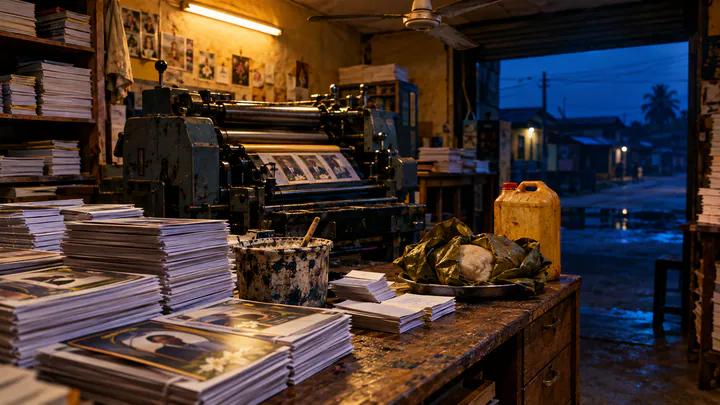
The ceiling fan turned, turned, and clicked. In the yard the generator hummed through the wall, patient as a man in a queue. Her nephew was asleep on the bales of unused card, one arm over his face, half a ball of kenkey unwrapped on its leaf beside him.
"Kwabena."
He sat up. "Auntie, I'm awake."
She held the programme in front of his face. He studied it with the expression of a boy reading a language he had once passed an exam in.
"That's Opanin," he said.
"That is Opanin's brother."
"They are the same."
"They are not the same. One of them is dead."
It came out in pieces. The family's flash drive. A folder called DARKO. Two photographs from the same cousin's wedding, DARKO_1 and DARKO_2, two old bald men in the same kente pattern. Kobby had chosen the second one. "The lighting was better," he said, and then, seeing her face, "but the lighting is not important."
Adjoa looked at the boxes. Two thousand programmes, sixteen pages each, printed, collated and nearly all stapled. The widow and the eldest son were coming at seven to collect them. The funeral began on the forecourt at nine.
Above the counter hung the sign she had painted herself eleven years ago: WE CHECK TWICE. The other printers on the road called her Madam No Mistake, half as an insult, and she had built a business on it. She had checked the hymn numbers. She had checked the spelling of every grandchild, including the one in Hamburg whose name had an umlaut. She had checked the dates against the church register. She had not checked the face, because she knew the face. Kwame Darko had sewn her wedding kaba and had told her, pins in his mouth, that she had a back like a government building.
At half past two she called Alhaji Mumuni, who sold her paper. The phone was off. She had known it would be; he had gone to Techiman for his niece's wedding and his shop was shut until Monday. She had bought his last gloss card on Wednesday. What remained in the shop was a ream and a bit of plain white A4 and a box of envelopes nobody had ever wanted.
"We can say it is Opanin when he was younger," Kobby offered.
"Yaw is the older one."
"Then when he was older."
She did not answer that, so he went back to his kenkey.
At a quarter past three she tried cutting the face off a spare cover with a blade, to see whether a correct photograph could be glued over it. The correct photograph would have to be printed on something. The something was plain A4, and Kwame's face on plain A4 looked like a man photographed through a bathroom window. She tried it anyway. Kobby held it up to the light, said, "Ei," and put it down gently, as if it might hear him.
At four the generator coughed twice and the fluorescent tube fluttered. Kobby went out with the jerrycan and the torch. Adjoa sat on the stool with her own kenkey, the fried fish and the pepper, and did not eat it. She started writing a correction slip on the back of a spoiled sheet. Due to a technical error. She crossed it out. Nothing technical had happened; a boy had liked some lighting. The management regrets. She was the management. She crossed that out too.
At ten to six, with the window going grey and the first trotros grinding past on the market road, someone knocked on the tailor's shop two doors down. Kwame's apprentice, Esi, had been sewing in there all night, finishing the family's black and red cloth. Then the knocking moved, and a voice came through Adjoa's door.
"Adjoa? Your light is on. Has Esi gone home? I've come for my suit."
She knew the voice. She opened the door, because what else was there to do, and Yaw Darko stood on the step in a singlet with a cloth over one shoulder, the gap in his teeth showing as he yawned.
"Your suit," she said.
"Black. For tomorrow. Today." He waved a hand. "Kwame cut it in March. Esi was to finish it."
"Kwame made your suits?"
"Kwame made all my suits." He said it as though everyone knew. "Through Esi. Before Esi, through the boy before her. I sent the measurements, he sent the bill. We did not need to talk to do business."
Then he saw the stack on the counter.
He picked up a programme. He looked at the cover for a long time. The fan turned, turned, clicked. Kobby came in from the yard with the jerrycan, saw who it was, and went straight back out to the yard.
Adjoa had spent four hours composing sentences, and none of them came. What came was: "My shop made a mistake. I made it. I didn't check the photograph."
Yaw turned the programme over, read the order of service, turned it back.
"I look well," he said finally. "He would hate this."
"I have paper for slips. Plain paper. I can print a correction and we glue one inside every programme before seven."
"Then give me a pen."
"I've drafted something—"
"Give me a pen, Adjoa."
He wrote standing at her counter, his cloth slipping off his shoulder, crossing out and starting again three times. When he slid it across, she read it twice, because that was what the sign said to do.
The face on this cover is mine. I am Yaw, his brother, and I am still alive. We always looked alike, which was one of the things we argued about. Kwame, I should have come to you before your funeral, not on the front of it. Forgive me. I still owe you for the suit.
"It doesn't say whose fault it was," Adjoa said.
"Nobody will care whose fault it was."
"I will care." She typeset his words in the same face as the programme, and underneath, in small letters, she added: Printed by Adjoa Print House, who made the error. He read it over her shoulder and grunted, which she took as permission.
She ran the slips four to a sheet. The press thumped and the room smelled of fresh ink and diesel. Kobby came back in and worked the guillotine without being asked. Esi brought the suit over in a plastic sleeve, looked at the stack, looked at Yaw, and said nothing, which in Esi's case was a speech. At half past six the three of them sat around the counter with pots of glue, Yaw in his new black trousers and singlet, pasting slips inside the front covers with the flat, careful thumbs of a man who had once been taught to do things properly by an older brother.
At seven a taxi stopped outside. The widow, Maame Afua, got out in black, followed by her son Kwadwo with a list in his hand. They came to the doorway and stopped.
Nobody spoke. Adjoa picked up a programme, opened it to the slip, and handed it to the widow.
Maame Afua read it. She read it again. She looked at Yaw, who had stood up and was holding the glue brush like a man caught with something he had stolen.
"You are wearing his trousers," she said.
"He cut them in March."
"He told me they were for a customer who never comes." She closed the programme. "Kwadwo. Take one of these to the MC before the service. He should read it before the hymns, or nobody will sing. They'll all be reading."
Kwadwo started counting boxes. Maame Afua held out a hand to Yaw, not for him to shake, but for the brush, and sat down on Kobby's stool to paste the last bundle herself.
Adjoa would hear later that by ten o'clock nobody on the forecourt was singing from page four. They were passing the slips down the rows, looking from the cover to the old man in the front row in the dead man's good black suit, and back again, and arguing in whispers about which brother had been the handsome one.