Six Hundred Miles with Our Father's Parrot
Two estranged sisters are told to deliver their late father's grey parrot to an address neither of them recognizes. Somewhere past Mercer, the bird starts speaking in a woman's voice — and repeating sentences no one taught him at home.

The parrot started talking somewhere outside Mercer, and he said it in a woman's voice neither of us had ever heard.
“Sound it out, Walter. You've got all day.”
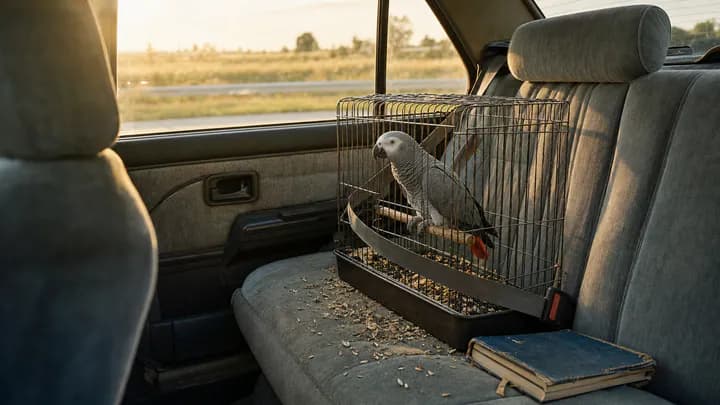
Jo lifted her foot off the gas so fast the car lurched. In the back seat, belted in like a toddler, Admiral shifted on his perch, dropped a sunflower hull through the bars, and looked at us with one flat yellow eye.
“Did he just —” Jo said.
“He did.”
“That's not Dad.”
“No,” I said. “That's nobody.”
We had been on the road four hours by then, and we had said maybe two hundred words to each other, most of them about gas stations. Six weeks earlier our father had died in the front room of the house on Alder Street, quietly, the way he did everything, and left behind a lawn mower with a bent blade, eleven jars of pickled beets, a grey parrot named Admiral, and a will with one line in it that neither of us could explain.
The bird and the blue notebook go to Vera Okonkwo, 114 Ridgeway, Bellhaven. Please take them yourselves. Please don't ship him.
Six hundred miles. Bellhaven was a dot on the coast road where, as far as we knew, our father had never once set foot.
“It's a girlfriend,” Jo had said at the reading. She'd flown in from three states away, wearing a coat too thin for October, and she said it like an accusation she'd been saving up.
“Mom's been gone eleven years, Jo. He was allowed a girlfriend.”
“Then why didn't we know her name?”
That was the part I couldn't answer, so I'd packed the cage in the car and told her to be ready by six.
The Blue Notebook
Admiral was thirty-one years old and had the vocabulary of a small, opinionated household. He did the microwave. He did the screen door. He did our father's cough, which was so accurate that Jo made me pull over the first time, and stood on the shoulder with her arms crossed, breathing hard, watching the field.
But he had never done the woman.
By the second afternoon he was doing her constantly. Sound it out. Take your time. Again, from the top. And in between, in our father's voice, rough and low and full of a shy patience I recognized from my whole childhood: The bus. The bus leaves. The bus leaves at nine.
“What is that?” Jo said. “Is that a poem?”
“I don't know.”
The notebook rode in the footwell in a plastic bag, and we had agreed — twice, out loud — that it wasn't ours to open. At a diner outside Ferrisburg, over eggs and coffee that tasted like a hot penny, Jo pulled it out anyway and put her hand flat on the cover.
“He asked us to carry it,” she said. “He didn't ask us not to look.”
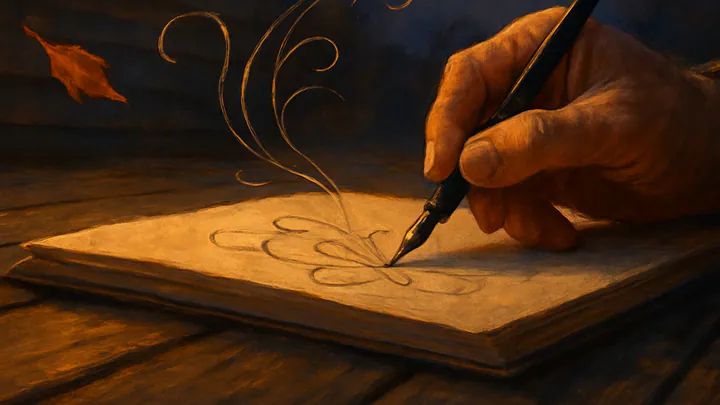
The first page was dated the spring our father turned fifty-two. It said, in a hand I would not have recognized as his — huge, careful, the letters standing apart like strangers at a bus stop — The bus leaves at nine. Then again. Then again. Eleven times down the page, and by the eleventh the letters had leaned together and become something almost like handwriting.
Jo turned the page. Milk. Bread. Onions. Rent is due Friday.
Another. Dear Nell, I hope your school year is going well. Written six times. Never sent.
I sat very still while the whole architecture of my childhood quietly rearranged itself. My father, who forgot his glasses at every parent-teacher night. My father, who had me read the menu aloud “because you've got the young eyes.” My father, who signed my permission slips slowly, with the pen held like a chisel, and always at the kitchen table where the light was best.
“He couldn't read,” Jo said.
“He could,” I said. “Eventually. Look.” Two-thirds through, the sentences got longer and the dates got further apart, and near the end there was a page of something copied out about a rabbit and a moon that I knew, because I had heard him read it aloud to my son last Christmas, and I had thought — God help me, I had thought it was sweet that he'd memorized it.
Jo put her forehead down on the table. In the car, muffled through the glass, the parrot said, You've got all day.
Bellhaven
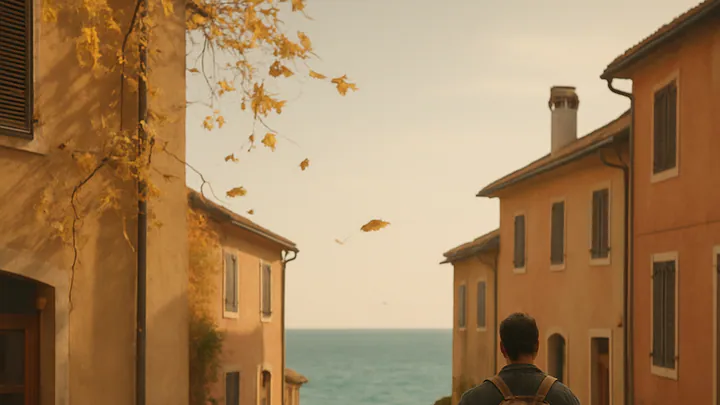
We drove the last stretch with the windows down and the salt coming in. Ridgeway was a short street of low houses with hydrangeas going brown and boats on trailers in the driveways. Number 114 had wind chimes made of flattened spoons and a woman on the step who had clearly been watching the road for a while.
Vera Okonkwo was seventy-something, with reading glasses pushed up into grey hair and a cardigan the color of good mustard. When she saw the cage in my arms, she made a sound I can only describe as a laugh with the bottom out of it.
“Oh,” she said. “Oh, you awful bird. You came.”
She fed us ginger cake in a kitchen full of library-sale paperbacks and told us the thing our father had spent nineteen years arranging not to tell us.
“I volunteered with the adult learning program at the county library,” she said. “Tuesday evenings, seven to nine. He came in the first week of April and stood in the doorway for ten minutes before he'd sit down. Told me he was there to help his daughter with her homework.” She smiled at the table. “He was forty-nine years old and he'd been signing his name off a copy he kept in his wallet.”
“Nineteen years,” Jo said. “He kept coming for nineteen years?”
“Eleven for the lessons. After that he came to help. He was very good with the men who were frightened.” Vera lifted her cup. “He wouldn't let me tell anyone. I said, Walter, your girls would be proud fit to burst, and he said — ” she stopped, and started again — “he said, they've got a father who can do anything. Let me get good enough first.”
“Good enough for what?” I said.
“Bedtime stories,” she said. “He wanted to read to his grandson without having the book by heart.”
I thought of Teddy on his lap, and the rabbit, and the moon, and the way my father's finger had moved under each word, which I had assumed was for the boy's benefit.
Jo was crying openly now, which she had not done at the funeral, not once, and I found that my hand had gone across the table to hers the way it used to when we were small and the house got loud.
Vera put the cage on the counter and opened the door. Admiral stepped out onto her wrist like a man coming home from work, and she scratched under his chin with one knuckle.
“He used to sit on the table between us,” she said. “Walter brought him because he said the bird didn't judge.”
The bird tipped his head, considered the room, and delivered his verdict in her voice, exact as a struck bell.
“Once more from the top, Walter.”
And then, in our father's — patient, unhurried, absolutely certain — “The bus leaves at nine.”
Vera laughed. Jo laughed, wetly, with her whole face. I put my finger against the warm grey feathers of his back and thought: he got there. Slowly, in secret, eleven times down a page, he got there.
We stayed for supper, and we left the notebook on Vera's shelf where it belonged, and we took the coast road home because neither of us was ready to be finished. Jo drove the first leg, then I did, and somewhere past midnight we started reading the highway signs out loud to each other — every exit, every town, every distance — sounding them out, taking our time, all the way back.
Frequently asked questions
Why does the story give the parrot the final word instead of either sister?
Admiral carries the voices of people who can no longer speak for themselves, so his mimicry becomes the only honest witness in the car. Letting him close the story keeps the moment from tipping into speech-making — he repeats, and the sisters are left to decide what it means.
Is Nell right to be angry that her father kept his lessons secret?
Her anger is really grief wearing a more manageable coat: she resents not the secret itself but the years she spent misreading his forgetfulness as indifference. The story suggests shame can be a form of love badly aimed, and that the people it protects rarely feel protected.
What does the blue notebook represent?
It is the record of a man practicing something small and enormous at once — the same sentence, over and over, dated in a hand that steadies as the pages go on. It reframes every ordinary evening the daughters thought they understood.
Do you believe Nell and Jo actually repair their relationship?
The ending offers a beginning rather than a resolution: they take turns driving, and they say the sentences aloud together. Repair in this story looks like shared practice, not a single reconciling speech.