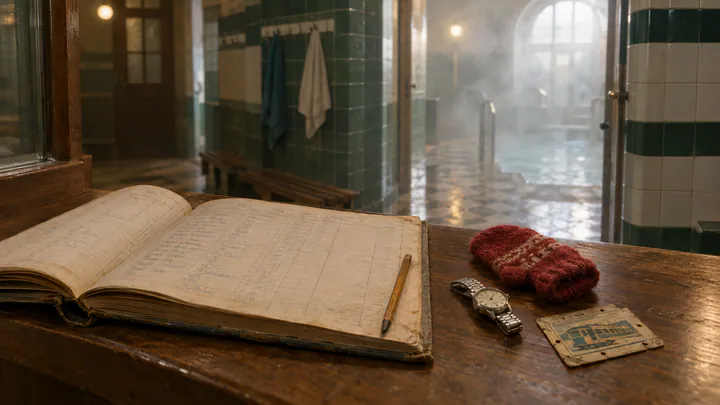
Rannvá Signs Off on the Last Batch
A short story about a Faroese salmon inspector in her final week, one shipment with a hole in its temperature log, and the choice her own mentor made twenty-six years earlier.
Drafted with AI. This version has not been reviewed by an editor, so it carries no ads — how we work.
Story Time is original short fiction. The characters, places and events in this story are invented.
Bárður had printed the log twice, as if a second copy might have filled itself in. He laid both sheets on Rannvá's desk, squared their edges with two fingers, and stood back from them the way he used to stand back from a fish he wasn't sure of.
"Cold store two," he said. "Tuesday night. The storm."
She found it without looking hard. A neat staircase of readings, 0.4, 0.5, 0.4, and then nothing from 01:12 until 05:40, when the logger woke up and carried on at 0.6 as though it had only blinked.
"The generator ran," Bárður said. "The compressors ran. Ólavur checked the door at three."
"Did Ólavur write that down?"
"He's telling me now."
Two hundred and twelve boxes of gutted salmon, four tonnes and a bit, packed for the Boulogne order. The truck was booked for four in the morning to make the sailing from Tórshavn. Through the office window she could see the fjord, flat and pewter, and the line of houses along the shore road where half the people who worked the gutting line lived.
Rannvá had three days left. Her locker was already half empty.
November 1998
The boots were her brother's and two sizes too big, so she had stuffed the toes with newspaper, and by Wednesday the newspaper had gone to pulp. She walked the length of the packing hall with her feet sliding inside the rubber and tried to look like someone who belonged there.
Sjúrður did not look at her feet. He looked at fish. He had a matchstick in the corner of his mouth that he never lit and never seemed to replace, and he talked to the salmon more than he talked to her.
"Press here. Behind the head. It should push back at you like it's annoyed." He lifted a gill cover with his thumb. "Red. Like a cut finger, not like a bruise. Eyes clear, not milk. Now you."
Her hands shook so badly the first day that she dropped a seven-kilo fish on the floor and the whole line laughed. Sjúrður picked it up, rinsed it, and gave it back to her without a word.
On Thursday the chart recorder in the cold room jammed. It was a round paper disc then, a thin red pen tracing the temperature in a slow circle, and sometime in the night the pen had run dry. A third of the disc was blank. A shipment for Rotterdam was stacked and waiting.
Sjúrður unclipped the disc, held it up to the strip light, and stood there long enough that she began to count. Then he folded it once, put it in his coat pocket, and signed the release.
"Is that allowed?" she asked, and heard how young she sounded.
"Go home, Rannvá," he said. "Come back at six."
November 2024
"I know what you're going to say," Bárður said.
"Then you can say it for me and save my voice."
He almost laughed. Twenty years ago he had been the trainee with the matchstick-thin arms who threw up the first time he saw the bleeding tanks, and she had stood beside him for a whole winter teaching him to read a log. Now he had a lanyard and a laptop and a wife who taught at the school, and in the spring he would have to tell the gutting line whether there was a second shift or not.
"Boulogne is the winter," he said. "If this doesn't arrive, they go to the Norwegians, and the Norwegians are cheaper anyway. That's Hjalti's job. That's my brother-in-law's job. That's eleven people from this road."
"I know who lives on this road."
"It was four hours. The compressors never stopped. You know they never stopped."
"I think they never stopped."
"Rannvá." He leaned on the desk. "It's your signature. Everybody knows it. Nobody in Boulogne has ever opened one of our boxes twice because your name is on the sheet. That's worth something. Use it."
That was the thing, she thought. That was precisely the thing. She picked up her pen, uncapped it, and capped it again.
"No," she said.
He straightened up. For a moment she saw the boy again, the one who had wanted so badly to be told he'd done well. Then the manager came back over his face like a shutter.
"Then I'll ring them and tell them we're short," he said, and went out without closing the door.
November 1998
She came back at six as she'd been told. Sjúrður was already in the packing hall, which was not unusual, but he was wearing yesterday's coat, which was. The night watchman, old Leivur, was coming off shift and nodded toward the car park.
"His car never moved," Leivur said. "Thought he'd had a few and was sleeping it off in the canteen."
Sjúrður's hands, when he took the clipboard from her, were a colour she had never seen on a person: raw red across the knuckles, white at the fingertips, the skin split in two places along the thumb. There was a probe thermometer in his coat pocket, the old kind with the dial, and the coat itself smelled of ice and fish slime.
She opened her mouth. He handed her a salmon.
"Gills," he said.
The Rotterdam shipment went out that morning. Nothing ever came back about it. She never asked him what he had done that night, and he never told her, and for twenty-six years she had turned it over at odd moments: in the shower, at her daughter's confirmation, once in the middle of a funeral. Whether he had trusted his hands or checked them. Whether it was courage or luck. Whether the folded disc in his pocket was a confession or just a piece of paper.
November 2024
At ten that night, instead of driving home, she put her boots back on.
The night crew was four people: Jóannes, the foreman, who had worked the plant longer than Bárður had been alive; Ásla, nineteen, three weeks in; and two Filipino lads, Rodel and Bong, who had come for one season eight years ago and never left. They were hosing down the gutting tables when she walked in with a box of fresh probes and a stack of blank paper.
"Every box," she said. "Lid off. Core temperature on three fish, head, middle, tail end of the stack. Check the ice. If the ice is tired, re-ice it. Write the box number, the time, three readings, your initials. Paper. Pen. No phones."
Jóannes looked at the clock, then at the stacks in cold store two, then at her.
"Two hundred and twelve," he said.
"Two hundred and twelve."
He pulled on a second pair of gloves.
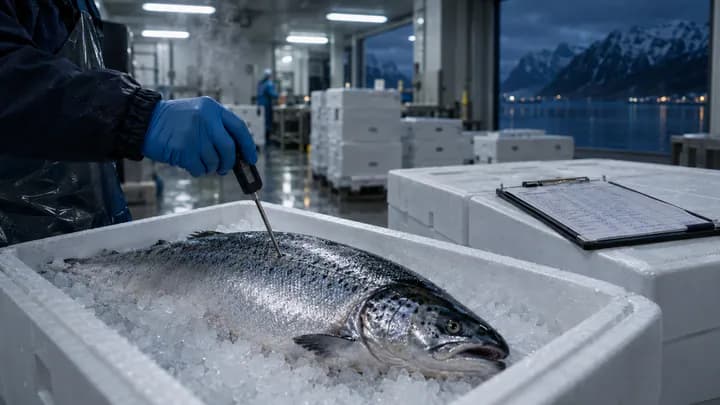
The cold store held at minus one. Within half an hour Rannvá couldn't feel her thumbs. She showed Ásla how to angle the probe so it went into the thick of the loin and not into the belly cavity, and how to read the gill without lifting the fish clear of the ice. Ásla's hands shook. Rannvá pretended not to see.
Box forty-one: 0.8, 0.9, 0.7. Box ninety: 1.1, 0.9, 1.0. Rodel sang under his breath, something with a lot of verses. Bong kept a running count on the back of his glove in marker.
A little after midnight the door swung open and Bárður came in carrying two thermoses and a bag of rolls from the bakery in Tórshavn, still in his good coat. He didn't say anything. He set the thermoses on a pallet, took a probe from the box, and started on the back row.
They worked without talking much. The fans roared. The fjord outside was black and the wind had come up again, rattling the loading door on its tracks. At one point the lights dipped and every one of them stopped and looked up, and then the compressors caught and the lights steadied, and Jóannes said, "Well, that's the log for tonight sorted," and even Bárður laughed.
At twenty to four they closed the lid on box two hundred and twelve. Rannvá went through the sheets at the canteen table with her hands wrapped around a cup she couldn't feel. Six hundred and thirty-six readings. The highest was 1.8. Not a cloudy eye in the lot.
She wrote it out plainly on a cover sheet. Logger failure, 01:12 to 05:40, Tuesday. Generator operation confirmed by night watch, verbal. Full manual verification, every unit, the following night, readings attached. Then the names, all six of them, not just hers. Then she signed.
Bárður read it over her shoulder.
"You could have done this at four in the afternoon and saved yourself the frostbite," he said. "Signed it, I mean."
"I could have."
He waited for more. She stapled the sheets together and handed them to him, and he took them out to the truck, where the driver was already sitting with his engine running and his lights on the wet gravel.
Rannvá peeled off her gloves. Her knuckles were raw red, white at the tips, split along one thumb. She looked at them for a while. Then she went to the sink and started washing the probes, one by one, because the day shift came on at six and they would need them.