Four Springs at the Evaporator
A short story about Ghislain, a Beauce sugar maker who tends his wood-fired evaporator by feel across four sugaring seasons while his brother-in-law pushes plastic tubing and machines.
Drafted with AI. This version has not been reviewed by an editor, so it carries no ads — how we work.
Story Time is original short fiction. The characters, places and events in this story are invented.
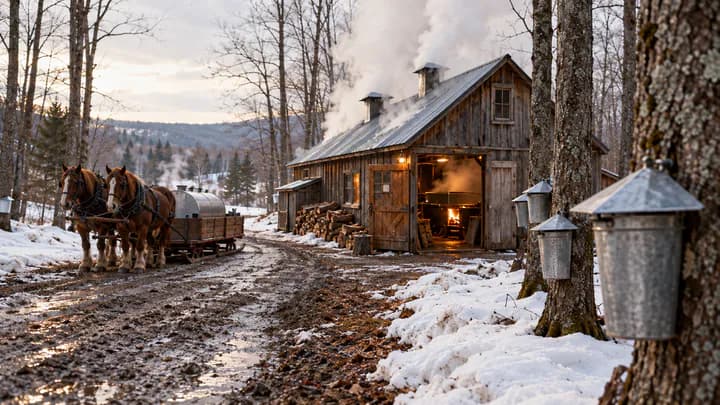
The front pan foamed up white, and Ghislain Veilleux, without turning around, flicked a scrap of salt pork off the end of his knife into it. The foam sank like a dog that had been spoken to. Behind him the shack door banged open and let in March, mud and cold and the smell of horse, and his brother-in-law Marcel Poulin, with a coil of blue plastic over one shoulder like a lasso.
“Don’t set that near the firebox,” Ghislain said. “It’ll melt, and the syrup will taste of your ideas.”
Marcel set it on the bench anyway. “Five-sixteenths polyethylene. You run it tree to tree, downhill, straight into a tank at the bottom. No buckets. No horse. Lessard over in Saint-Benoît put in two thousand taps last fall.”
“Lessard would put a motor on his wife if she’d hold still long enough.”
Ghislain opened the firebox. The heat came out at him like a held opinion. He read the coals by colour, orange at the door going white at the back, and fed in three lengths of split maple and one of birch for the quick flare. Steam rolled up through the roof vents so thick that from the road the cabane looked like it was burning, which was how people knew to come. He kept a thermometer on a nail by the finishing pan and used it only at the very end, to prove to Francine he had been right. Syrup told you when it was ready. You dipped the scoop and lifted it, and when the drops stopped falling one by one and joined into a sheet, a little apron of amber hanging off the edge, it was done.
“You’re forty-four,” Marcel said. “You and the horse gather nine hundred buckets, twice a day when it runs.”
“Pomponne gathers them. I walk beside her and give advice.”
It was Sunday, and the Gilberts had come up from Saint-Joseph the way they did every year, three cars of them, cousins with cousins. Francine had the long tables set in the cabin next door: pea soup, beans baked in syrup, ham, and the fried pork rinds everyone in the Beauce called oreilles de crisse and no grandmother had ever managed to rename. Ghislain carried out a pot of syrup boiled past the sheeting point and poured it in ribbons across a trough of packed snow. The children stood in a line with their wooden sticks, waiting for it to set just enough, and rolled it up into amber lollipops that tried to pull their back teeth loose.
A girl in a red tuque tugged his sleeve and pointed at the nearest tree. He lifted the tin lid off the bucket and tipped a little sap into her cup. She drank it the way children always did, suspicious first, then surprised: cold, nearly nothing, water that remembered something sweet.
“You can’t drink from a pipe,” Ghislain said to Marcel, over her head. “Think about that.”
“I think about it,” Marcel said, “every Monday, when Francine calls my house to ask if we’ve got any liniment.”
The run of 1983 came early and quit early. There were three good freezes in the first week, and then the nights went soft and the sap clouded in the buckets by noon. Ghislain boiled through two nights straight to save it before it turned, and what came off the pan was dark and strong and tasted faintly of the buds coming. Most of it went to the co-op in barrels at bulk price.
Marcel came by on the last Sunday with a calculator in his coat pocket, the kind with a little window of green numbers. He sat on the woodpile while Ghislain split.
“Vacuum pulls sap even on a weak day,” he said. “Lessard made his whole crop this year. Then you put the sap through osmosis. A machine, membranes, takes out three-quarters of the water before it ever sees your fire. Half the wood. Half the hours.”
“Half the hours at the evaporator is half the Sundays.”
“Nobody’s taking your Sundays.”
Ghislain set another round on the block. “The Gilberts don’t drive up from Saint-Joseph to watch a machine hum.”
Marcel looked at the green numbers for a while, then put the calculator away. He had done it himself the year before, on his own sugarbush across the rang road, and he did not say whether he missed anything. Ghislain did not ask.
Josée, sixteen, came up the path carrying two full buckets, sap slopping over the rims onto her boots. She was the only one of them who still said the run was the best part of the year and meant it. She set the buckets down and shook out her hands.
“Uncle Marcel’s right, you know,” she said. “Your knees click on the stairs. I can hear them from my room.”
“Your room is where you should be,” Ghislain said, “doing homework, not listening to my knees.”
She laughed and picked the buckets up again, and he watched her go into the shack and pour them into the tank without spilling a drop, and he split the next piece crooked.
In 1988 the runner of the gathering sleigh caught in a rut of slush on the north slope, the tank shifted, and Ghislain put his shoulder to it without thinking. Something low in his back let go like a rope cut with a knife.
He spent nine days on the kitchen floor, because the floor was the only thing that didn’t hurt, looking at the underside of the table and listening to the season happen without him. Pomponne had been retired two springs already; they gathered with the tractor now, which he had agreed to only because the horse was older than Josée. Through the window he could see the steam going up from the shack. Marcel was boiling. Marcel, who had a machine at home that did half the work for him, came every evening and boiled on Ghislain’s old wood-fired rig until midnight, and never once mentioned it at supper.
On the tenth day Ghislain walked out with a broom handle for a cane and stood at the finishing pan. Marcel dipped the scoop and held it up. The syrup came off in a sheet.
“I watched you,” Marcel said. “Thirty years. You think I wasn’t watching?”
Ghislain tasted it. It was good. That was the part that stung.
The forestry man from the ministry came in April and walked the sugarbush with them. On the north slope the crowns of the old maples had gone thin, bare twigs at the top where there should have been buds. He said rain, he said acid, he said soil, he said nobody knew yet. Ghislain counted the trees that weren’t worth a tap anymore and stopped counting at forty.
The dealer’s order form lay on the bench beside the evaporator in 1994, weighted with a coffee mug so the steam wouldn’t curl it. Fourteen hundred taps, mainlines, a vacuum pump, and at the bottom, in Marcel’s square hand, a used osmosis unit: his own, which he was replacing with a bigger one.
“I’ll give you a good price,” Marcel said. “Family price.”
“Family price is the most expensive kind.”
Josée stood by the door with her son Mathieu on her hip, though he was six and too big for it. She worked at the caisse in Saint-Georges now, Monday to Friday, and drove up every weekend in March, and she had said it plainly at Christmas: she would take the cabane after him. She would not hang buckets.
“I can keep it, Papa,” she said now. “I can’t keep it the way you kept it. Those are two different offers.”
Ghislain fed the fire. Maple, then birch. The coals were going white at the back. He was fifty-nine, and his back told him the weather a day before the radio did. He thought about the Gilberts, who came in four cars now, and about the north slope, and about a shack with blue lines running down the hill into it like veins on the back of a hand, steady and quiet, the sap arriving whether anyone walked out to meet it or not.
He picked up the pen.
“The trees along the road,” he said. “The twenty-two my father tapped. Those stay on buckets.”
Marcel frowned. “It’s twenty-two trees. You’ll lose more walking out to them than you’ll gain.”
“They’re not for the syrup.”
He signed. He pushed the form across the bench, and Marcel folded it into his coat without looking at it, the way a man puts away something he has carried a long time and no longer needs to argue for.
That Sunday the road row was hung as it always had been: galvanized buckets, peaked tin lids, the sap ticking into them in the thaw. The Gilberts’ grandchildren found them first. Mathieu showed them how to lift the lid, because he had been shown, and Ghislain came down from the shack with a stack of paper cups.
Mathieu drank, and frowned. “It’s just water.”
“Taste again.”
He did. He held the cup a moment, working it out, and then held it up for more. Ghislain filled it, set the lid back on the bucket, and walked up the hill to tend the fire before the front pan foamed over.