Small Space Storage Ideas That Actually Work in 2026
Small space storage works when you edit first, build upward, and make every piece of furniture do two jobs. Here are renter-friendly systems, with real measurements, honest costs, and the failure points nobody warns you about.
Drafted with AI; reviewed by Najam Kausar on . How we work.
TL;DR: Small space storage works when you do three things in order — edit what you own, build upward instead of outward, and buy furniture that stores things inside it. Tension rods, over-door racks, under-bed bins and modular shelving add serious capacity with no renovation, usually for under $200.
Small homes aren't a design problem you solve once. They're an ongoing relationship with your belongings. Whether you're in a 400-square-foot studio, a shared rental, or a starter home with no basement, storage is what makes a space feel deliberate instead of cramped.
What counts as small space storage, and why does it feel harder in 2026?
Small space storage is any system that increases usable capacity in a home without increasing its footprint — vertical surfaces, hidden volume inside furniture, and reversible hardware that doesn't damage a rental. The defining constraint isn't square footage alone; it's square footage you're not allowed to modify.
Two pressures have converged. New apartment floor plans have generally trended more compact while cost per square foot has climbed, and most of us own more small goods than previous generations did — cables, appliances, gear, hobby equipment. Meanwhile, a large share of renters can't drill a hole without risking a deposit. More things, less room, fewer tools. That's the actual puzzle, and the good news is that the best answers are cheap and fully reversible.
Should I declutter before buying storage bins?
Yes — and it's not a moral point, it's a math one. Empty bins don't reduce volume; they add rigid, stackable volume of their own. Every organizing project that starts at the store ends with containers on the floor holding things you never open.
Give it one focused afternoon and work by category, not by room. Duplicates only become visible when all seven partially used rolls of tape are in the same pile.
- The 12-month rule. If you haven't used it in a year and it isn't sentimental or genuinely seasonal, it's a donation candidate.
- The replacement test. For anything you're unsure about, ask what it would cost and how long it would take to replace. Under $20 and under 20 minutes? Let it go.
- Measure before you order. Write down shelf heights, interior drawer depth (not exterior), and the diagonal of any awkward nook. Returns are a tax on impatience.
Wardrobes are usually the biggest single win here.
Which vertical storage actually adds the most capacity?
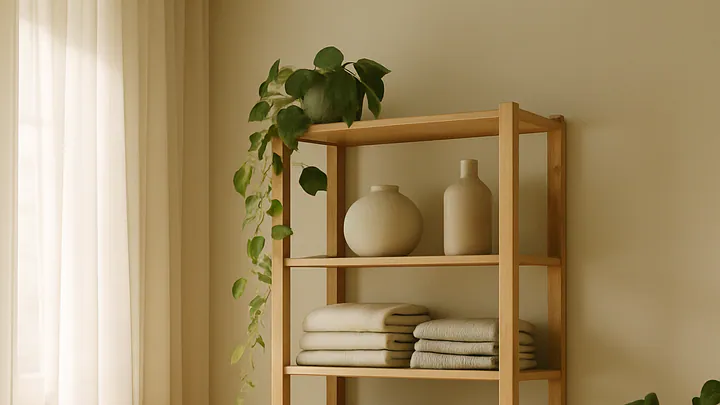
Tall and shallow beats short and deep, every time. A 72- to 80-inch bookshelf that's only 12 inches deep occupies barely more floor area than a side table but delivers five or six full shelves. Depth is what eats a room; height is nearly free.
Tall, narrow shelving
Choose adjustable shelves so the same unit can hold cookbooks, a printer, and laundry detergent as your needs change. Always use the included anti-tip anchor — one small screw, patchable at move-out, and non-negotiable if children or pets live with you. If you're anchoring into drywall with no stud behind it, use a toggle bolt rather than the plastic plug in the box.
Over-the-door organizers
The back of a door is the only free surface most homes have. Current versions go well beyond flimsy shoe pockets: metal mesh pantry racks, hook-and-bar systems for bags, clear-pocket panels for cleaning supplies. The edge case: most over-door hardware is sized for doors up to about 1.5 inches thick, which covers standard interior doors but often not thicker exterior or fire-rated ones. Check that the door still closes flush before you load it.
Tension rods in unexpected places
A short tension rod under the sink becomes a hanging bar for spray bottles. One inside a cabinet becomes a vertical divider for cutting boards and sheet pans. One across the upper closet adds a second hanging row for off-season clothes. Where they fail: heavily textured walls, tile with grout lines, and any span over about 48 inches with real weight on it. Tension rods hold clothing and bottles; they do not hold cast iron.
What furniture is worth buying when every piece has to do two jobs?
In a small home, any piece that only does one job is a luxury. The best multi-function furniture stores things inside it rather than merely on top of it.
- Storage ottomans — coffee table, extra seat, and a home for blankets, board games, or toys.
- Bed frames with drawers or a hydraulic lift base — can replace a dresser entirely. Honest caveat: side drawers need roughly 24 inches of pull clearance, so they're useless on a bed shoved against a wall. In that layout, choose a lift-top base or footboard drawers instead.
- Lift-top coffee tables — turn a couch into a desk in seconds and hide cords inside.
- Hinged-top benches — entryways, dining nooks, the foot of the bed.
What are the best storage fixes room by room?
Kitchen
Tiered risers inside cabinets so the back row is visible, a magnetic strip on the side of the refrigerator for knives or spice tins, and stackable bins grouped by behavior (breakfast, snacks, baking) rather than by food type. A narrow rolling cart in the gap beside the fridge holds cans that cabinets can't.
Bedroom
Doubling the closet rod is the single biggest capacity gain available: the upper rod at roughly 80 inches, the lower at about 40, which fits shirts above and folded pants below. Slim velvet hangers recover several inches of rod per section. Under the bed, measure floor-to-slat clearance — most rolling bins need about 6 inches, compression bags about 4. Storage and sleep quality are more linked than people expect, which is why our bedroom refresh guide for 2026 treats visible clutter as a sleep variable.
Bathroom
A floor-to-ceiling étagère over the toilet reclaims three or four shelves of otherwise dead air; most need about 26 inches of clear width. A single turntable inside the vanity stops bottle avalanches. Watch out: adhesive hooks are the least reliable in bathrooms, because steam and cleaning residue break the bond. Wipe with isopropyl alcohol first, let it cure the full recommended time, and never hang the hair dryer from the first hook you stick up.
Entryway
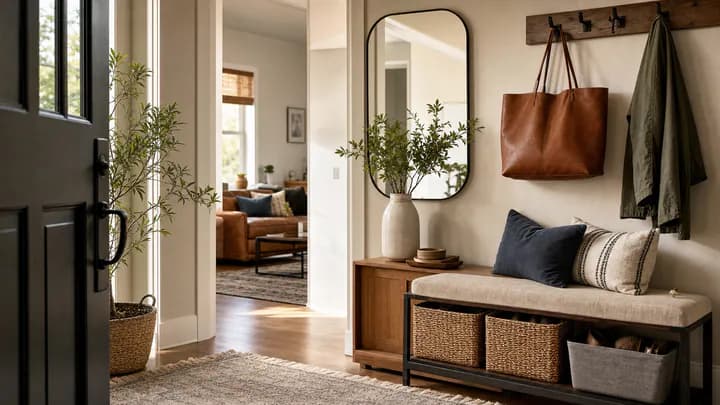
Even a nonexistent entry can be manufactured from one floating shelf with hooks underneath. If you have a few feet to work with, a slim console, a key rack, and one shoe basket cover 90 percent of daily friction — our guide to small entryways that work hard goes deeper on the layout.
Living room
Floating shelves flanking the TV add display and storage with zero floor cost. Opaque baskets on a low shelf swallow remotes and chargers. A 10-inch-deep sofa table behind the couch converts dead space into a second surface for lamps and drinks.
How much does a small space storage setup cost in 2026?
A full starter kit for a studio or one-bedroom typically runs $80 to $200 if you buy deliberately. Below is how to allocate it, and what each tool reliably holds.
| Tool | Typical cost | Best for | Where it fails |
|---|---|---|---|
| Adhesive hooks and strips | $8–$20 per pack | Keys, towels, light tools, cabinet doors | Textured or flat-matte paint, humid bathrooms, anything over the rated weight |
| Tension rods (3 sizes) | $10–$25 total | Under sinks, inside cabinets, extra closet row | Long spans, tile, heavy loads |
| Clear latching bins | $25–$60 for a set | Closets, high shelves, under-bed | Cheap lids that don't stack; bins bought before measuring |
| Slim velvet hangers | $15–$30 for 50 | Recovering rod space, visual calm | Heavy coats and structured jackets, which need wide shoulders |
| Tall shallow shelving unit | $40–$90 | The largest single capacity gain per dollar | Tipping risk if the anti-tip anchor is skipped |
| Vacuum compression bags | $15–$30 | Puffy coats, comforters, seasonal bedding | Down loses loft if compressed for years; anything with structure or leather |
Worked example. Say you're setting up a 400-square-foot studio: one 72-inch shelving unit ($65), three tension rods ($16), two over-door racks ($32), four under-bed rolling bins ($44), and expandable bamboo drawer dividers ($22). Total: $179, and no holes except one anchor screw. If the number makes you flinch, treat it like any planned expense and set aside a small monthly amount. None of this is financial advice; it's just calendar math.
What are the most common and costly small space storage mistakes?
- Buying bins before measuring. The classic version: ordering six bins that are half an inch too tall for the closet shelf. Always measure interior height, not exterior.
- Storing things where you don't use them. If retrieving an item requires a step stool more than twice a week, it's in the wrong zone. Frequency, not size, should determine shelf height.
- Overloading adhesive hardware. Rated weights assume a clean, smooth, fully cured surface. A hook that drops a mirror costs more than the deposit you were protecting.
- Opaque bins everywhere. Anything you can't see, you buy again. Reserve opaque containers for living areas and use clear ones wherever retrieval speed matters.
- Deep storage as a default. A 24-inch-deep cabinet is really a 12-inch cabinet with a 12-inch archaeology site behind it. Add pull-out trays or shallow bins, or stop using the back half deliberately.
When this doesn't apply: if you have a garage, basement, or dedicated storage unit, skip the aggressive compression tactics. Vertical living-space storage is a response to scarcity, and forcing it on a home that isn't scarce just makes rooms feel busy.
How do I keep the system from falling apart after three months?
Assume decay and schedule against it. Every storage system degrades — the perfectly labeled spice drawer will eventually contain one unidentifiable orange jar. Run a 15-minute reset on a single zone each week, rotating: pantry, then bathroom, then entry, then closet. Nothing ever collapses because nothing goes more than a month unvisited.
Pair that with one behavioral rule that does more than any container: one in, one out, applied only to the categories that overflow in your home. For most people that's clothing, mugs, and cables — not everything.
Cluttered environments are widely reported to raise stress and make focus harder, especially for people working from home. You don't need a magazine-perfect interior to feel the difference; modest, maintained organization changes how a space feels to live in far more than a one-time overhaul does.
Editorial note: this is general home organization guidance, not professional interior design or contracting advice. For structural changes, anchoring heavy furniture, or any modification to a rental unit, consult a qualified professional and review your lease first.
Key takeaways
- Edit before you organize — empty bins add volume, they don't remove it.
- Vertical, shallow storage delivers the most capacity per square foot; depth is what eats a room.
- Every piece of furniture in a small home should store something inside it.
- Measure interior dimensions and door thickness before ordering anything.
- Match container type to room: clear where retrieval matters, opaque where calm matters.
- A rotating 15-minute weekly reset keeps systems alive far longer than a perfect initial setup.
Frequently asked questions
What is the best storage solution for a small apartment?
The highest-return combination is vertical storage plus dual-purpose furniture: one tall, shallow shelving unit, over-door organizers on two or three doors, and a bed or ottoman that stores things inside it. That trio adds capacity without consuming floor space, and none of it requires renovation.
How do I add storage without drilling into walls?
Tension rods, adhesive hooks and strips, freestanding shelving, over-the-door organizers, and under-bed bins all add real capacity with zero holes. The one exception worth making is a single anti-tip anchor screw for any tall shelf, which leaves a patchable hole most landlords accept.
How much should I expect to spend on small space storage in 2026?
A practical starter kit — bins, drawer dividers, hooks, hangers and one vertical shelving unit — typically lands somewhere between $80 and $200 for a studio or one-bedroom. Buy in two rounds instead of one so you only replace what genuinely failed.
What is the biggest storage mistake people make in small homes?
Buying containers before decluttering and before measuring. Bins bought blind rarely fit the shelf or the items, so they end up stacked on the floor holding things you never use — which makes the room feel smaller, not larger.
Are clear bins better than decorative baskets?
Clear bins win anywhere retrieval speed matters — closets, pantries, under the bed, high cabinet shelves. Opaque baskets win in living areas where visual calm matters more than instant visibility. Most homes need both, split by room rather than by preference.
How much clearance do I need for under-bed storage?
Measure from the floor to the lowest rail or slat, not to the mattress. Most rolling under-bed bins need about 6 inches of true clearance, and vacuum-compression bags need roughly 4. If you have under 4 inches, bed risers are usually cheaper than replacing the frame.
Do over-the-door organizers fit every door?
No. Most over-door hooks are cut for doors up to about 1.5 inches thick, so they fit standard interior doors but often not thicker exterior or fire-rated doors. They also block the door from closing flush against tight casing, and they can loosen self-closing hinges over time.
How do I store seasonal items when there's no attic or basement?
Compress soft goods into vacuum bags and slide them under the bed, then use flat labeled bins on the top closet shelf for anything that can't be compressed. Rotate twice a year so off-season gear never occupies prime, easy-reach space.