Multi-Functional Furniture: What Actually Earns Its Space
Convertible furniture only pays off when the second function gets used. Here are the clearances, price ranges, mechanisms and failure points that decide whether a storage bed, Murphy bed or expandable table is worth buying.
Rewritten with AI and republished automatically. Our editors set the standards and fix reported errors — how we work.
TL;DR: Multi-functional furniture only pays off when the second function actually gets used and the first one isn't ruined. Buy for the deployed footprint, not the folded one; check clearances, mechanism ratings and replacement parts. Storage beds and expandable tables almost always earn their keep. Sofa beds and nesting cubes often don't.
What is multi-functional furniture, and what does it actually solve?
Multi-functional furniture is any piece designed to perform two or more distinct jobs — sleeping and seating, dining and working, storing and sitting — usually through a mechanism, a hollow cavity or a modular shape. It solves a floor-area problem, not a storage problem in general: it converts vertical or hidden volume into usable capacity so a room can serve more roles per square foot.
That distinction matters. If your home is cluttered because you own too much, a lift-up bed just hides the excess. If your home is tight because one room has to be a bedroom, an office and a guest room, convertible pieces are the correct tool. A useful framing: you're buying time-sharing of space, and time-sharing has a cost in friction.
How do I decide whether a convertible piece will earn its space?
Use a two-part test before you spend anything. First, the frequency rule: the secondary function should be used at least twice a month, or the piece is a dedicated item you're overpaying for. Second, the ten-second rule: if converting takes longer than about ten seconds and requires clearing objects off it first, you will stop converting it within a month.
Then compare against the thing you'd otherwise buy. A storage bed at $1,200 that replaces a $600 dresser and returns three square feet of floor is a straightforward win. A $2,400 sofa bed used four nights a year is a $600 sofa plus a very expensive guest arrangement — an air mattress and a better sofa often beats it.
Honest exception: this math changes if you're hosting an elderly parent or a child who visits every other weekend. Frequency, not intention, decides.
What does multi-functional furniture cost in 2026?
Expect roughly $80 for a storage ottoman up to about $4,000 for a built-in-look Murphy bed cabinet, installed. The ranges below reflect typical US retail in 2026 and are approximate — regional delivery, solid-wood construction and custom sizing all push the top end higher.
| Piece | Typical range | What you give up | Worth it when |
|---|---|---|---|
| Storage bed with drawers | $500–$1,800 | Drawers blocked by nightstands or walls | You'd otherwise buy a dresser |
| Gas-lift ottoman bed | $700–$2,500 | Access requires clearing the bed | Storing seasonal, not daily, items |
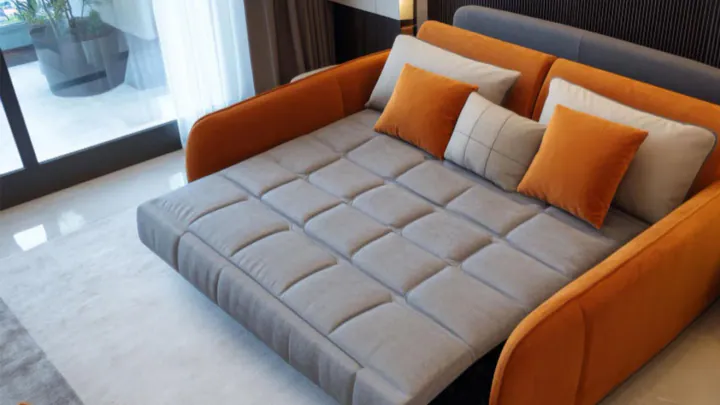
| Sofa bed | $800–$3,000 | Seat depth and mattress thickness | Guests stay monthly or more |
| Murphy bed (cabinet, installed) | $1,500–$4,000 | Wall anchoring; permanent-ish | One room must be two rooms daily |
| Expandable dining table | $400–$2,000 | Leaf storage; seam under linens | You host more than four people occasionally |
| Wall-mounted fold-down desk | $150–$600 | No leg room drawers; needs studs | Work sessions under three hours |
If a piece like this is a stretch, plan the purchase rather than financing it. Setting aside a fixed monthly amount usually gets you the better-built version three months later instead of the flimsy version tonight.
Which guest-sleeping solution should I choose when there's no guest room?
Match the solution to nights-per-year and who's sleeping. Occasional adult guests do fine on a good air mattress; a weekly guest or a nightly sleeper needs a real mattress, which rules out most folding sofa mechanisms.
| Option | Nightly-use comfort | Floor area when open | Setup time |
|---|---|---|---|
| Standard sofa bed | Poor to fair | Sofa depth plus ~40 in. | 30–60 seconds |
| Murphy bed | Excellent (full mattress) | Full bed length from wall | 10–20 seconds |
| Daybed with trundle | Good | Doubles in width | 20–30 seconds |
| Convertible chaise / futon | Fair | Compact | 5–10 seconds |
| Quality air mattress | Fair, short-term | Full bed footprint | 3–5 minutes, plus storage |
The detail nobody mentions: most folding sofa-bed frames cap mattress thickness at about four to six inches, and the horizontal support bar sits under the sleeper's lower back. A three-inch topper fixes a lot of it, but you then need somewhere to store the topper.
How do storage beds and lift mechanisms work — and where do they fail?
Drawer beds ride on side rails and need side clearance; lift-up ottoman beds use gas pistons rated for a specific mattress weight range, and the whole slatted deck hinges upward from the foot. Both fail in predictable ways.
- Drawers that can't open. A bed pushed into a corner loses one side entirely. Measure the drawer extension plus standing room before choosing the wall.
- Pistons mismatched to the mattress. A dense hybrid on pistons sized for foam makes the base heavy to raise and fast to drop. Check the stated weight range, and replace pistons rather than the bed when they weaken.
- Moisture under foam mattresses. A sealed storage cavity with no airflow can trap humidity under a foam mattress. Look for ventilated slats and air the base out a few times a year.
- Daily items in seasonal storage. Anything you need more than weekly should not live under a mattress. Winter bedding, luggage and off-season clothing are the right tenants.
Free-standing tall storage is a separate safety matter: US rules now require clothing storage units to meet a tip-over stability standard, and anything tall in a child's room should still be anchored to a stud. If you're rethinking the whole room, our bedroom refresh guide for calm, cozy upgrades pairs well with the storage decisions here.
What size should an expandable dining table be for my room?
Allow about 24 inches of table edge per seated person, 36 inches of clear space behind each chair so people can stand, and a walkway of at least 30 inches around the extended table. Measure the room at full extension first, then shop for a table that fits that number.
Butterfly leaves that fold and store inside the table are worth paying extra for, because a separate leaf leaning in a closet is a leaf you'll stop using. Drop-leaf and console-to-table designs are excellent for studios but usually seat six at most, and the seam will show under a thin tablecloth.
One quiet advantage: a dining table that seats four everyday and eight at extension often replaces both a desk and a craft surface. Add a nearby drawer or basket for laptop, charger and mouse, and the conversion time stays under a minute.
How do I fit a working home office into a room that isn't one?
Pick the hardware to match your session length. Fold-down wall desks and secretary cabinets are right for sessions under about three hours; full workdays need a fixed surface at least 24 inches deep, a real chair and monitor height at eye level, because bad ergonomics will outlast any space saving.
- Wall-mounted drop-front desk: anchors into studs, closes over the mess, no leg-room drawers.
- Sit-stand desk with a shallow top: gives you two postures from one footprint — the closest thing to true multi-function in an office.
- Bookcase-plus-pullout: a shelf unit with a sliding writing surface hides the work zone in a living room.
- Rolling cart as a mobile office: the cheapest solution that actually works; everything lives on the cart and the cart lives in a closet.
Cable management is the thing that decides whether a fold-away desk stays fold-away. One power strip mounted to the underside, one short cable per device. And if the desk is going somewhere far from the router, fix the network before blaming the furniture.
What multi-functional furniture actually works for kids' rooms?
Buy for the next stage, not the current one: convertible cribs that become toddler beds, loft beds with a desk beneath for school-age kids, and storage benches that double as seating. Anything that only fits an 18-month window is a rental, not a purchase.
Two practical constraints. Loft and bunk beds need about 30 inches of clear height above the top mattress so a child can sit up, and low ceilings kill the idea entirely. Toy chests should have slow-close or lid-support hardware and ventilation openings — a heavy free-falling lid is the main hazard in an otherwise harmless piece.
Is DIY worth it, and how do I choose pieces that last?
DIY makes sense for static pieces — storage benches, bookshelf room dividers, a trunk turned coffee table — and rarely for anything counterbalanced. Murphy bed hardware, gas pistons and folding sofa mechanisms should come as engineered kits with rated load ranges and anchoring instructions.
For longevity, the mechanism matters more than the material. Before buying, ask three questions: Are replacement pistons, slats and hinges sold separately? Is the joinery mechanical (bolts, dowels, cam locks) or glued and stapled? Is the panel stock certified to a formaldehyde-emissions standard, and is there a low-emissions certification such as GREENGUARD Gold on the finish? Solid or FSC-certified wood and reclaimed timber are good signals, but a modular piece you can repair and reconfigure beats a beautiful one you have to throw away when a hinge fails.
How do I style it so the room doesn't look like a showroom of gadgets?
Keep a cohesive palette, let one piece be the mechanism and the rest be quiet, and use vertical lines and light to stretch the room. The failure mode of convertible furniture is visual noise — six different clever things in one room read as chaos, not design.
- Match finishes across two of three tones: wood, metal, textile.
- Mount lighting and shelving high to draw the eye up and free surfaces.
- Place a mirror opposite a window, not opposite clutter.
- Choose legs over skirts where you want the floor to read as continuous.
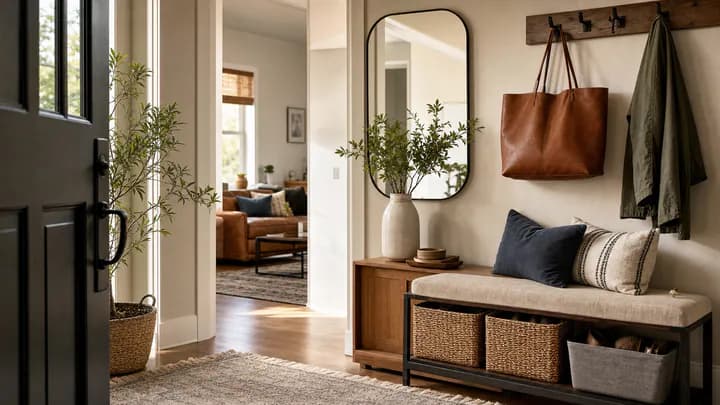
The same restraint applies at the front door, where convertible pieces earn the most per inch — see our notes on small entryways that work hard for bench-plus-storage layouts.
What could this look like in a 480-square-foot studio?
Here's a worked example for a one-room apartment with a single closet and a 9-foot ceiling. Total spend would land in the low thousands, staged over about six months.
- Murphy bed cabinet against the interior wall ($2,000, installed). Returns roughly 30 square feet during the day. Needs 80 inches of clear floor when open — that floor stays empty, always.
- Round drop-leaf table on casters ($450). Seats two closed, four open, doubles as the desk. Casters mean it rolls clear of the bed's swing path.
- Storage ottoman pair ($240). Seating for guests, coffee table with a tray, and home for the mattress topper and spare bedding.
- Wall-mounted shelf with a 10-inch fold-out ledge ($180). Standing laptop station, coffee drop, no floor area used.
- Nothing else. The closet gets a second rod, and the wardrobe shrinks.
The single decision that makes it work isn't a product. It's taping the Murphy bed's open outline on the floor and living around it for a week before ordering.
Key takeaways
- Measure the deployed footprint, not the folded one — and tape it on the floor before buying.
- Apply the frequency rule: a second function used less than twice a month rarely justifies the compromise or the cost.
- Storage beds and expandable tables are the highest-hit-rate categories; standard sofa beds are the lowest for nightly sleeping.
- Check mechanism ratings — piston weight ranges, mattress thickness limits, stud anchoring — and buy brands that sell replacement parts.
- Keep daily-use items out of hidden storage; reserve cavities for seasonal things.
- Style with restraint: one visible mechanism per room, a tight palette, and lighting that pulls the eye upward.
Frequently asked questions
Is multi-functional furniture worth the extra cost?
It's worth it when the second function is used at least twice a month and the primary function isn't badly compromised. A sofa bed used four times a year rarely justifies paying double for worse seating; a storage bed that replaces a $600 dresser and frees three square feet of floor usually does. Price the alternative you'd otherwise buy, then compare.
Can you sleep on a sofa bed every night?
Most standard sofa beds are not built for nightly use — the folding steel frame limits mattress thickness to roughly four to six inches and the support bar creates a pressure point. If someone will sleep there most nights, choose a Murphy bed, a daybed with a real mattress, or a sofa bed rated for regular use with a slatted deck instead of a wire grid.
How much clearance does a lift-up storage bed need?
You need enough room at the foot of the bed to stand while the base swings up, usually two to three feet, plus clear ceiling height above the headboard on some designs. Also check the mattress weight range the gas pistons are rated for; a heavy hybrid mattress on pistons sized for foam makes the base hard to lift and slow to close safely.
Do Murphy beds have to be attached to the wall?
Most do, into wall studs or the floor, which makes them a problem in rentals that prohibit structural fasteners. Freestanding Murphy cabinets that anchor to the floor plate or sit on a weighted base exist and are the usual workaround — confirm the anchoring method before ordering, and check your lease.
How big should an expandable dining table be?
Allow about 24 inches of table edge per person and 36 inches of clear space behind each chair so people can push back and stand. A table that expands to seat eight but leaves only 24 inches of walkway will feel unusable, so measure the room at full extension before you measure the table.
What's the most common mistake with convertible furniture?
Measuring the folded footprint and forgetting the deployed footprint. A Murphy bed needs the floor in front of it empty, a fold-down desk needs a chair pulled out, and a lift-up bed needs standing room. Tape the open dimensions on the floor and live with the outline for a few days before you buy.
Is DIY multi-functional furniture safe?
For low-risk pieces like a storage bench, a bookshelf room divider or a repurposed trunk, DIY is fine and often better made than budget retail. Skip DIY for anything with counterbalanced springs, gas pistons or a load that swings — Murphy bed hardware and lift mechanisms should come as an engineered kit with a rated weight range and clear anchoring instructions.