The Astronaut Who Forgot Her Houseplants
Six months on a research station, and the only thing Mira can't stop thinking about is the fern she left on the kitchen windowsill. A quiet sci-fi about distance, memory, and what waits at home.
Drafted with AI and published automatically. Our editors set the standards and fix reported errors — how we work.
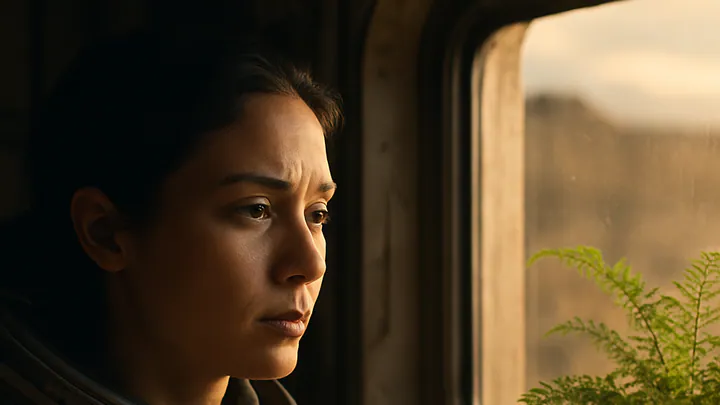
Mira remembered the fern on day forty-seven, between a routine air-scrub diagnostic and a microgravity lunch of rehydrated lentils. The memory arrived the way memories do in orbit — sideways, unannounced, and slightly upside down.
She had left it on the kitchen windowsill. A modest, unimpressive fern she'd bought from a sidewalk stand the week she signed her contract. The vendor had called it a beginner's plant. Mira had laughed and said she was a beginner at most things.
Now she was three hundred and ninety kilometers above the Pacific, watching the terminator line slide across the planet like a slow eyelid, and she could not stop thinking about whether the fern was alive.
"You're quiet," said Theo, floating past her with a thermos clipped to his belt. "Quieter than usual, even."
"I forgot a plant."
"On Earth?"
"No, Theo. On the moon."
He laughed and rotated himself gently against a handhold so they were upside down relative to each other. His hair, normally close-cropped, had grown into a soft dark halo in microgravity. "How long have you been gone?"
"You know how long."
"Then it's dead."
"Probably."
"Definitely."
She didn't answer. Theo, sensing the wrong note, drifted away to check the carbon scrubbers, leaving her with the soft hum of the station and the long blue curve of the world below.
What She Left on the Sill
The fern had not been the only thing she'd left behind, of course. There was an apartment in a small city full of soft rain. There was a brother who called every other Sunday and a mother who didn't call at all. There was a man named Idris who had baked bread on the morning she launched and packed three slices in her go-bag, even though she could not eat them at altitude.
But she had thought, before leaving, that she had prepared for all of it. She had set up automatic payments. She had given the spare key to her brother. She had told Idris, gently, that six months was longer than it sounded and that he should not wait, though he had said he would anyway.
The fern, somehow, she had simply forgotten. She had walked through the kitchen on the morning of launch, picked up her coffee mug, rinsed it, and not noticed the green thing on the sill at all.
It was, she realized now, the only living thing she had left in her own care.
That night — "night" being a polite fiction, since the sun rose every ninety-two minutes — she pulled herself into her sleep pod and recorded a message home.
"Sami," she said to her brother's voicemail, "I need a favor. There's a fern in my kitchen. On the windowsill. I don't know if it's alive. Could you go check?"
She paused, floating in the dim blue light of the pod.
"If it is alive, water it. If it isn't, throw it out. Either way, just — tell me. Okay. Love you. Bye."
She slept badly.
The Reply
Sami's reply came in three days later, as a video. She watched it on her tablet while curled in the cupola, Earth scrolling beneath her in greens and golds.
Her brother's face appeared, tired and amused, in the warm yellow light of her own kitchen. He had let himself in. He looked older than she remembered, though only six months had passed.
"Okay," he said, swinging the camera around. "Here is your apartment. It smells like nothing, which I think is a good sign. Here is your terrible couch. Here is the kitchen."
The camera panned, shaky, toward the window.
"Here is —"
He stopped.
For a moment Mira could see only the white of the sill and the gray rectangle of sky beyond it. Then Sami tilted the camera and she saw the pot.
The fern was alive. Not just alive — flourishing. Its fronds had grown long and arched, brushing the glass, curling toward the light. Someone had been watering it.
"So," said Sami's voice, off-camera, "I have questions."
The video cut, and a second clip began. This one had been recorded earlier, judging by the daylight. Idris was standing in her kitchen holding a small green watering can. He looked startled to be filmed.
"Hi," he said.
"Hi," said Sami, from behind the camera.
"I was just —" Idris gestured at the plant. "She didn't ask me to. I just had a key from before, and I thought — well, it was new. It seemed unfair."
"How often do you come?"
"Once a week. Sometimes twice. I open the window for a while. It likes the air."
"Does she know?"
Idris looked directly at the camera, and Mira, three hundred and ninety kilometers up, felt her chest tighten in the strange weightless way that meant something earthly was happening to her heart.
"No," he said. "I didn't want to make it a thing. She has enough up there."
The video ended.
Mira watched the cupola fill with sunrise for the fourteenth time that day. Sunrises in orbit were quick and businesslike — a wash of gold, a flare of white, the day already in progress. She had stopped being moved by them around week three. Now she found herself moved again, though not by the sunrise.
She thought about the fern. She thought about how a thing you forgot could be remembered by someone else on your behalf. How love, in its quieter forms, sometimes looked like a watering can and a key you hadn't asked to be kept.
She thought about what she had said to Idris before leaving. You should not wait. As though waiting were a thing one did with one's whole posture, arms folded, eyes on the door. As though it could not also look like Tuesday afternoons in someone else's kitchen, opening a window for a plant.
She pulled out her tablet and began to record.
"Idris," she said, and then stopped, because she did not yet know the rest of the sentence. She let the silence run. Outside, the Atlantic slid past in a slow blue sigh. Somewhere down there a kitchen window was open, and a fern was reaching toward the afternoon, and a man was perhaps making tea.
"Idris," she said again. "I'm coming home in eleven weeks. I know I said don't wait. I'm asking you, now, to ignore me about that. I'll explain when I land."
She paused.
"Tell the fern I said hello."
She sent the message before she could revise it, and watched it blink out into the long dark between herself and everything she had, against her better judgment, left growing on the sill.