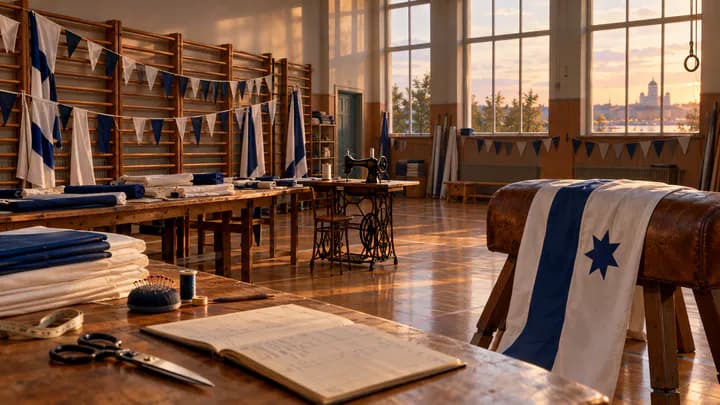
The Diver Who Brought Back the Wrong Year
When a salvage diver surfaces from a sunken village with a calendar that doesn't match the world above, she has one tide to decide which year to keep.
Drafted with AI and published automatically. Our editors set the standards and fix reported errors — how we work.
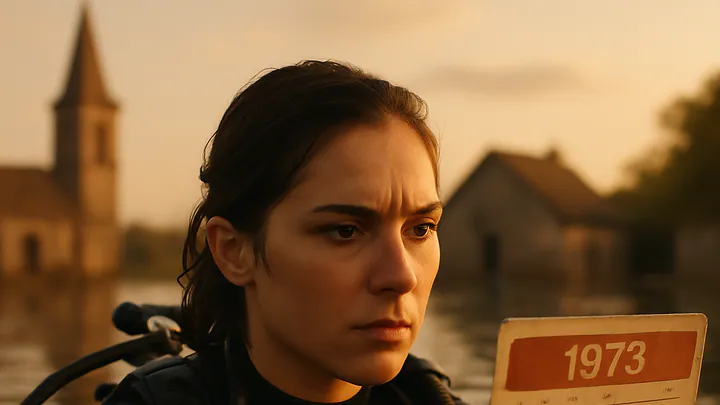
The lake gave Mira back at 6:14 in the evening, and the first thing she did was hold something small and wet above her head like a trophy nobody had asked for.
Per knew before she spoke. He had been her tender for nine seasons, and he could read her shoulders through the canvas suit the way other men read weather. Whatever she'd brought up, it wasn't a coin or a spoon or a brass nameplate from one of the drowned doorframes. It was paper. Paper that had spent eighty years underwater and somehow still had corners.
"Get me out," she said, and her voice came thin through the helmet's brass throat. "Per. Get me out now."
He hauled. The boat tipped. The pulley sang its little iron hymn, and Mira came over the gunwale in stages — boots, belt, the great copper bell of her head — until she was sitting on the bench dripping lake into the floorboards and refusing to let go of the thing in her glove.
Per unscrewed the helmet. Her hair was flat to her skull, her face the color of skim milk. She was forty-one years old and looked, for one bad moment, like a child who had seen something a child shouldn't.
"Show me," he said.
She opened her hand.
It was a calendar. A cheap printed thing, the kind a hardware store used to give away at Christmas, with a watercolor of a stag on the upper half and a grid of days on the lower. The paper was soft as cloth and ought to have dissolved. It hadn't. The ink was clear. The month at the top read OCTOBER. The year beneath it read a year that was not this year and not the year the village had drowned. It was a year between. A year that, as far as anyone above the water surface knew, had simply not happened to the people of Vassgard, because by then they had already been moved to the new town up the ridge and the lake had already swallowed their kitchens.
Per looked at it for a long time.
"That's not right," he said, finally, because he was a practical man.
"No."
"They left in '46. The valve closed in '47."
"I know when the valve closed, Per."
He touched a corner of the paper. It felt like a moth's wing. One of the dates — the 14th — had been circled in pencil, and beside it, in a careful, slanted hand, someone had written: Anna's birthday. Don't forget the candles this time.
Mira began to cry, quietly, the way she cried about nothing, which meant it was about everything.
What she had seen down there
She told him while he rowed, because the outboard felt rude.
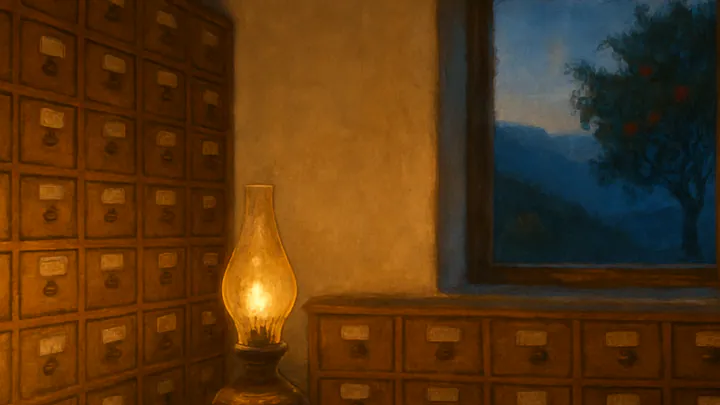
The village was where the village always was, ninety feet down, furred with algae and patient silt. She had gone in through what used to be the side door of the schoolhouse, looking for a brass bell the historical society had paid her to find. The bell was not there. A kitchen was there. A kitchen that had not been part of the schoolhouse in 1946 or any other year she knew of.
There had been a table set for two. Plates. A pot, upright, as if gravity in that room had its own opinions. On the wall, a calendar. On the calendar, a circled date.
And — this was the part she did not want to say, because saying it made it a fact — there had been a candle on the table. Not the wax remnant of one. A candle. White. Whole. Unlit, but dry.
Ninety feet down. Dry.
"I took the paper," she said. "I didn't take the candle. I wanted to. I didn't."
Per rowed. The oars made the small kind apologetic sound oars make when their rower is thinking. The ridge above them was going pink. Somewhere up there, in the new town, was the assisted living home where old Anna Lindqvist sat by a window and forgot, gently and without distress, the names of the children she had raised. Anna had been a girl in Vassgard. Anna had been twelve when the valve closed. Anna had been, by every record they had, the last person to leave the village before the water came in.
"She told me once," Mira said, "that her father had promised they'd come back. After. For one last birthday in the old house. She said it was the only promise he ever broke."
"Mira."
"What if he didn't break it."
Per stopped rowing.
The lake held them, perfectly level, the way a hand holds a cup it is afraid to spill. The calendar lay between them on the bench like a small and serious animal.
There are things a person can do with a piece of paper from a year that didn't happen. A person can take it to a museum, where it will be put behind glass and labeled provenance uncertain, and schoolchildren on field trips will fail to notice it. A person can put it in a drawer and never open the drawer again. A person can burn it, which is what a coward does, and which is also sometimes what a kind person does.
Or a person can drive up the ridge in the morning, sign the visitors' book at the home, and put the paper in the hands of a woman who is eighty-nine years old and has forgotten almost everything except the shape of one October.
Mira did the last one.
She did not tell Anna where it came from. She said only that an old neighbor had wanted her to have it. Anna held it for a long time with both hands, the way you hold a bird, and then she touched the circled 14th with one finger, and her face did something Mira did not have a word for. It was not surprise. It was the opposite of surprise. It was the look of a person who has been waiting, politely, for a very long time, and has just been told the train is here.
"He remembered the candles," Anna said.
"Yes."
"I told him. I told him he would."
She folded the paper in half, then in half again, and tucked it into the pocket of her cardigan. She looked out the window at the ridge, at the place where the lake began, and she smiled at it the way you smile at someone across a crowded room who has finally, finally turned around.
Mira drove home the long way. The lake on her left was the same lake it had always been, holding what it held. She did not look at it. She did not need to. Whatever year it was keeping down there, it was keeping it for someone, and that someone, today, had been remembered.
That, she thought, was enough work for one tide.