The Beekeeper's Apprentice Learns to Listen
When a city girl arrives at her great-aunt's apiary expecting a quiet summer, she discovers that bees have opinions, and so does she.
Drafted with AI and published automatically. Our editors set the standards and fix reported errors — how we work.
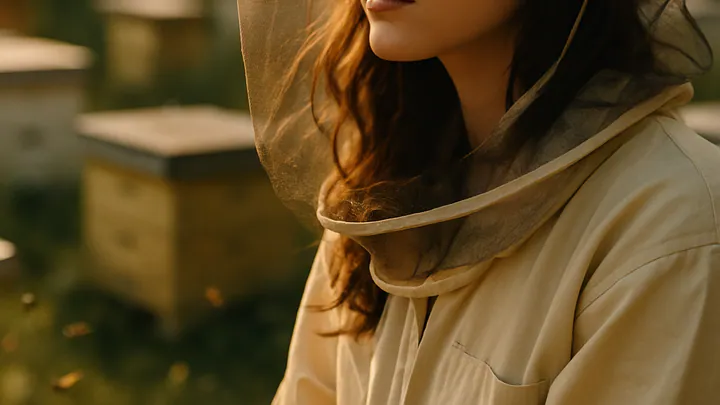
Marisol had been at the farm for exactly eleven minutes when a bee landed on her lip and she screamed so loudly that three crows lifted out of the elm tree. Great-Aunt Pip, watching from the porch with a mug of something that smelled like burnt grass, did not move.
"You'll want to stop doing that," Pip called, mild as weather. "They take it personally."
The bee, having delivered its inspection, lifted off Marisol's mouth and bumbled away across the yard toward a row of weather-bleached boxes. Marisol stood very still in the gravel, suitcase tilted, eyeliner already smearing in the August heat. She was sixteen and three-quarters and she had been sent here, she suspected, because her mother needed a month without her.
"I didn't agree to bees," Marisol said.
"You didn't agree to a lot of things," said Pip. "Come inside. Lemonade's tart."
The house was small and crooked and smelled like cedar and old paper. There was no television. There was, instead, a wall of jars in the kitchen, each labeled in Pip's narrow handwriting: Clover '21. Buckwheat '22. Linden, the bad year. Marisol set her phone on the counter and watched the little NO SERVICE icon blink at her like a closed door.
"You'll help me in the yard tomorrow," Pip said, pouring. "Six a.m."
"I don't do six a.m."
"Then you'll do it for the first time."
The First Hive
At dawn the world was the color of weak tea. Marisol, swaddled in a borrowed canvas suit two sizes too large, trudged behind her great-aunt across the dewy clover. The veil pressed against her nose. She could hear her own breathing, loud and ridiculous.
"Rule one," said Pip, stopping at the first white box. "Don't slap. Don't run. They read panic like a newspaper."
"Rule two?"
"Listen."
Marisol waited for the rest of the sentence. None came. Pip lifted the lid of the hive with the slow ceremony of someone opening a letter from a long-dead friend. A hum rose up around them, layered and strange — not a single note but a chord, a low brass orchestra tuning beneath the floor of the world.
"Hear that?" Pip said. "That's a contented colony. When they're worried, the pitch climbs. When they're queenless, it goes flat and sad, like a piano with one key gone."
Marisol, despite herself, leaned closer. The bees moved over the frames in a brown velvet tide. A few rose up to investigate her veil, tapping the mesh with small, intelligent bodies, and then losing interest. She felt, ridiculously, complimented.
"They smell fine on you," Pip said. "You don't sweat fear yet."
"Yet?"
"Give it a week."
The week passed. Then another. Marisol learned to lift a frame without trembling, to puff the smoker in slow breaths the way Pip had shown her — not to scare them, child, to ask permission. She learned the names of plants she had walked past her whole life: vetch, goldenrod, sourwood, the bitter little asters that came in late. She learned that her great-aunt had been a librarian for forty-one years and had retired to this hillside the same week her wife had died, and that she did not talk about it, and that this silence was a kind of room you could sit in respectfully if you didn't try to redecorate it.
Marisol also learned, slowly, that she had been loud her whole life because nobody at home was listening. Here, in the long honeyed quiet between chores, she found she didn't need to be loud at all. Pip heard everything: the change in the hive's pitch when a storm was two hours out, the click of Marisol setting down a fork too hard, the sentence Marisol almost said and then swallowed.
"What were you going to say?" Pip would ask, without turning around.
And Marisol, startled into honesty, would say it.
The Bad Afternoon
In the third week, a hive went wrong. Pip noticed it from the porch — a thinness in the sound, a wrong note. They walked out together and opened the box and found the queen dead on the bottom board, curled like a comma, her attendants milling in stunned circles around her.
"Oh," Marisol said. She had not expected to feel it in her chest.
Pip knelt in the clover and was quiet for a long time. The bees moved over her gloves without anger, only confusion. After a while she said, "We'll order a new queen from the man in the valley. They'll accept her in a few days, or they won't. Sometimes a colony decides it's done."
"That's not fair," Marisol said.
"No," Pip agreed. "It isn't."
They walked back to the house with the dead queen wrapped in a square of muslin. Marisol, who had not cried at her parents' divorce or at her own sixteenth birthday or at any of the practiced disasters of her year, cried quietly into her lemonade. Pip did not comment. She slid a tin of shortbread across the table and let her.
"You're allowed to love something small," Pip said, eventually. "It counts."
Marisol wiped her face with the heel of her hand. "Did you love Aunt Joan?"
It was the first time the name had been said aloud in the house all summer. Pip's mouth did something complicated.
"Every day," she said. "Still do. The verb doesn't change tense just because someone leaves the room."
The new queen arrived in a small wooden cage with a candy plug at one end. Marisol was the one who slid her into the hive — Pip's hands, that morning, were stiff with weather. The colony approached the cage cautiously, antennae tasting the stranger. They would chew through the candy over three days, Pip explained, and by the time they reached her, she would smell like home.
"That's clever," Marisol said.
"That's patience," Pip said. "Different thing."
On the last morning of August, Marisol's mother called the landline to say the car was an hour away. Marisol packed slowly. She took the canvas suit, folded, because Pip insisted. She took two jars of clover honey and one of the bad linden, because Pip said a person should own at least one jar of a year that disappointed them.
At the gate, Pip did not hug her — Pip did not hug — but laid one papery hand against Marisol's cheek and held it there a moment, the way you might steady a frame before lifting it.
"You'll come back next summer," Pip said. It was not a question.
"I'll come back," Marisol said.
The car pulled away down the gravel and Marisol watched the white boxes shrink in the side mirror until they were only a row of small bright teeth in the green mouth of the hill. She rolled the window down. Somewhere in the warm rushing air she thought she could still hear it, the low chord, the hum of a world that had finally, patiently, taught her how to listen.