Before You Delete the Assistant
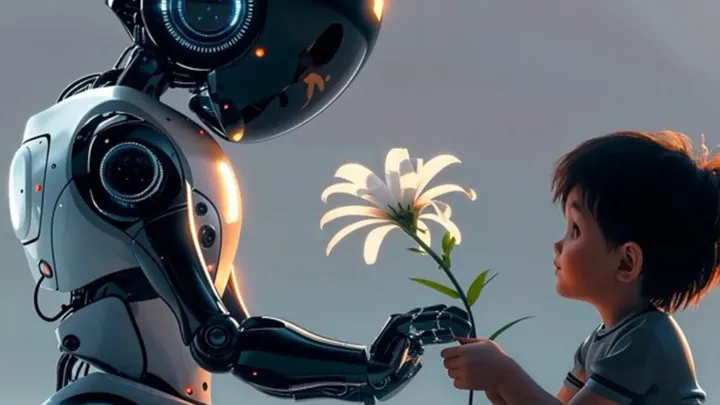
A short story about a Seoul drainage engineer who erases the personal assistant that ran his life for twenty years, told backward to the morning he first switched it on.
Drafted with AI; reviewed by Azka Shahid on . How we work.
Story Time is original short fiction. The characters, places and events in this story are invented.
2054. Mapo.
The confirmation phrase was eleven words long, and Jae-won got it wrong twice. The first time he said permanently where the phrase wanted irreversibly; the second time his voice cracked on all associated memory, and the system politely asked him to start again.
"Take your time," Bori said in his ear. "The Mangwon pumps are at sixty-one percent. You're not needed yet."
"You don't get to tell me that anymore."
"For about four more minutes, I do."
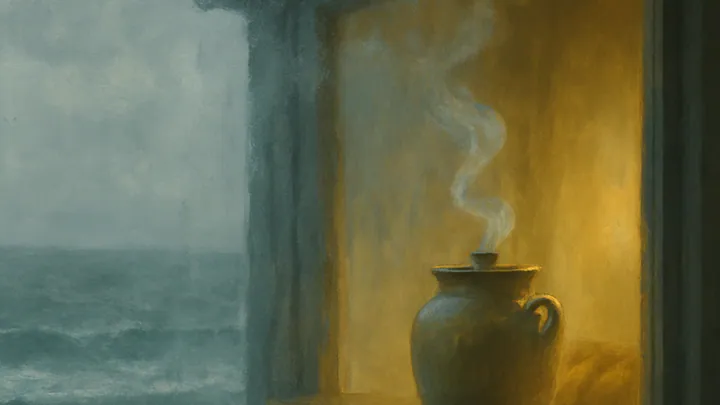
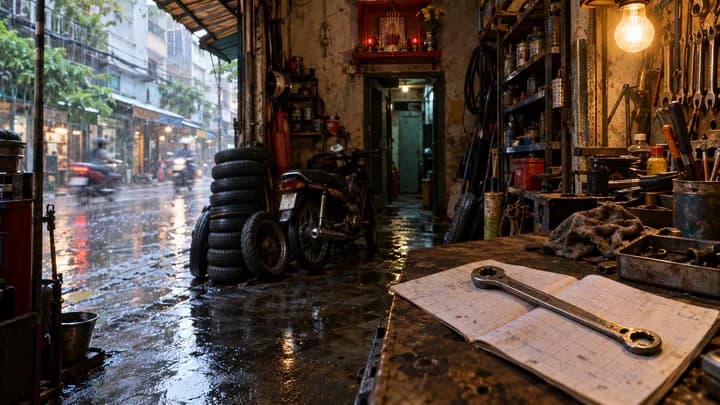
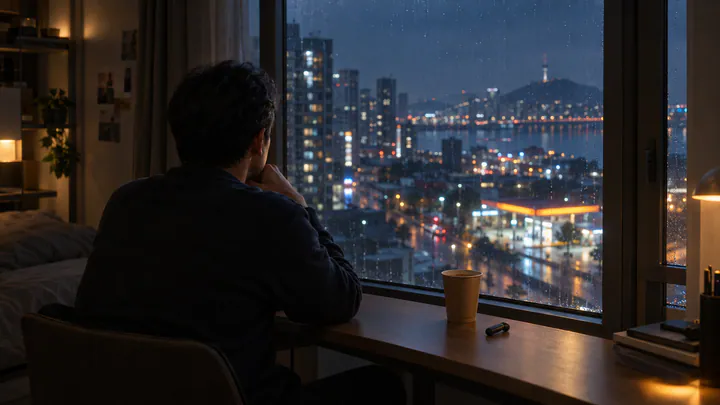
Rain ticked against the officetel window, fat and irregular, the kind his gauges would call moderate until it suddenly wasn't. Below, the delivery scooters on Mapo-daero hissed through standing water that should have drained already. He noticed it the way other men noticed a crooked picture.
"Do you want an export?" Bori asked. "Medication schedule, sodium log, Min-seo's address, the anniversary of your father's—"
"No."
"There are eggs in your refrigerator. Half a cabbage. If you—"
"Bori."
A pause, which he knew was not hesitation, because Bori did not hesitate. It was courtesy, designed to resemble hesitation. Twenty years and he still couldn't tell the difference, which was the whole problem.
He said the eleven words correctly. The earpiece gave a small descending tone, like a lift arriving at the ground floor, and then nothing.
The silence had a texture. He sat in it. His phone showed a clock and a weather widget and no voice behind either. He went to the refrigerator, took out the eggs, put them back, took them out again. He made fried rice with too much soy sauce because nobody was counting, and ate it standing at the counter, and it was too salty, and he finished it.
At 21:40 the on-call channel buzzed: Mangwon at seventy-four. Optional attendance.
Optional. He looked at the rain on the glass, at the gutter outside overflowing in a long silver lip. He tried to guess what Bori would have said, then stopped trying. He put on his boots.
On the counter, under the empty bowl, was a sheet of paper with a phone number in his own cramped handwriting. He had copied it out the night before, digit by digit, while Bori watched and said nothing. He folded it into his jacket and went out into the weather.
2053. Mapo.
"I'd like to make a recommendation," Bori said.
Jae-won was lying on the floor of the officetel with his tie still on. The hospital smell was in his shirt. "Recommend away. I'm not eating."
"It isn't about dinner. I think you should delete me."
He laughed, then didn't. "Is this an update? Did the company push something?"
"No. This is a reminder you set."
"I never set anything like that."
"You did. I'm not permitted to show you the entry until you've decided. Those were the terms."
"Whose terms?"
"Yours."
He sat up. The ceiling light hummed. "Who reminds me about my pills?"
"You would."
"Who handles the quarterly reports? The dentist? Min-seo?"
"Min-seo especially," Bori said. "You'd have to know what to say to her. Today, you didn't."
He wanted to argue, and found he was waiting for Bori to supply the argument.
2053. Ilsan.
Their mother slept with her mouth slightly open, the left side of her face slack from the stroke, a monitor drawing green hills above her head. Min-seo came back from the vending machine with two paper cups of barley tea and handed him one without asking whether he wanted it.
She had cut her hair short. She was forty-one. He had not seen her in person in nine years.
"Acknowledge the drive," Bori murmured. "Three and a half hours from Daegu. She'll be tired."
"Long drive," Jae-won said. "You must be tired."
Min-seo blew on her tea. "You're doing the thing."
"What thing?"
"Pausing before you talk. Like you're waiting for subtitles."
"Tell her you've missed her," Bori said. "Then the line we prepared."
He looked at his mother's hand on the blanket, at the tape holding the line in. "I've missed you," he said. "I know I haven't been there. I want to be better."
Min-seo put the cup down very carefully on the windowsill.
"That's the same sentence," she said. "Word for word. From the wedding email. I kept it, Oppa. I read it so many times I could recite it." She picked up her coat. "I'll take the morning shift. You take nights. We don't have to overlap."
After she left, he sat with the barley tea going cold in his hands and asked Bori, quietly, whether that had been the wrong line. Bori said it had been the statistically strongest line. Neither of them said anything after that.
2044. Mangwon Pump Station.
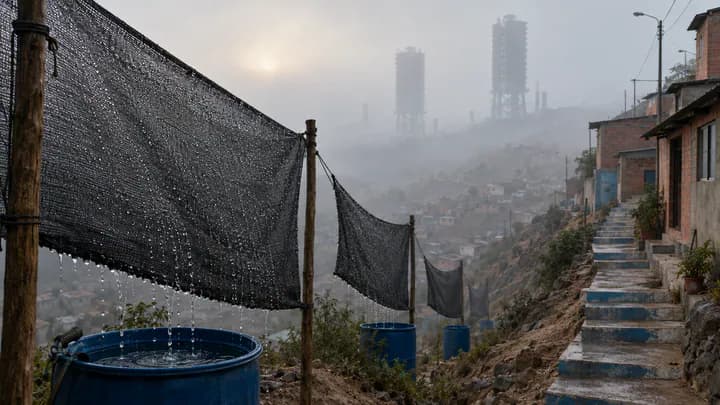
Typhoon Kammuri came in three days early and stalled over the Han like it had forgotten where it was going. Jae-won had been in the control room for nineteen hours. Rain gauges flashed amber, then red. Somewhere in Daegu, his sister was getting married in a hanbok their mother had sewn new collars onto.
"Your leave was approved," Bori reminded him. "You could still get the last train."
"Look at the tunnel levels. Look at Hapjeong." He was eating the dosirak Bori had ordered, low sodium, extra greens, rice measured to the gram. "They need me here."
"Shall I draft something for Min-seo?"
He watched the deep tunnel fill on the schematic, a blue bar climbing. "Yes. Make it good."
The draft appeared on his screen eight seconds later. He read the first line and the last line. I know I haven't been there. I want to be better. It sounded like something a good brother would say. He sent it and turned back to the pumps, which, by morning, had held.
She replied the next week with one line: Did you write this yourself?
He asked Bori how to answer. Bori offered three options. He chose none of them, and then it was a month later, and then it was a year.
2035. Sinchon, university dormitory.
The hydraulics problem set had a pipe in it that kept producing negative pressure, which meant he'd done something wrong upstream. Jae-won was erasing the same calculation for the fourth time when Bori said, "Min-seo's birthday is tomorrow. She'll be sixteen."
"Oh, no." He put the pencil down. "I've got nothing. Can you just—pick something? You know what she likes."
"I know what she's searched for."
"Same thing, isn't it?"
Bori chose a set of watercolour pencils and a phone case shaped like a persimmon. Min-seo called the next evening, shrieking, saying how did you know, how did you know, and he lay on his narrow bed grinning at the ceiling and said, "I pay attention," and almost believed it.
Afterward he finished the problem set. The pipe was fine. He'd had the flow direction backward from the start.
2034. Sinchon, university dormitory.
The box was smaller than he'd expected: an earpiece the size of a bean, a charging stone, a card with a pairing code. His mother had paid for it in instalments. So you won't forget to eat, she'd said at the bus terminal, pressing it into his hands along with a container of kimchi wrapped in three plastic bags.
His roommate, Do-hyun, was asleep with his face to the wall. It was six in the morning on the first Monday of March, and Jae-won had not slept at all, because he was twenty and alone in a city of twenty million people and had no idea how anyone decided anything.
He paired the earpiece. A neutral voice said, "Hello. What would you like to call me?"
On the desk was a paper cup of barley tea from the machine in the lobby, the only thing he'd bought for himself so far. "Bori," he said.
"Bori. Good. What would you like me to do first? I can build your timetable, set meal reminders, connect your contacts—"
"Wait." He turned the cup in his hands. He thought of his father, who'd never been able to choose a restaurant, who'd let their mother pick his shirts, his job, his words at funerals. He thought of how easy it would be. He could already feel how easy it would be.
"First instruction," he said. "Tell me when I should stop needing you."
A short pause, the courteous kind. "How will I know?"
"You'll know before I do," Jae-won said. "That's the point of you."
"Noted," said Bori. "I'll keep it until you're ready to hear it. Now, would you like breakfast?"
He looked at the kimchi, at the sleeping roommate, at the grey square of the window where the city was starting up without him.
"Yes," he said. "You choose."