The Salt That Spelled Her Brother's Name
A short story about a salt farmer in the Little Rann of Kutch whose brine pans begin growing crystals shaped like letters, and the trader who wants every one of them.
Drafted with AI and published automatically. Our editors set the standards and fix reported errors — how we work.
Story Time is original short fiction. The characters, places and events in this story are invented.
12 October 1998
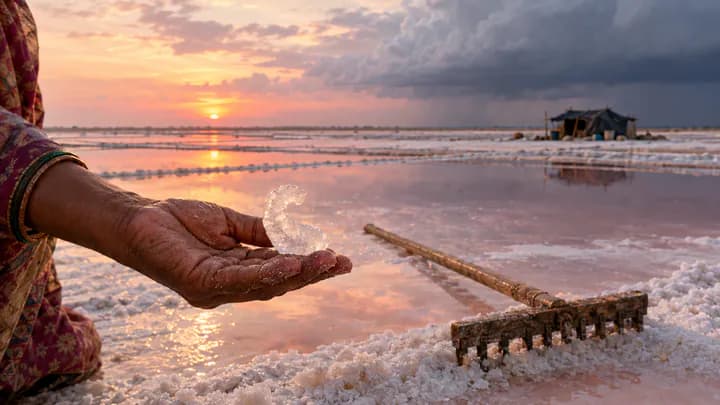
The front of this book is for Popatbhai's numbers. The back is mine. This morning the tractor dropped me, the tarpaulin, the diesel drum and two sacks of bajra flour eighteen kilometres out past the last thorn bush, at Bapu's old pans. I paced the corners and marked them with my heels. Jaydev's half is mine to work this year too, since he is in Surat polishing diamonds for people he will never meet. Dhanuben's family is two kilometres east. Between us there is nothing but the flat and the wild asses, who stand and stare as if I owe them money.
Jaydev has not written since Diwali last year. One postcard: Work is good. Food is bad. Don't send pickle, it leaks.
21 October 1998
Brine came up at eleven feet, green-smelling and bitter. The pump coughed all morning before it ran. Popatbhai drove out in his jeep with the advance, four thousand rupees, and wrote it in the front of this book in his slanting hand. Same rate as last year: twelve paise a kilo. I asked for fifteen. He laughed the way men laugh when they want you to know the joke is you.
"Bhavnaben, the market decides," he said.
"Then send the market out here to tramp the pans."
He left me a packet of glucose biscuits, as if that settled it.
2 December 1998
Six weeks of flooding, tramping, raking. My heels have gone white and hard as the crust. Pan two is crystallising. At dawn the rake's teeth caught on something, and I bent and picked out a crystal the size of my thumbnail. It was shaped like ક. Not like it. It was ka, the first letter Masterji ever chalked on the board for us. I held it to the lantern until the kerosene ran low. I put it in the tea tin.
10 December 1998
Four more. મ, ન, પ, ગ. Dhanuben's husband says the Rann puts a lake on the horizon every noon, so why not letters. Her girl, who goes to school in Patdi, read them out loud and asked if I carve them with a needle at night. I showed her my hands. A needle would be lost in them.
27 December 1998
A word. Four crystals grown together in a row on the floor of pan three: પાણી. Water. I did not rake that corner for an hour. I sat on the bund and drank from my own matka as though the pan had asked me to.
9 January 1999
Popatbhai saw the tin. He took one ga away "to show someone" and came back with a man from Ahmedabad who had two cameras and called the letters a folk miracle. The man paid two hundred rupees for one crystal. Two hundred. That is more than sixteen hundred kilos of my ordinary salt.
Then Popatbhai made his offer, standing in my pan with his shoes on. Thirty-six paise a kilo for everything I harvest, triple, if the letters keep coming. He takes the letters separately. Temple shops in the city, he says, people will want lucky salt for their doorways.
"And if they stop?"
"Then we go back to twelve, and nobody is hurt."
I said yes. The advance has to be repaid either way.
24 January 1999
New words. આંખ. Eye. And the next morning, beside it, દુખે. Aches.
Dhanuben's cousin worked the wheels in Surat for two years. She says they sit cross-legged from eight in the morning to ten at night with a loupe screwed into one eye, and the ones who last are the ones who stop blinking. Jaydev was always rubbing his eyes as a boy. Ma used to put a drop of castor oil in them and he would howl.
I sold eye and aches to Popatbhai for three hundred. I watched him wrap them in newspaper and put them in his shirt pocket like change.
11 February 1999
This is what I have not written down until now.
When Jaydev was seven, Masterji hit his knuckles with a ruler for writing જ wrong. He curled the bottom of it, like a tail. The ruler did not cure him. It made him do it harder, out of spite, every ja for the rest of his schooling, and in his own name most of all.
This morning, pan two: જાગું છું. I am awake. The ja has a tail.
14 February 1999
Market day in Patdi. I paid the STD booth man to dial the number Jaydev gave us, a unit in Varachha. A man answered over the noise of grinding.
"Jaydev? Which one? We have four."
"From the Kharaghoda side. Left-handed."
"Left-handed ones don't last on the wheel, ben." Someone shouted behind him. "He moved to another unit. Or he went home. Ask in your village."
"I am his village," I said, but he had already put the receiver down. The booth man charged me for three minutes anyway.
6 March 1999
The words come every two or three days now. Popatbhai visits twice a week. He has bought a steel box with a latch for them. He brought a woman from Bombay in sunglasses who wanted "a full sentence, something spiritual," and seemed disappointed when I showed her રોટલી. Roti.
"What does it mean?" she asked.
"That he's hungry," I said, and Popatbhai stepped on my foot.
She bought it anyway.
19 March 1999
બેન. Sister. Then: રાતે ગણું છું. At night I count.
Bapu made us count salt sacks to fall asleep. One sack, two sacks, until the trucks in our heads were full. Jaydev always cheated and skipped to a hundred.
Every crystal I sell goes to a different doorway in a different city. I lie on the cot and imagine him spread across Ahmedabad, Bombay, Rajkot, a word here, a word there, nobody able to read him whole. Then I think of the four thousand in the front of this book, and the roof in the village that needs new tiles before June, and I sell the next one too.
15 April 1999
The heat has arrived properly. The brine burns any cut. The asses come close at dusk to lick the bunds.
Pan three, at first light, in crystals so clear I could see the black floor through them: જયદેવ. His whole name. The tail on the ja curled like it was showing off.
Popatbhai saw it before I could cover it. He offered a thousand rupees on the spot, then fifteen hundred.
"It's cracked," I said. "Look, through the middle of the va. It will fall to pieces in your jeep."
He looked at me a long time. Then he looked at the steel box, already heavy, and let it go. Men like him know when to take the smaller profit.
It is not cracked. It is in the tea tin, under the rice.
2 May 1999
The trucks came for the heaps. Popatbhai did the sums on the bonnet of his jeep, and for once the number at the bottom of the front of this book is mine and not his. Advance cleared. Eight thousand six hundred rupees in my blouse, in a handkerchief, pinned twice.
Since the name, no more words. Only salt. Ordinary, good, white salt.
8 June 1999
Last entry. The clouds have been sitting in the south-west for three days like buffaloes deciding whether to cross. Dhanuben's family loaded their tractor this morning. Once the rain comes, the sea creeps back and my pans will be a lake, and the asses will move to the islands, and nothing I made here will exist.
Popatbhai came at noon for the last of the letters. I gave him the tin. All of it, every loose ka and ma, the water I had been saving, the I am awake. He counted it twice and paid me two thousand more and asked, very lightly, about the cracked one.
"It went," I said. "Salt goes."
In Patdi I did not buy tiles. I went to the bus stand and bought one seat on the night bus to Surat, departing six-fifteen, window side, because I want to see what it looks like when the ground stops being flat.
The name is wrapped in a strip of Ma's old red odhni, inside a plastic bag, inside my pocket, where I can feel the tail of the ja through the cloth with my thumb. It must stay dry. I have read the sky wrong before.
The front of this book says what I owed. The back is finished now. When I find the right unit in Varachha, and the right one of four Jaydevs, and he starts in about the pickle, I will not argue. I will put my hand in my pocket.