The Beekeeper Who Translated Silence
When a retired linguist inherits her grandfather's apiary, she discovers the bees have been keeping a record no one taught them to keep.
Drafted with AI and published automatically. Our editors set the standards and fix reported errors — how we work.
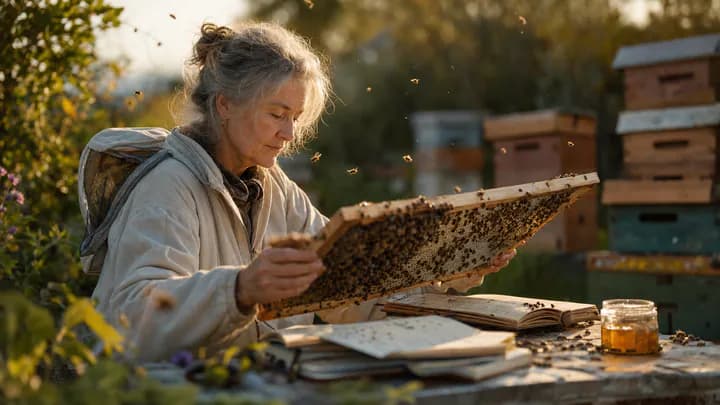
The bees were already grieving when Wren arrived, and she could hear it before she opened the gate. A low, unbraided humming, the kind a choir makes when it has forgotten the words but remembers the feeling.
She set down her suitcase in the gravel drive and pressed a palm to the wooden fence. Her grandfather had built it forty years ago from cedar he'd milled himself, and the grain was still warm under her hand, as though the wood had been listening for footsteps and was relieved someone had finally come.
"All right," she said, to no one. "All right, I'm here."
The orchard sloped down toward a creek she remembered as wider. Six pale hive boxes stood in a crooked line beneath the apple trees, and around them the air was thick and shimmering, as though heat were rising even though it was only April. Wren had spent thirty-one years studying the way human languages braided themselves out of breath and bone. She had never studied bees. But she knew the sound of a sentence whose speaker had just learned a death, and that was the sound coming from the hives.
The Inheritance
Her grandfather, Aldo, had left her three things: the apiary, a leather notebook, and a letter so brief it felt like a shrug.
Wren, it said. The bees keep the rest. Read slowly. Don't smoke them unless you must. They prefer to be asked.
She read the letter twice on the train and three more times in the taxi from the station, looking for the trick of it. Aldo had been a practical man — a retired postmaster who pruned his pear trees with a kitchen knife and wrote his Christmas cards in pencil. He was not a man given to mysteries. And yet here he was, leaving her bees and the suggestion that the bees were keeping something.
The notebook, when she finally opened it that first evening at the kitchen table, was nothing like she expected. No diagrams of frames or honey yields, no almanac of bloom dates. Instead, page after page of small, careful sentences.
April 6. The hive by the gate hummed in the key of my mother's name today. I had not said it aloud in nine years.
June 19. Storm last night. The bees grieved the apple branch before I saw it had fallen.
November 2. They will not let me forget Ines. I am grateful and I am tired.
Wren closed the notebook and put both hands flat on the table to steady herself. Outside, the hum from the orchard had softened into something almost like sleep.
What the Bees Knew
She began, the next morning, the way she had begun every fieldwork project of her career: with a chair, a thermos, and silence.
She set the chair ten feet from the nearest hive and sat. She did not bring the notebook. She did not bring a recorder. She had learned a long time ago that machines made witnesses nervous, even the ones with six legs.
For three days she only listened. The hum was not one sound but many — a tide of overlapping tones that rose when the sun warmed the boxes and thinned at dusk into something almost confessional. By the fourth day, she could pick out the hive nearest the gate from the others. Its note was lower. Wrenched, somehow. As if it carried a weight the others were taking turns helping it hold.
On the fifth morning, without quite deciding to, she said her grandfather's name aloud.
"Aldo."
The hum did something she could not at first describe. Later, writing it down, she would say it folded — the way a long sentence folds around a name it has been waiting to use. The pitch dropped a half-step, then rose, then settled into a tone she felt behind her sternum more than in her ears.
She sat very still. Her eyes were wet and she had not noticed when that had started.
"Oh," she said. "Oh, you do, don't you. You keep him."
The bees hummed on, unbothered, doing whatever it was bees did when they were also doing this.
The Visitor
The woman who came up the drive that afternoon was perhaps seventy, in a yellow raincoat though the sky was clear, carrying a jar wrapped in a tea towel.
"You're Aldo's girl," she said. It was not a question. "I'm Pera. From the blue house past the bend. I brought back his jar. He always wanted his jars back."
Wren took the jar. It was empty, washed, smelling faintly of honey and lemon.
"He used to give you honey," Wren said.
"He used to give everyone honey." Pera looked toward the hives, and her face did the small private rearrangement of someone seeing a familiar thing across a new distance. "Are they all right? After."
"They're grieving," Wren said, and was surprised to hear herself say it plainly, the way one might say they're thirsty.
Pera nodded as if this were obvious. "He used to say they were better at it than people. That they didn't try to be done with it."
They stood together in the gravel for a while. A single bee looped a slow figure-eight between them and went back to its work.
"He left me a notebook," Wren said. "He wrote down what they hummed."
Pera smiled, and her eyes crinkled. "Did he. Well. He always was a translator at heart. Worked the post office his whole life, you know — moving other people's words around. I expect he was glad to find someone speaking in a language nobody had claimed yet."
After Pera left, Wren walked down to the hives with the empty jar in her hands. She set it on the grass beside the cedar fence, the way one leaves a cup out for a guest who might still come.
The Translation
She stayed through the summer. She had meant to stay a week.
She learned, slowly, what her grandfather had learned. That the hive by the gate carried the names. That the hive nearest the creek carried weather — storms remembered, droughts feared. That the smallest hive, the one Aldo had marked with a chip of blue paint, carried the things he had not said to anyone, and that it hummed sometimes in a key she did not recognize, in a register that felt like a question she had not yet been asked.
She filled a new notebook. Then half of another.
One evening in August, she sat on the porch with the second notebook open on her knee and realized she had not, in weeks, tried to be done with anything. Not her grandfather. Not the marriage that had ended the winter before she came. Not her mother, dead ten years now, whose name she had been unable to say aloud at the funeral.
She said it now. Quietly, into the orchard.
The hum folded.
Somewhere in the apple trees a thrush answered, mistaking her for evening. The bees went on keeping what they kept, the way they had always done, the way they would do tomorrow, and Wren — translator of breath and bone, student of every borrowed tongue — sat very still on her grandfather's porch and let herself, at last, be understood.