The Bell Ringer of the Sunken Chapel
Every low tide, Odell walks out to a chapel the sea forgot to keep. He rings its bell for a village that no longer answers — until one morning something answers back.
Drafted with AI and published automatically. Our editors set the standards and fix reported errors — how we work.
Odell woke, as always, to the sea deciding what it would give back. Through the open shutter he could hear the tide unbraiding itself from the rocks, the small hiss of retreat, and he knew he had roughly an hour before the chapel would be walkable again.
He dressed by feel. Wool trousers stiff at the knees, boots still damp from yesterday, the oilcloth coat that smelled of kelp no matter how many times he beat it against the porch rail. On the table he left half a heel of bread for the gulls, because his mother had done that, and her mother, and because habits were the only inheritance the coast permitted.
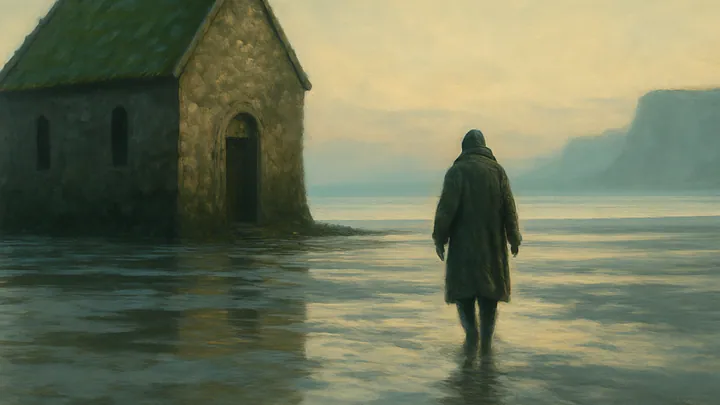
The path down to the flats was chalky and switchbacked. At the last bend he paused, as he always did, to look. The chapel sat a quarter mile out, roof green with barnacle and weed, its steeple canted like a man listening. At high tide only the cross showed, a small dark mark on the water. At low tide the whole building rose slick and dripping, the door leaning on its hinge, and a person could walk to it across the wet sand without wetting more than an ankle.
Nobody had come with him in eleven years.
The Ringing
The chapel had belonged to a village called Hallow's Reach, though the name was more the map's than anyone's. The sea took it the winter Odell was thirty-four. Not in a storm, which would have been dramatic and correct. In increments. A garden wall one spring. A well the next. Then a lane, a bakery, a school, until the last families packed carts and moved inland to towns that did not know their songs. Odell had stayed because someone had to ring the bell for evensong, and because the chapel, stubborn as an old tooth, refused to fall.
He crossed the flats now, boots making the wet sand sigh. Crabs the size of coins scattered from his shadow. He climbed the three stone steps, which were always the first to reappear, and pushed the door.
Inside smelled like a rock pool that had learned Latin. The pews were long gone, taken by tide or driftwood hunters. What remained was the stone floor, the stone walls, the stone font full of seawater and a small confused fish, and the rope.
The rope hung from a hole in the ceiling where the bell tower began. It was thick as his wrist, wound with tar and old prayer. Odell wrapped his hands around it, set his feet, and pulled.
The bell above him spoke. One long bronze note that rolled out over the flats and the cliffs and the empty houses on the headland where no smoke rose from any chimney. He rang it seven times, as had always been done at first light, one for each day of the week the village had been alive.
Then he waited. He always waited. It was the part of the ritual he had never quite explained to himself.
Today, the wait produced something.
What Answered
It was not a bell. It was a small, definite tap against the stone under his boots. Then another. A patient, questioning knock, like someone at a door who was not sure the house was occupied.
Odell stood very still. He was sixty-one years old and he had spent the last decade addressing an audience of gulls and weather. He knew the sound a settling building made, and the sound a stone made when a wave shifted it, and this was neither.
He knelt. He put his ear to the floor.
Tap. Tap-tap. Tap.
"Hello," he said, feeling foolish and not caring. "Hello, whoever you are."
The tapping paused, as if considering him, and then resumed with what he could only describe as relief.
He got up and walked the length of the chapel until he found the loose flag near the old altar — a stone he had lifted once, years ago, to see if the crypt beneath had flooded. It had. He had put the stone back and not looked again, because the sea was allowed to take what it took.
He lifted it now. Beneath was not water. Beneath was a stairway going down into dry dark, and at the bottom of the stairway, holding a small candle in a jar, was a child.
She looked up at him with the calm of someone who has been waiting a very long time and has grown good at it. She was perhaps eight. Her dress was the color of old hymnals. She was not wet.
"You rang," she said.
"I ring every morning," Odell said.
"I know," she said. "We hear you. We wanted you to know."
Odell sat down on the top step because his knees required it. "We," he repeated.
"The ones who couldn't leave," the child said, matter-of-fact. "Not ghosts. Just — kept. The chapel keeps us. That's what it's for." She tilted her head. "Didn't you know?"
He thought of the eleven years. Of ringing into what he had believed was nothing. Of the way the bell's note always seemed to come back to him a half-beat too warm, as if it had passed through a room with a fire in it.
"I suspected," he said, which was truer than he had known until he said it.
"You can come down," the child offered. "It's nice. My grandmother is here. She remembers your mother."
Odell looked down the stairs. He looked back at the door of the chapel, at the flats beyond, the tide already whispering that it meant to return within the hour. He thought about the bread on his table, the shutter he had left open, the small stubborn life he had built out of one habit and a lot of weather.
"Not today," he said gently. "But I'll ring again tomorrow. And I'd like — if you don't mind — I'd like to know your name, so I know who I'm ringing for."
The child smiled. It was the smile of a person being seen after a long time of being merely remembered.
"Ivy," she said. "Ivy Marsh."
"Ivy Marsh," Odell said, tasting the name. "Good morning, Ivy Marsh."
He lowered the stone gently, as one lowers a lid on a sleeping thing, and walked back out into the widening light. Behind him, faintly, he thought he heard soft applause, or perhaps only water finding a new pocket in the wall.
He crossed the flats before the tide could catch him. At the top of the path he turned and looked back at the chapel, its cross beginning to shine as the sun climbed, and for the first time in eleven years he did not feel like the last person on a coast. He felt like the first person on a bridge.
Tomorrow he would ring eight times. One for each day of the week the village had been alive, and one for Ivy Marsh, who had, at last, said hello.