Europe's New Border Rules in 2026: EES and ETIAS Guide
Europe's borders are going digital. Here's what the EU Entry/Exit System and ETIAS actually mean for short trips in 2026 — how the 90/180-day rule works, what happens at the airport, and the mistakes that ruin itineraries.

TL;DR: Americans and other visa-free visitors still do not need a visa for short trips to Europe. But two systems now sit between you and the passport stamp you used to get: the EU Entry/Exit System, which records your face and fingerprints at the border, and ETIAS, an online authorization you complete before you fly. The 90-days-in-180 limit has not changed — enforcement of it has.
Our team has watched a lot of trip plans wobble over border paperwork that travelers only discovered at the gate. This guide covers what is actually changing, what is not, and the handful of edge cases that cause real problems.
What is the EU Entry/Exit System, and how does it change arrival?
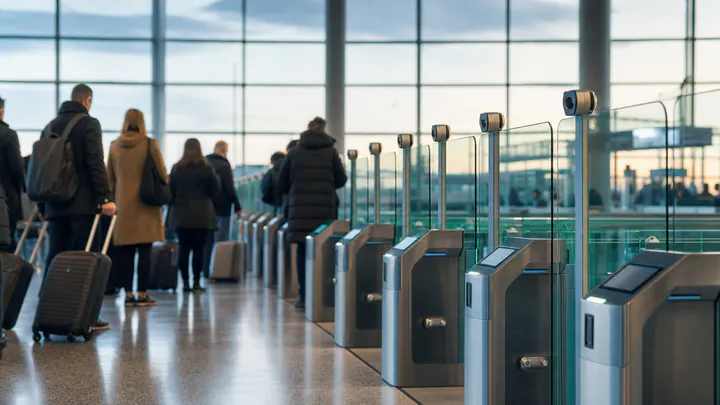
The EU Entry/Exit System (EES) is an automated border database that records non-EU visitors entering and leaving the Schengen Area, replacing manual passport stamping with a digital record of your travel document, facial image, fingerprints, and the date and place of each crossing. In plain terms: the stamp goes away, and a computer does the counting instead.
The practical consequence is that your first crossing takes longer than you are used to. A border officer or self-service kiosk captures your biometrics and creates a file; on later crossings, the system recognizes you and the check is quicker. The data is retained for a defined period, so a return trip within a few years should not require full re-registration.
The second consequence matters more. Under the old paper system, a faded or missing stamp gave travelers a lot of accidental leeway. Now entry and exit dates are logged precisely, every time, at every crossing point — air, land, sea, and rail. There is no longer any ambiguity about how many days you have used.
Do I still need a visa for Europe, or is ETIAS a visa?
ETIAS is not a visa. It is a pre-travel authorization for people who are already visa-exempt — a short online form checked against security and immigration databases before you board. Citizens of the United States, Canada, Australia, Japan, the UK and dozens of other countries fall into this group.
The application asks for passport details, contact information, employment and education basics, your first destination country, and a few security questions. Most applications are designed to return an answer quickly; a minority get flagged for manual review, which is exactly why you should not apply the night before a flight. There is a modest one-time fee, with exemptions for younger and older applicants — confirm the current amount on the official EU website rather than a third-party site.
Two details trip people up. An approved ETIAS is tied to the passport you applied with, so renewing your passport means reapplying. And approval is permission to travel to the border, not a guarantee of entry — the officer at the border still makes the final call.
Which scheme applies where? A quick comparison
| Scheme | What it is | Where you do it | Applies to |
|---|---|---|---|
| EES | Biometric entry/exit registration replacing passport stamps | At the border, on arrival and departure | Schengen Area crossings |
| ETIAS | Pre-travel online authorization tied to your passport | Online, before booking or well before departure | Visa-exempt visitors to participating European countries |
| UK ETA | Separate UK electronic travel authorisation | Online or via the official UK app | Visa-exempt visitors to England, Scotland, Wales, Northern Ireland |
| Ireland | No EES, no ETIAS; standard immigration check | At the border | Visitors to the Republic of Ireland |
| Long-stay visa | National visa or residence permit for stays over 90 days | Consulate of one specific country, before travel | Anyone exceeding the short-stay limit |
The key takeaway from that table: Europe is not one jurisdiction. A London-Paris-Dublin trip can involve three different sets of rules in ten days.
How does the 90/180-day rule actually work?
You may spend up to 90 days inside the Schengen Area in any rolling 180-day period. Both your arrival day and your departure day count as full days, and the 180-day window moves forward continuously — it does not reset on January 1 or on a calendar quarter.
A worked example. Say you spend 45 days in Portugal in March and April. In September, you want to return. To know whether you can, count backward 180 days from each planned date and add up the Schengen days inside that window. If the spring trip has fully dropped out of the rolling window by then, you have the full 90 days again. If part of it is still inside, you have less.
What does not count toward your 90 days?
- Time in the United Kingdom or Ireland.
- Time in most Western Balkan countries such as Albania, Montenegro, Serbia, Bosnia and Herzegovina and North Macedonia.
- Time in Turkey, Georgia, and other non-Schengen European destinations.
- Time at home, obviously — but only after you have exited and the exit is recorded.
This is why long, seasonal European trips often route through non-Schengen countries deliberately. If you are planning an extended stay, our guide to basing yourself in one place for longer stays pairs well with this counting math: fewer moves means fewer border crossings to track.
How much extra time should I allow at the airport?
Allow meaningful extra buffer on your first crossing of the trip, especially at large hub airports during peak departure waves, at busy land borders, and at ferry and rail terminals where checks happen before you board. Enrollment is a one-time cost in time, but it lands on the day you can least afford it.
Some practical hedges:
- Avoid tight self-transfer connections through a Schengen entry point on the way in. If you must connect, book a single ticket so the airline owns the rebooking.
- At land and sea borders, travel outside peak hours where you can — early afternoon on a weekday beats Friday evening.
- Have your passport out and your fingers clean and dry. Scanner failures on dry or damaged fingertips are a common and unglamorous cause of delay.
- Travel with children? Biometric rules differ by age, and families move slower through kiosks. Budget accordingly.
Timing the trip itself helps more than any airport hack. Crossing during quieter weeks is one of the underrated advantages of shoulder-season trip planning — the same border hall behaves very differently in late April than in mid-July.
Which mistakes cost travelers the most?
These are the failures we see repeatedly, and nearly all of them are preventable weeks before departure.
- Passport validity confusion. For Schengen entry, the standard requirement is a passport valid for at least three months beyond your intended departure date and issued within the previous ten years. Travelers often remember the "six months" rule from elsewhere and forget the issue-date rule entirely.
- Planning to the exact 90th day. A canceled flight or a strike can push you into an overstay you did not choose. Leave a buffer of several days.
- Assuming the UK counts. It does not count toward Schengen days, but it does require its own authorization for visa-free visitors. Two separate applications, two separate rules.
- Applying for authorization too late. Most decisions are fast, but the ones that are not can take days. Apply when you book, not when you pack.
- Renewing a passport and forgetting the link. A new passport number invalidates the connection to your existing authorization.
- Mismatched names. Enter your name exactly as printed on the passport's machine-readable zone — no nicknames, no dropped middle names, no fixed "typos" that were actually correct.
Who is treated differently?
Holders of a residence permit or long-stay visa from a participating country, family members of EU citizens exercising free movement rights, and certain other categories are handled under separate rules and are generally not subject to the short-stay counting in the same way. Dual nationals should think carefully about which passport they present — entering on an EU passport and leaving on a US one creates a messy record. Pick one document and use it consistently for the whole trip.
What should I do before I book my 2026 trip?
Work through this in order, ideally at the point you start pricing flights rather than the week before you leave.
- Check your passport's expiration date and its issue date against the three-month and ten-year rules.
- List every country on your itinerary and label each one Schengen, UK, Ireland, or other.
- Add up the Schengen days, including arrival and departure days, and check them against any Schengen travel in the previous six months.
- Apply for any required online authorizations as soon as they are available for your trip, and save the confirmation offline.
- Photograph your passport's data page and store it separately from the passport itself.
- Confirm your first point of entry, since some applications ask for it and airlines may verify it.
Solo travelers should fold this into a broader pre-departure routine — our first-timer's solo travel playbook covers documents, check-ins, and contingency contacts in the same sitting.
Is any of this worth worrying about?
For a straightforward two-week vacation inside the limit, honestly, no — you will fill in a short form, stand at a kiosk, and get on with your trip. The systems are designed for high-volume normal travel, not to catch out tourists.
The people who need to pay real attention are long-stay travelers, snowbirds, remote workers hopping between countries, frequent business flyers, and anyone whose personal document situation is unusual. For them, the shift from human-stamped passports to automated records is a genuine change in exposure. Precision now matters in a way it did not before.
Editorial note: this article is general travel information, not immigration or legal advice. Entry requirements, fees, and launch timelines change, sometimes at short notice. Before you book and again before you fly, verify the current rules on official government sources for every country on your itinerary, and consult a qualified immigration attorney or the relevant consulate if your situation is complicated.
Key takeaways
- Visa-free travel to Europe continues; EES adds biometric border records and ETIAS adds a pre-travel online authorization.
- The 90-days-in-any-180 limit is unchanged, but it is now counted automatically and precisely — informal leeway is gone.
- Check both your passport's expiration date and its issue date; the ten-year issue rule catches people out.
- The UK and Ireland sit outside the Schengen count and have their own separate requirements.
- Apply for authorizations when you book, allow extra time at your first border crossing, and never plan to the exact 90th day.
- Reapply for authorization after any passport renewal, and use one consistent travel document for the entire trip.
Frequently asked questions
Do Americans need a visa to visit Europe in 2026?
No — US citizens still travel to the Schengen Area visa-free for short stays of up to 90 days in any 180-day period. What is new is biometric registration at the border under the Entry/Exit System, and eventually an ETIAS travel authorization, which is a pre-screening step rather than a visa.
What is the difference between EES and ETIAS?
EES is what happens at the border: a digital record of your face, fingerprints, and entry and exit dates that replaces passport stamps. ETIAS is what happens before you fly: a short online application tied to your passport that you complete in advance and that airlines check at boarding.
How do I count my 90 days in the Schengen Area?
Count every day you are physically inside the Schengen Area, including your arrival and departure days, then look backward across the previous 180 days from any given date. The window rolls continuously, so the total is recalculated every day rather than resetting on a fixed date.
Does time in the UK or Ireland count toward the Schengen 90 days?
No. The United Kingdom and Ireland are outside the Schengen Area, so days spent there do not count against your Schengen allowance. They have their own separate entry rules, including the UK's Electronic Travel Authorisation for visa-free visitors.
How long will the new biometric border checks take?
Your first crossing after the system registers you takes the longest because facial image and fingerprints must be captured; later crossings within the data retention period are typically faster. Build in extra buffer time at your first arrival airport and at land and ferry crossings during peak periods.
Do I need a new ETIAS if I renew my passport?
Yes. An ETIAS authorization is linked to the specific passport used in the application, so a renewed or replaced passport requires a new application even if the old authorization has not expired.
What happens if I overstay the 90-day limit?
Overstays are now recorded automatically rather than depending on a border officer noticing a missing stamp, and consequences can include refusal of entry on future trips or a formal entry ban. If you need more than 90 days, apply for a national long-stay visa from the specific country where you will spend most of your time.