A Bus Horn Stole the Rooster's Morning
A short story about a grandmother in the Oaxacan mountains, a blackout, and the fable of a proud rooster who lost the dawn to the first bus and had to bargain for a new hour.
Drafted with AI; reviewed by Azka Shahid on . How we work.
Story Time is original short fiction. The characters, places and events in this story are invented.
The lights went out in the middle of Emiliano's complaint about the beans, and for a moment the whole of San Pedro Yaxila seemed to slide off the mountain. The refrigerator stopped humming. Down the slope, the radio at the Cruz house died halfway through a cumbia, and somebody's dog began barking at the sudden quiet.
"There," said his grandmother, as if she had ordered it. "Now you can't see what you're not eating."
Tiburcia found the ocote splinters by feel, in the tin on the shelf where they had lived since before Emiliano was born, and struck a match. The resin caught with a hiss and a smell like Christmas. She carried the little flame out to the porch, set it in a clay saucer on the railing, and lowered herself into the chair with the woven plastic seat.
Emiliano followed, because the kitchen was worse. Beyond the porch the valley had vanished. No streetlight at the bend, no glow from the agencia building, no headlights crawling up the switchbacks. Just the pines, blacker than the sky, and the cold climbing out of the ravine.
"My phone's at four percent," he said.
"Then save it for something important."
"Like what?"
"Like a story." She pulled her rebozo tighter. "Ask me something."
He didn't want to. But the dark was very large, and she was the only thing in it that talked back. "Why does the Méndez rooster crow at lunchtime? Ricardo says he's broken."
"Ricardo's father is broken. The rooster is keeping a promise."
In the time before the road, Tiburcia said, when people walked to Ixtlán with their sandals in their hands to save the leather, there was a rooster named Candelario.
"Roosters don't have names."
"This one named himself. He thought it was too important to leave to people."
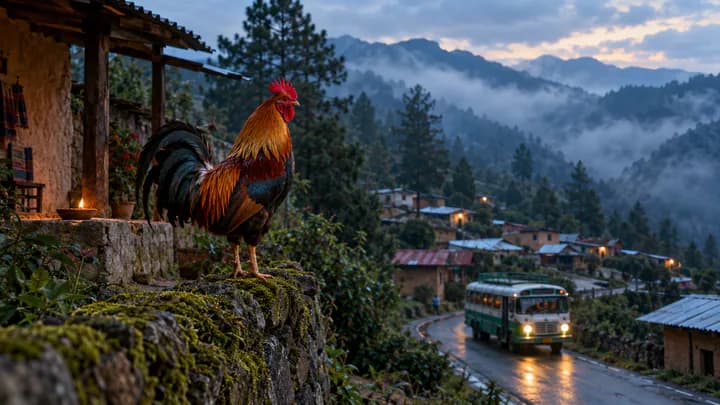
Candelario slept on the highest beam of the Méndez corncrib, and every night, at an hour no clock had told him, he felt the morning before it arrived: a thinning in the cold, a change in the frogs, the smell of the dew deciding to fall. Then he climbed to the top of the stone wall, set his yellow feet, swelled a chest the color of embers, and let it go.
And San Pedro Yaxila obeyed. Women blew the ash off their comales. Men took their machetes down from the nails. The sacristan, still in his blanket, went to ring the church bell, always after Candelario, never before. The rooster did not believe he announced the morning. He believed he made it, and that if he ever kept his beak shut, the sun would stay sulking behind Cerro Pelón like a child who hadn't been called.
Then the road came. Men in orange vests. A yellow machine that chewed the mountainside and spat out gravel. Black tar that steamed when it rained. And at the end of all that, the bus.
It was green and white with LA SERRANA painted on the side in looping letters, and it left the plaza at five o'clock sharp to reach the city by ten. Before it left, the driver leaned on the horn. It sounded like a cow being stepped on by a larger cow.
"That's not a sound," Emiliano said.
"You weren't there."
"Neither were you."
"I was sixteen. I rode that bus every Saturday to sell my mother's huipiles. Do you want the story or not?"
He pulled his knees up inside his sweatshirt. "Go on."
The first morning, Candelario was already on the wall, chest full, beak open, when the horn tore down the street. Every door in the village banged. By the time his crow came out, the comales were lit and nobody turned a head. A girl carrying a bucket walked right past him to the plaza, because the horn meant the bus, and the bus meant the city.
So he crowed at four. Nobody rose. Doña Herminia threw a sandal at him and kept the other one, out of thrift.
So he crowed at three. The dogs howled, the babies wailed, and the sacristan, more asleep than awake, rang the bell for a mass that did not exist. Half the old women of San Pedro walked up to the church in the dark and stood there in their shawls, waiting for a priest who was home in bed. After that the children called Candelario el loco and flapped their elbows at him on the way to school.
"He should have just cut the wire," said Emiliano.
"He was a rooster, not your uncle."
What Candelario did was worse. One night, while the driver slept across the back seat of the bus in the plaza, he squeezed up under the front bumper and stuffed the horn full of corn silk. When there wasn't enough corn silk, he pulled feathers from his own breast and packed those in too.
At five the next morning the horn made a noise like a goose with a cold. The whole village laughed. Then the driver hit it again, harder, and out came a cloud of feathers, red and gold, drifting down over the plaza like confetti at a fiesta. Every person there knew whose they were.
Higinio was twenty-four and had driven the Serrana for three weeks. His father had driven mules on the old path, and Higinio had learned the new road the same way, curve by curve, with his heart in his teeth. He did not care about mornings. He cared about getting Doña Herminia and her cheeses down the mountain before the Saturday market closed, and about the brake pads, and about a girl who sold atole near the bus terminal in the city.
So when his headlights found a half-bald rooster standing in the middle of the road at a quarter to five, wings spread wide like a tiny bishop, he stopped the bus and got out.
"Compadre," he said. "You're going to get flattened."
"The morning is mine," said Candelario.
"Keep it. I don't want it. I want to make the market." Higinio crouched, because his mother had raised him to speak to elders at their height. "You know what nobody owns? Noon. I'm up on the pass at noon eating my tlayuda, and I look down at the milpas, and the men keep swinging in that sun because nobody tells them to stop. Old Nicanor fell over in his beans last week. They thought he was dead."
Candelario lowered one wing a little. "Noon is a lesser hour."
"Noon is when the food comes. Nobody throws sandals at the one who brings lunch." Higinio scratched his jaw. "You take noon. I take five. And every night when I come back through, I'll blow the horn at your wall. Not for the village. For you."
"Three times."
"Two."
"Two and a half."
"There's no half of a horn, compadre."
They settled on two, and that the bus would slow down past the Méndez wall so the dust didn't settle on his tail. The next day, when the sun stood straight over the church, Candelario climbed the wall and crowed. Out in the milpas the men straightened, wiped their necks, and looked up the hill, and there came the women with baskets wrapped in embroidered cloth, the tortillas still warm, the chiles blistered black. They ate under the avocado trees and nobody fainted. And that evening, coming round the bend, the Serrana sounded twice.
Emiliano was quiet long enough that Tiburcia thought he had fallen asleep against the post.
"That's not why," he said finally. "Ricardo says he's just old and the light confuses him."
"Ricardo says many things."
The ocote was burning down to a curl. Tiburcia watched him watch it. She had known since he was four, when he used to call out from his bed every few minutes with a question about worms or airplanes, never anything he needed answered. Only to hear someone answer.
"Abuela." His voice had gone smaller. "I kept arguing because when you stop talking, it's just the dark."
"I know, mijo."
"You knew?"
"Why do you think I told such a long one?" She found his hand, cold, and held it. "Then I won't stop. You know Higinio's nephew drives the night bus now, and he still honks twice at the Méndez wall. He doesn't even know why, his uncle just told him the rooster would be offended if—"
The bulb over the door flickered and blazed. Inside, the refrigerator shuddered back to life, and from down the slope the Cruz radio picked up the cumbia exactly where it had left it.
Emiliano blinked in the yellow light. He did not let go of her hand.
"Wait," he said. "Listen."
Headlights were swinging up the last switchback. As the bus came round the bend, it slowed, and two short blasts rang off the stone wall across the road. From somewhere behind it, half asleep and deeply offended, the Méndez rooster answered.