The Bicycle Courier Who Delivered Lost Hours
Mira's courier bag carries envelopes that don't contain paper. When a recipient refuses delivery, she has to decide what to do with a stranger's missing afternoon.
Drafted with AI and published automatically. Our editors set the standards and fix reported errors — how we work.
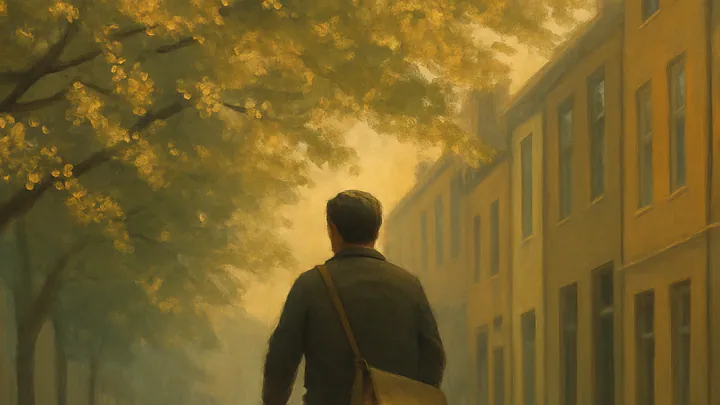
The envelope weighed nothing, which was how Mira knew it was full. She tucked it into the canvas satchel against her hip and pushed off from the curb, the bicycle's chain clicking like a clock that had finally remembered the time.
Her route that morning was the usual loop — three deliveries in the river district, one near the old market, and a final stop she always saved for last because the address was a long, sloped street with linden trees that smelled, in late spring, like honey left too near a window. She had been a courier for the Hours Office for six years, which was longer than most. Couriers tended to leave after they figured out what was in the envelopes. Mira had figured it out in her second week and stayed anyway.
Inside each envelope was an hour somebody had lost.
Not metaphorically. The Office collected them — afternoons spent in waiting rooms that turned out to be the wrong waiting rooms, mornings dissolved into arguments nobody remembered starting, whole evenings misplaced under the weight of a phone screen. The Office gathered them up the way a street sweeper gathers fallen blossoms, sorted them, and sent them back to their original owners by bicycle, because bicycles were the only vehicles slow enough not to spill the contents.
The first delivery that morning went to a woman in a green housecoat who opened the door, signed for her envelope, and immediately sat down on her front step to open it. Mira didn't watch. It wasn't polite. But she heard the small inhale, the way you hear someone find a coin in an old coat pocket, and she pedaled away smiling.
The second went to a baker with flour on his eyebrows who slipped the envelope into his apron and said, “Tell them thank you,” though Mira had explained, many times, that the Office did not accept thanks. The Office did not accept anything. That was the point.
The third was a no-answer. She left the envelope in the brass slot beside the door, where it would wait, patient as a cat, until the recipient came home.
It was the fourth delivery that broke the morning open.
The address was a narrow house the color of weak tea, with a small iron gate and a hand-lettered sign in the window that read NO SOLICITORS, NO SURVEYS, NO CONDOLENCES. Mira liked the sign. She had once considered making one for herself.
She rang the bell. A man answered — mid-fifties, perhaps, in a cardigan that had been washed into softness, holding a teacup as though it were the only thing keeping him upright.
“Delivery from the Hours Office,” Mira said. “For a Mr. Halloran. One envelope, signature required.”
He looked at the envelope. He looked at her. He did not extend his hand.
“I don't want it,” he said.
This had happened twice before in six years. Both times Mira had used the script the Office provided, which was gentle and which she did not entirely believe. She tried it now.
“Sir, the hour belongs to you. The Office is only returning what was already yours. You're not required to use it. You can keep it sealed. You can throw it away. But we do need a signature confirming receipt.”
“Then it isn't mine,” he said, “because if it were mine I could refuse it.”
This was the kind of logic Mira had encountered before, mostly from men who taught philosophy or sold insurance. She tried again.
“May I ask which hour it is?”
He glanced at the envelope. There was, on its front, a small notation in the Office's neat script: a date, eleven years prior, and a time — 2:14 p.m. to 3:14 p.m.
His face did something complicated. He set the teacup on the hall table very carefully, as if it had grown heavy.
“I know that hour,” he said. “I don't want it back.”
“All right,” said Mira.
She didn't ask. Couriers learned, early, not to ask. But she also didn't leave. She stood on his step with the linden trees breathing honey around her, and waited, because waiting was a thing bicycles taught you.
After a long moment he said, “It was the hour I spent in a hospital parking lot. I couldn't go in. I sat in the car. My sister was inside. By the time I went in, she —” He stopped. “I lost that hour because I couldn't stand to remember it. The Office is welcome to keep it.”
Mira nodded. She understood, in the way couriers came to understand things, that the Office could not actually keep it. Hours that were refused did not return to the archive. They simply dissolved, which sounded clean but wasn't. Somewhere a small piece of a person's life would go missing for good, and the person would never know what they had lost, only that something was lighter than it should have been.
She thought about saying this. She didn't.
Instead she said, “Would you like me to keep it for a while?”
He looked at her properly for the first time. “You can do that?”
“I can hold it in my satchel,” she said. “Not forever. But for the rest of the route. If by the time I finish you still don't want it, I'll mark it refused and that will be that. If you change your mind, I'll come back.”
This was not Office policy. This was not anything. Mira had never offered it before because she had never thought of it before.
Mr. Halloran considered. Then he nodded, once, the way a man nods when he has agreed to a thing he does not yet trust.
“The rest of the route,” he said.
Mira pedaled slowly through the linden street and out toward the market. The envelope in her satchel still weighed nothing, but she was aware of it the way you are aware of a held breath.
She thought about the hour inside it. An hour in a parking lot. The particular silence of a car with its engine off. The way grief can arrive before the news does, sitting in the passenger seat, asking you not to go inside yet.
It occurred to her, somewhere between the market and the bridge, that the hour was not only the worst hour of a man's life. It was also, perhaps, the hour in which he had loved his sister most acutely — loved her so much he couldn't bear to watch her go. The Office did not sort hours that way. The Office sorted by clock time. But hours, Mira had come to suspect, were not really clock-shaped. They were shaped like the people who lived inside them.
By the time she returned to the tea-colored house, the linden light had shifted to gold. Mr. Halloran was waiting on his step, the teacup gone, his hands open on his knees.
“I'll take it,” he said, before she had dismounted.
She handed him the envelope. He signed her slip with a pen that needed shaking. He did not open the envelope in front of her, which she appreciated, and she did not look back as she rode away, which she hoped he appreciated too.
That night, filing her route sheet at the Office, Mira added a small note in the margin: Delivery completed. Recipient required additional time.
The clerk read it, nodded, and stamped it without comment. Outside, the city's lost hours went on quietly finding their way home, one slow bicycle at a time.