The Cartographer of Tuesday Alleys
A mapmaker who charts only the alleys that appear on Tuesdays meets a stranger asking for a route that shouldn't exist. What she draws next surprises them both.
Drafted with AI and published automatically. Our editors set the standards and fix reported errors — how we work.
Odile kept her office in a stairwell that had once belonged to a hat shop, and she only worked on Tuesdays. This was not eccentricity; it was necessity. The alleys she mapped only existed on Tuesdays, and even then, only between the hours when the light couldn't decide what color to be.
She was forty-one, small, precise, and prone to smudging ink on the side of her hand. Her hair was cut like someone had done it herself with kitchen scissors, because she had. On the wall behind her drafting table hung sixty-three completed maps, each one dated, each one showing a network of narrow passages that unfolded through the city like veins in a leaf no one had ever quite drawn before.
The bell above her door rang at three minutes past two. This was unusual. Odile rarely had visitors, and the ones she did have tended to arrive apologetically, as though they had followed a scent they weren't sure they trusted.
The man in her doorway was tall and slightly stooped, with a wool coat that had seen more winters than he had. He held his hat against his chest the way people used to at funerals.
“You’re the cartographer,” he said. Not a question.
“On Tuesdays,” Odile said.
“It is Tuesday.”
“Then yes.”
He stepped inside without being invited, but so gently that it didn’t feel like a trespass. He looked at her maps for a long time. Odile let him. People needed to look. The maps invited it — thin ink lines, small annotations in her cramped hand: closes at half-four, smells of bread on damp days, the cat here is not friendly but is fair.
“I’m looking for a route,” the man said finally.
“Then you’ve come to the right person.”
“From Fen Street,” he said, “to my mother’s kitchen.”
Odile set down her pen.
The Impossible Commission
“I don’t know where your mother’s kitchen is,” she said carefully.
“Neither do I,” the man said. “Not anymore. She’s been gone eleven years. But I remember the way there. I remember every step of it, from when I was a boy. It’s only that the city’s not the same city. The buildings between here and there have moved, or been replaced, or forgotten themselves. I can’t walk it. I’ve tried.”
Odile studied him. His eyes were the pale grey of someone who had spent a long time looking through windows.
“I make maps of what’s there,” she said. “I don’t make maps of what isn’t.”
“But the Tuesday alleys aren’t there either. Not most of the time.”
She opened her mouth to argue, and then didn’t. It was a fair point. She had never quite worked out what the Tuesday alleys were made of. They were solid enough when she stood in them; her boots left prints in their damp cobblestones. But if she went looking on a Wednesday, there was only a brick wall, or a launderette, or a slice of sky between two buildings that shouldn’t have room for anything at all.
“Tell me the way,” she said. “As you remember it.”
The man sat down in the chair opposite her, though she hadn’t offered it. He did not seem rude, only tired.
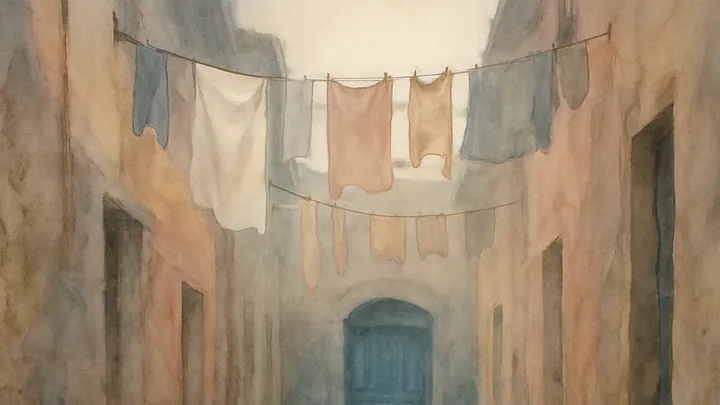
“Out of Fen Street,” he began, “past the tobacconist that used to be there — you’d turn left where the pavement dipped. There was a passage behind the greengrocer’s where they kept the crates. You’d go through it, and come out on a small square with a fountain that didn’t work. Left again, past the piano teacher’s window — you could always hear scales — and then down a lane with laundry above it. My mother’s door was blue. There was a mat that said Please Wipe, though it never made anyone.”
Odile wrote as he spoke. She didn’t mean to. Her hand moved before she’d decided to move it, sketching not the streets themselves but the shape of them, the rhythm — a dipped pavement, a fountain, a lane of hanging linen. When he finished, she had a rough diagram on the paper, and something in her chest that felt like recognition, though she had never walked such a route in her life.
“I don’t know if this exists,” she said quietly.
“It did.”
“That’s not the same thing.”
“Isn’t it?”
What the Alleys Remember
He left her his address — a boarding house on the north side — and said he would come back next Tuesday, if she had anything for him. If she didn’t, he would understand. He put his hat on at the door and paused.
“What made you begin?” he asked. “The Tuesday alleys.”
Odile considered lying. She usually did. But something about him made lying feel wasteful.
“I got lost once,” she said. “When I was twenty. I turned down a street that shouldn’t have been there, and I came out four hours later in a part of the city I’d never seen. I’ve been trying to find it again ever since.”
“And?”
“I haven’t. But I’ve found others.”
He nodded, as if this confirmed something. Then he was gone, and the bell above the door rang once, apologetic, and Odile sat alone with a diagram of a route she had never taken to a house that no longer existed.
She went walking that afternoon.
She started from Fen Street. The tobacconist was long gone; in its place was a shop that sold second-hand telephones, which struck her as sad in a way she couldn’t name. But the pavement did dip, just there, and behind what was now a florist there was a narrow passage she had never noticed. She turned into it.
The light did the thing it did on Tuesdays — that particular hesitation, as if the day were holding its breath. Odile walked. She came out into a small square. There was no fountain, only the round stone base of one, weathered smooth. Someone had planted marigolds in the basin.
She turned left. Somewhere above her, faintly, she could hear scales — up, and down, and up again — though she could see no piano, no teacher, no window that might contain either. The lane beyond was hung with laundry that could not possibly still be drying at this hour.
At the end of the lane was a blue door.
Odile stood in front of it for a long time. She did not knock. She was not sure the door would still be there if she did, and she was not sure it would matter. She took out her notebook and drew what she saw: the door, the mat, the number above the lintel that she could just make out — 17. She drew the lane, the invisible piano, the marigold fountain. She annotated in her small cramped hand: Tuesdays only. Belongs to someone.
Then she walked back the way she had come, and the passage behind the florist was gone, and she came out onto a street she didn’t recognise, and then one she did, and then home.
The following Tuesday, the man returned. She gave him the map.
He looked at it for a long time. His hands shook, very slightly, but he did not cry, which Odile respected. He asked her what she wanted to be paid. She told him nothing; she had drawn it for herself, really, and he had only asked first.
He folded the map into his coat pocket, next to his heart, which was where people put maps when they meant to use them.
“Will it still be there?” he asked. “When I go?”
Odile thought about it. She thought about the marigolds, and the scales, and the way the light had hesitated.
“It’s Tuesday,” she said. “That’s usually enough.”