The Understudy Cellist of the Sunday Orchestra
For six years Mira has warmed the cello no one calls on. When a snowstorm strands the principal, she discovers what a lifetime of second chair has taught her.
Drafted with AI and published automatically. Our editors set the standards and fix reported errors — how we work.
The snow had been falling since Thursday, and by Sunday morning it had eaten the city whole. Mira Aldren stood at her kitchen window with a mug of tea gone cold in her hands, watching a lone plow scrape a losing battle down Barrow Street, and she thought — as she often did on concert days — that she would not be needed.
She had been the understudy cellist of the Sunday Orchestra for six years. Six years of arriving forty minutes early. Six years of tuning in the green room while the principal, Yosun Vale, held court in the corridor telling stories about Prague. Six years of sitting in the second row of the cello section during rehearsal and then, on performance nights, watching from the wings in a plain black dress that no one photographed.
The phone rang at ten past nine.
“Mira.” It was Devon, the orchestra manager, and his voice had the particular flatness of a man calculating disasters. “Yosun’s train is stuck outside Halston. They’re saying six hours, maybe eight. You’re on.”
She set the mug down very carefully, as though a sudden movement might spill the morning.
“The Elgar,” she said.
“The Elgar,” Devon agreed. “Concerto and all. Can you?”
What she wanted to say was: I have been able to for six years. What she said was, “Yes.”
The concert hall in winter smelled of radiator dust and old varnish. Mira arrived with her cello strapped to her back like a second spine, snow melting off her coat and pooling on the marble. In the green room, the other players looked at her the way people look at a substitute teacher: kindly, warily, already forgiving mistakes she hadn’t made yet.
“You’ve got this,” said Petra, the second violinist, who was too generous to be believed. “You know the piece.”
“I know the piece,” Mira echoed, and it came out sounding like a prayer.
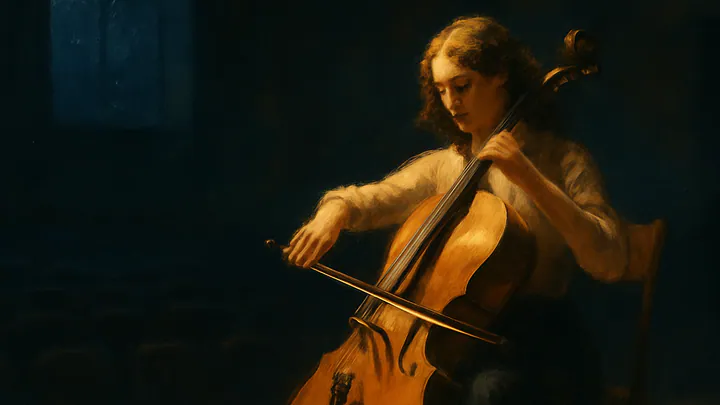
She unpacked the cello. Its wood was warm from being carried close against her back, and when she drew the bow across the C string to test it, the note filled the room in a low, patient way, like a dog settling by a fire. She had bought this instrument at twenty-two with money her grandmother had left her. It was not a famous cello. It had no name, no provenance, no plaque. It was hers, and it had never once refused her.
Devon poked his head in. “House is thin — snow. Maybe two hundred. Conductor wants a word.”
Maestro Ellery was a small woman with iron hair and the calm of someone who had been surprised too many times to be surprised again. She took Mira’s hands in her own — a gesture so unexpected that Mira nearly pulled away — and said, “Play it like you’ve been waiting.”
“Waiting for what?”
“For this. For any of it. You’ll know.”
The Concerto
The stage lights were warmer than she remembered from rehearsals. From the wings the hall had always looked like a black cave with distant stars; from the soloist’s chair it looked like a room full of held breath. She could see faces. A man in the third row with a scarf still around his neck. A woman with a child on her lap, the child staring at the cello as if it were an animal that might speak.
Maestro Ellery raised the baton.
The Elgar begins with the cello alone — four chords, unaccompanied, a door being opened in an empty house. Mira had played those chords ten thousand times in her apartment, into the wall she shared with a retired accountant who once told her, through the plaster, that her practicing was the best thing about being widowed. She played them now.
The first chord came out too quiet. She heard it and did not panic. The second she let bloom. By the third, something in her chest that had been folded for six years began, slowly, to unfold.
She had thought, all those years in the second chair, that being the understudy was a kind of pause. A held note. A waiting. She had been wrong. Every rehearsal, every wing-watch, every silent night mouthing the phrasing while Yosun took the bows — those had not been waiting. They had been listening. She had listened her way into a musician she did not know she was becoming.
The orchestra came in behind her like a tide meeting a river, and Mira did not fight it and did not lead it. She joined it. In the second movement she found a passage she had always disagreed with Yosun about — a phrase Yosun took briskly, almost businesslike — and she let it slow, let it ache, let it remember something. The first violin glanced across at her, startled and then delighted, and adjusted.
She was not showing off. She had nothing to prove and no one to prove it to. Yosun was on a train outside Halston. The hall was half empty. The snow was still falling. There was only the cello and her hands and the door she had finally, after six years, walked through.
When the last chord faded — the long, low farewell of the fourth movement, a sound like a lamp being turned down in a room where someone is finally asleep — Mira kept her bow on the string a beat longer than she needed to, because she did not want to be the one to end it.
Then she lifted it.
The silence that followed was the kind she had heard only twice before in her life: once when her grandmother died, and once in a forest at dusk when a deer had walked out of the trees and looked at her. It was not empty. It was full of something that had not yet decided how to move.
The applause, when it came, was not a wave. It was a room of people remembering, one by one, that they had bodies and hands.
Backstage, Petra was crying without embarrassment. Maestro Ellery said only, “There,” as if confirming a suspicion. Devon was already on the phone, though Mira could not tell to whom.
She packed the cello slowly. Her hands were shaking, but not in the way she had feared they might shake — not with fright. With use. Like a runner’s legs after a long, honest distance.
Outside, the snow had thinned to a slow, considering fall. She walked home with the cello on her back, and the streetlamps threw her shadow ahead of her, then behind, then ahead again.
She thought about Yosun, stuck on a train, and felt no triumph, only a quiet kinship: two cellists in one city, both, in their different ways, still moving toward the concert.
She thought about the years of second chair, and did not regret them.
At her building she paused before going in. The window on the third floor — the accountant’s — was lit. She lifted a hand, though he could not see her, and climbed the stairs to play, for no one, the first four chords again.