The Cartographer's Daughter Draws the Sea
When Ines inherits her father's unfinished atlas, she discovers a coastline that shouldn't exist — and a small boat waiting where the ink is still wet.

The atlas arrived on a Tuesday, wrapped in brown paper and smelling faintly of pipe smoke, though her father had quit smoking twenty years before he died. Ines sat with it on her kitchen floor for a long time before she cut the twine.
She had expected the atlas. Her father had promised it to her the way other fathers promised houses or watches — casually, over dinner, as though it were nothing. When I go, you get the maps. He said it with a wink each time, tapping the side of his nose, and she had rolled her eyes because he was sixty-two and healthy and would surely outlive her mediocre plants.
He had not outlived them. The plants sat on her windowsill now, faintly accusatory.
The atlas was leather-bound, the color of a wet stone, and heavier than it had any right to be. When she opened it, dust rose in a thin gold curtain. The first page was a map of their old neighborhood, drawn in her father's slanted hand: the bakery on the corner, the alley where she had lost her first tooth, the lamppost he had walked her past every evening. He had labeled the lamppost Ines's North Star, temporary.
She laughed, and then she cried, and then she turned the page.
The Uncharted Page
The atlas was full of places she recognized — the lake where they had camped, the train station where he'd taught her to read the departure board, the hospital where her mother had died and then, decades later, where he had died too. He had drawn the hospital as a small kind building with a garden. She appreciated that.
But near the back, past the maps of cities and countries and one very detailed map of his own vegetable patch, she found a page she did not recognize.
It showed a coastline.
The coastline was unfamiliar — a long curve of shore with three small islands offshore, a lighthouse on the middle one, and a bay shaped like a comma. There were no place names. There was no compass rose. In the corner, in her father's handwriting, was a single line: For when you're ready. The ink is still wet.
Ines touched the page. Her fingertip came away blue.
She sat back on her heels. The ink was still wet. Not smudged, not tacky — wet, as though he had drawn it that morning. She held her finger up to the light and watched the blue slowly fade into her skin like a bruise in reverse.
"All right," she said aloud, to her father, to her plants, to the empty apartment. "All right, you strange man."
She took the atlas to the coast the following Saturday. Not any specific coast — the nearest one, a two-hour train ride and then a bus and then a walk. She didn't know what she was looking for. She only knew that her father had drawn a place, and had said she would be ready, and she was tired of not knowing whether he had been right.
The beach she arrived at looked nothing like the map. It was a working beach, with fishing boats and a snack stand and a woman selling seashells strung on wire. Ines sat on a bench and opened the atlas on her lap. She compared the drawn coastline to the real one. The real one had no islands. It had no comma-shaped bay. It had a great deal of seaweed and a child crying about a dropped ice cream.
"Excuse me," said a voice.
Ines looked up. An old woman stood beside the bench, holding a paper cup of tea in both hands. She was looking at the atlas.
"Where did you get that map?" the woman asked.
"My father drew it."
"Ah," the woman said, as though this explained something. "Is he a patient man?"
"He was."
The woman nodded slowly. She sipped her tea. "The boats leave from the pier at four," she said. "If you're going."
"Going where?"
The woman smiled and walked away, her sandals slapping softly against the boards.
The Boat That Was Waiting
Ines told herself she was not going. She told herself as she bought a coffee. She told herself as she walked toward the pier at three forty-five. She told herself as she stood at the end of the pier at four o'clock and watched a small blue boat drift up to the ladder with no one steering it.
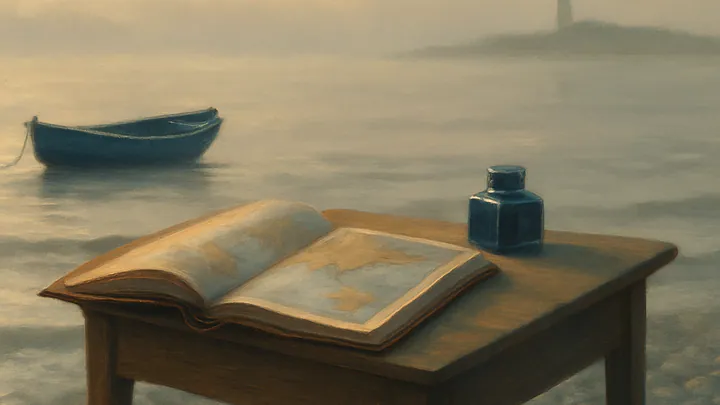
The boat was empty. Its paint was chipped. On the bow, in careful lettering, someone had written a name: Temporary.
Ines laughed once, a sharp sound like a hiccup. Then she climbed down the ladder.
The boat carried her without an engine, without a sail, without any explanation she could give herself later. The shore behind her thinned into a gold line. The sea was quiet and the color of the inside of an oyster. She sat with the atlas open on her knees and watched her father's coastline rise up out of the water ahead — first the three islands, then the lighthouse, then the comma-shaped bay, exactly as he had drawn them.
She landed on a beach of pale gray pebbles. The lighthouse blinked once, in greeting.
There was no one there. Of course there was no one there. She was not a fool. She had not come expecting to find her father waving from the dunes, or her mother laying out a picnic, or any of the small heartbroken hopes she had refused to name on the boat.
What she found was a wooden desk, set on the beach as though someone had just carried it out to catch the light. On the desk was a fresh sheet of paper, a bottle of blue ink, and a pen.
Beside the pen was a note, in her father's handwriting:
You draw the next one. I ran out of pages.
Ines sat down at the desk. The pebbles shifted comfortably under her shoes. She uncapped the ink. She thought for a long time about what a coastline was, and what it meant to draw one, and how her father had spent his whole life making places she could find later.
Then she dipped the pen and began, slowly, to draw a shore of her own — a place with a bakery on the corner and a lamppost labeled North Star, permanent.
The ink stayed wet a long time, waiting to see who she was ready to bring.
Frequently asked questions
What role does the atlas play beyond being an inheritance?
The atlas functions as a language between father and daughter — a way of loving that outlasts speech. Each drawn place is a small, private monument, and passing the pen forward suggests grief eventually asks us to become mapmakers ourselves.
Why does the father label the lamppost 'temporary' and the daughter later label hers 'permanent'?
The father lived knowing everything was passing, and named it honestly. His daughter, further along in her grief, chooses to insist on permanence — not as denial, but as an act of authorship. Both labels are true in different seasons of loss.
How does the story use magical realism without tipping into full fantasy?
The strangeness is domestic and quiet: wet ink, an empty boat, a coastline that matches. Nothing is explained, and the narrator does not marvel too loudly. This restraint lets the magic feel like an extension of grief rather than an escape from it.
What does the ending suggest about who Ines might draw next?
The open ink invites but does not command. She could draw her father, her mother, or a stranger not yet met. The story trusts the reader to sit with that possibility, honoring the private nature of what we choose to summon when we're finally ready.