The Seed Librarian of the High Valley
In a windswept mountain town, a quiet woman keeps a library where books are replaced by seeds — until a stranger arrives asking for one that should not exist.
Drafted with AI and published automatically. Our editors set the standards and fix reported errors — how we work.
The first frost came on a Tuesday, and by Wednesday the stranger was at the door of the seed library asking for something that did not exist.
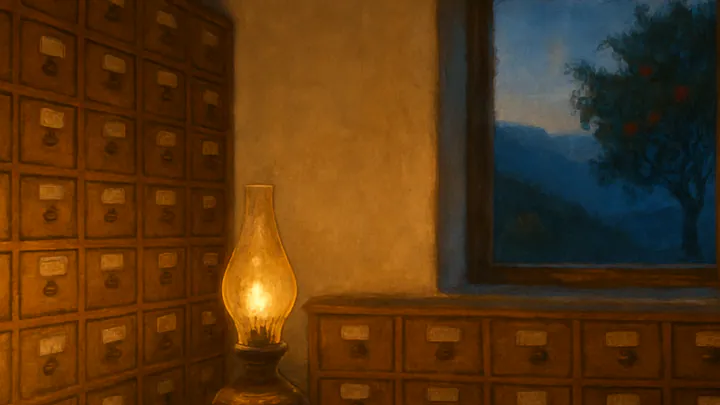
Ines had been alphabetizing envelopes — amaranth, anise, apple (crab) — when the brass bell over the lintel gave its small, embarrassed cough. The library occupied what had once been a goat shed, white-washed inside, ceilinged with pine. Where other libraries held books, hers held drawers. Three hundred and forty of them, each labeled in her grandmother's slanting hand, each holding paper packets the size of playing cards. Inside the packets: seeds. Bean, gourd, marigold, tobacco, three kinds of bitter chicory that nobody planted anymore but which Ines kept alive on principle.
The stranger was tall and travel-worn in the way of people who have crossed a pass on foot. His coat was good wool gone shabby at the cuffs. He carried no pack, which was odd, and no walking stick, which was odder.
"You're the seed librarian," he said. Not a question.
"I'm the only one in the valley who'll admit to it." She closed the drawer. "You can borrow a packet if you sign the book. Plant what you take. Bring back twice what you borrowed, dried and labeled, by the next autumn. That's the whole of it."
"And if I can't bring it back?"
"Then you'll have to send a letter explaining why, and I'll decide whether to lend to you again."
He almost smiled. The almost was the most interesting thing about him. "I'm looking for blue wheat," he said.
Ines did not answer immediately. Outside, a magpie was working through the apple tree, scolding nothing in particular. She let it scold.
"There's no such thing," she said at last.
"There was."
"Then there was. There isn't now."
"I think you have it."
She studied him. He had the patient stillness of a man used to being doubted. His hands, resting at his sides, were callused along the knuckles in a way she recognized: a thresher's hands, a winnower's hands. Not a thief's.
"Sit down," she said. "I'll make tea. If you've come up the pass on foot you've earned tea whether I lend to you or not."
The Drawer Without a Label
The tea was rosehip and a little mint, and they drank it at the small table by the window where Ines did her cataloguing. The stranger gave his name as Marko and offered no surname, which she did not press. People in the high valley had been known to arrive without surnames and leave without forwarding addresses. The mountains accommodated this.
"My grandmother grew it," he said. "She said her grandmother carried it across the Karavanke in the lining of a child's coat. Blue as a bruise, she said. Made a flour you could only use for festival bread because it stained your hands for a week."
"I've heard the story."
"Then you know it."
"I know of it. That isn't the same."
But she was lying, and she suspected he knew. There was a drawer at the bottom of the eastern cabinet that had no label. Her grandmother had told her, the year before she died, never to lend from it without thinking three nights first. Ines had opened it exactly twice in twenty-two years. Once to confirm the packets were still dry. Once to add a sachet of lavender against weevils. She had not opened it to take anything out.
"Why now?" she asked. "Why come looking now?"
Marko set his cup down. "My mother is dying," he said, without drama. "She's asked for the festival bread. The real one. I've tried to bake it with rye, with spelt, with a blue corn from down south that turns grey when you grind it. She tastes it and she's polite. She's always polite. But it isn't the bread."
"And if I don't have what you want?"
"Then I'll have failed her, and I'll go home and bake her something else, and we'll both pretend it was enough." He looked up. His eyes were the colour of wet slate. "I'm not here to take anything. I'm asking."
Ines turned her cup a quarter turn on its saucer. Then another quarter turn. The magpie in the apple tree gave up its argument and flew off.
What the Rules Were For
The rules of the library were her grandmother's, and Ines had inherited them along with the drawers and the slanted handwriting and the responsibility of not letting anything go extinct on her watch. The rules were not unkind. They were only careful. Plant what you take. Bring back twice. If you cannot, write and explain.
The unwritten rule, the one her grandmother had whispered the year of her dying, was this: some things are kept not to be lent, but to be remembered. Lend those, and you may save them, or you may lose them entirely. You will not know which until afterward.
Ines thought about her mother, who had loved sour cherries and had not lived to see the orchard fruit again. She thought about the bread her own grandmother had made, which she remembered mostly as a colour and a warmth, and not at all as a taste. She thought about Marko's mother, whom she had never met, sitting somewhere down a valley she had never visited, being polite about grey bread.
She stood up.
The drawer without a label opened with a small reluctant sound, as if it had grown comfortable being closed. Inside lay seven paper packets, each no bigger than a sparrow's wing. She took one. She closed the drawer. She came back to the table and laid the packet between them.
"You'll plant half," she said. "You'll keep half against a bad year. You'll bring back four times what you borrow, not twice, because this drawer is different."
"I'll bring back six."
"Four is enough. Six is showing off." She almost smiled too. "And you'll write to me, in spring, whether it sprouts. Whether it doesn't. Whether your mother tastes the bread before she goes. All of it. I want all of it."
He took the packet with both hands, the way one takes a small bird from a child. "I will."
"Sign the book."
He signed. Marko, of the lower valley, for blue wheat, one packet, autumn. His handwriting was neat and a little tired.
At the door he paused. "Why did you lend it?"
Ines considered. The honest answer was that she was sixty-one and had no daughter and had begun, lately, to suspect that keeping a thing safe and keeping a thing alive were not the same project. But that was a long answer, and the light was going.
"Because you asked," she said. "And because you knew to ask politely."
He nodded once, and went out into the blue dusk, and the bell over the lintel coughed again, and Ines stood for a long time at the window watching him grow small against the road.
Then she went back to her drawers and resumed alphabetizing, because the work of remembering does not stop just because someone has taken a little of it away with them, in a paper packet, down the mountain, toward a kitchen she would never see.