The Ice Cutter's Apprentice at Loon Lake
In a village where winter is harvested and stored like grain, a reluctant apprentice discovers that the shape of the ice remembers everything the summer forgot.

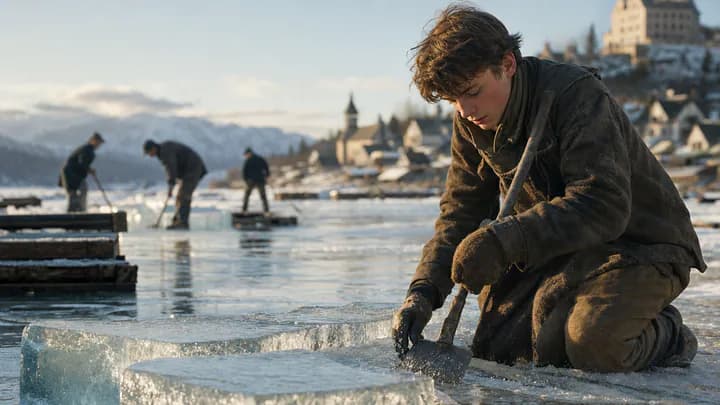
The lake groaned like a great animal turning in its sleep, and Wick was told this was the sound of the ice deciding to let itself be cut. She stood at the edge with her hands stuffed into borrowed mittens, watching old Ozias walk out onto a surface that, three days ago, had drowned a fox.
“Come along, girl,” he called, without turning. “Ice won't wait for your opinion.”
Wick was fifteen and had not asked to be here. Her mother had signed the apprenticeship papers over a bowl of turnip soup and slid them across the table like a losing hand at cards. You'll learn a trade. You'll learn to be still. Wick had never been still in her life. She had shouted at teachers, kissed the wrong boy at the harvest dance, and set fire — small, contained, but a fire — to a shed that had it coming.
So: ice cutting. Six months on Loon Lake with a man who spoke to weather.
She stepped out. The ice held. Of course it held; it was thicker than her father had been tall. But her stomach still tucked itself under her ribs the way it had the first time she'd climbed the church roof.
Ozias had already knelt near a black scar in the surface where yesterday's cut had refrozen thin. He touched it with one bare finger, listened, and shook his head. “Not this one. She's holding a summer in her yet.”
“Holding a what?”
“Move on,” he said, and did.
The First Block
By noon Wick had learned three things. One: the ice saw was longer than she was tall and had teeth like an argument. Two: her breath, in the cold, tasted faintly of iron. Three: Ozias did not explain anything until he had watched you fail at it twice.
The first block she helped free came up gleaming, a coffin-sized cube trailing lake water that steamed as it hit the air. Ozias hooked it with his tongs and set it upright on the sled. He crouched, put his ear against the flat face, and closed his eyes.
“Sing me what you've got,” he murmured.
Wick, who suspected he was cracked in a way winter had made worse, said nothing. But she watched. He listened for a long minute, then nodded and marked the block with a stub of blue chalk. A single letter: M.
“What does that mean?” she asked.
“Means it goes to Merrin's. She'll want this one for the ice room under the inn. Wedding season starts in June. This block remembers a June.”
“Ice doesn't remember.”
Ozias straightened, slowly, the way a man does when his knees have opinions. He looked at her for the first time all morning. His eyes were pale as skimmed milk and not unkind.
“Girl,” he said, “what do you think ice is?”
“Water. Frozen.”
“Water that stood still long enough to pay attention.” He tapped the block. “This lake watched every summer of the last eighty years. Boats. Kissing. A boy who drowned in '62 and the mother who wouldn't come back to shore. It watched, and it froze, and the freezing is a kind of writing. If you know how to read a block, you know what it's carrying. If you know what it's carrying, you know where to send it.”
Wick stared at him. Then at the block. It was, undeniably, a block of ice.
“You're teasing me,” she said.
“I don't tease,” said Ozias. “Ask my late wife.”
Learning to Listen
Winter deepened. The village bought ice the way it bought bread — routinely, without wonder. Merrin the innkeeper took the June blocks and packed them in sawdust beneath her cellar. The doctor took blocks Ozias marked with Q, for quiet, and kept them near the room where he treated fevers. The schoolteacher, of all people, took a block marked L and would not say why, only that her classroom felt easier for a week afterward, as if the children had been read a story none of them could quite recall.
Wick stopped laughing about it in the second week, because she began to hear it too.
Not with her ears. With the flat of her palm, pressed to a fresh block while Ozias watched with the patience of a man who had waited his whole life to be believed. The first thing she heard was so small she thought she'd imagined it: the sound of oars. Then a woman laughing, far away, in a language Wick didn't speak. Then nothing, and then — clearly, absurdly — the smell of cut grass.
She jerked her hand back. Ozias grinned. It was the first time she had seen his teeth.
“There you are,” he said.
“What was that?”
“Somebody's July. 1974, maybe. The lake's fond of that one.”
After that, Wick began to ask for blocks. She would kneel on the ice and place both hands on a candidate before Ozias cut it, and she'd say: this one is angry, or this one is a wedding, or, once, weeping without knowing she'd started, this one is my grandmother, this one is my grandmother's kitchen. Ozias let her cut that block herself, though she was not yet strong enough, and did not correct the crooked line she sawed. He helped her load it onto the sled and walked with her all the way to her mother's door and left it there without a word.
Her mother came out at dusk. She stood on the porch a long time looking at the block, which was already beginning to sweat in the lantern light. Then she sat down on the step beside it and put her forehead against the ice, and Wick, watching from the road, understood for the first time that her mother had been someone's daughter too.
The Thaw
They cut until March, when the lake began to sigh differently and Ozias declared the harvest finished. On the last day he gave Wick a knife with a bone handle and told her it had been his teacher's, and his teacher's teacher's, and that she was to keep it oiled or he would haunt her personally.
“I'm coming back next winter,” she said. It was not a question.
“I know,” he said. “I already told Merrin.”
They stood together at the edge of the lake, which was still solid but no longer certain of itself. Somewhere under their feet, Wick could feel the water thinking about being water again. All the summers it had swallowed were preparing to rise, unread, into the mouths of fish and the roots of reeds and the long slow drift of clouds.
“It seems a waste,” she said, “all the ones we didn't cut.”
Ozias considered this. He had a way of considering that made a question feel honored.
“No,” he said at last. “The lake needs to keep some for herself. Otherwise, come November, she'd have nothing to freeze.”
Wick nodded. She tucked the knife inside her coat, close to her ribs, where it would learn the rhythm of her breathing before winter came around again.
Frequently asked questions
What does the ice symbolize in the story?
The ice functions as a kind of physical memory — a substance that has been still long enough to record what happened around it. It asks us to consider what parts of our own lives freeze into us, unnoticed, and what we choose to carry forward.
Why does Ozias let Wick cut the block that contains her grandmother?
It's a moment of trust and inheritance. He recognizes that some memories can only be released by the person they belong to, and that grief, cut cleanly, becomes something a family can hold together rather than alone.
How does the story treat Wick's earlier troublemaking?
The story refuses to make her past a wound to be healed. Her restlessness isn't cured by the work; it's redirected into attention. Stillness, in Ozias's teaching, isn't the opposite of fire — it's a different way of paying attention to heat.
What do you make of the final image of the lake keeping some summers for herself?
It reframes the whole apprenticeship. The work isn't extraction but partnership. There's a quiet argument here about consent, ecology, and the wisdom of leaving some things unread — even, or especially, when we could read them.