The Last Piece Is Always the Sky
Frankie's mother entered the Bramblewick Open thirty-one times and never won. When Frankie takes her place at the jigsaw championship, the only partner left is the rival who always beat her.

My mother entered the Bramblewick Open thirty-one times and never once won it, and she never once blamed the puzzle.
"The puzzle is innocent," she used to say, tipping a thousand pieces onto the kitchen table with the solemnity of a woman pouring communion wine. "The puzzle did not ask to be cut up. Everything that goes wrong in that hall is people."
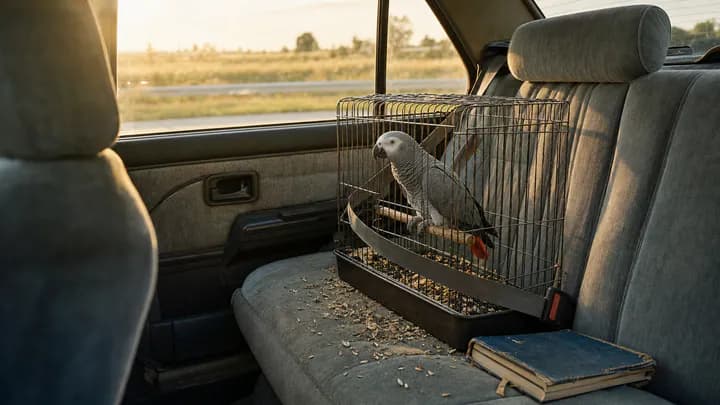
Eighteen months after we buried her, I drove out to the Bramblewick Leisure Centre with her sorting trays in a bag-for-life on the passenger seat, and the first thing that hit me when the doors hissed open was chlorine. The pool is next door. The whole championship smells faintly of somebody else's swimming lesson. I had forgotten that. I had forgotten how the lino squeaked, and how they ran the tables in six long rows under lights that buzzed at a pitch just low enough to pretend you couldn't hear it.
At the registration desk, a man with a lanyard and a biro behind each ear found my name before I gave it.
"Odell," he said. "Pairs. Paid in advance."
"That's not — " I stopped. My mother had paid the following year's entry the previous autumn, the way she always did, before she knew there was going to be a problem with the following year. Twenty-two pounds, banked against a future she fully intended to attend. "Right," I said. "Pairs."
"And your partner?"
My mother had been my partner. That was the whole arrangement. I had done it at nineteen and at twenty-four and at thirty, and each time I had complained about the drive.
The man clicked his biro. "We've got one other unattached," he said, and pointed down the hall. "Table fourteen."
Hilde Brannock was eighty-one years old and sat very straight, the way people do when sitting straight has become a decision rather than a habit. Her cardigan was the colour of wet sand. On the table in front of her, squared to the edge like a surveyor's instrument, was a dented tin of butterscotch.
Nineteen wins, that tin had seen. Nineteen, most of them taken off my mother by margins that my mother recited at Christmas the way other families recite grace.
"Frances," Hilde said. Not a question.
"Frankie."
"Your mother called you Frances when she was cross with you and Frankie the rest of the time, so I've heard both." She nudged the tin an inch toward me. "My sister Ann has had her hip done. She is furious about it. Sit down, you're blocking the light."
I sat down. I had come here, if I am honest, to beat this woman. I had come to finish what my mother had spent three decades failing to finish, and here was my mother's rival offering me a butterscotch and telling me to mind the light.
"I'm not as fast as Ann," Hilde said.
"I'm not as fast as anyone."
"Good. Then nobody's disappointed."
At ten o'clock, the marshals walked the rows and laid a sealed black bag at each station. At one minute past, a whistle went, and two hundred people tore plastic at exactly the same moment, and the sound was astonishing — like rain arriving all at once on a tin roof.
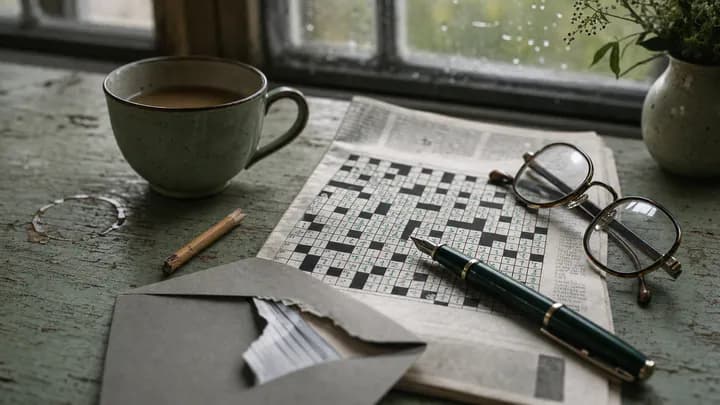
The image was on a card face-down beside the bag. I turned it over. Cottage Under the Milky Way. One thousand pieces. Perhaps three hundred and fifty of them were cottage, hedge, gatepost, and a lit yellow window.
The rest was sky.
Somewhere near the front, a man groaned like he'd been shot.
Two-Two, Three-One
I did what I know how to do. I flipped pieces face-up, edges to the left, and started grouping by colour, which is a fool's errand when six hundred and forty pieces are the same six shades of blue-black with a dusting of stars.
Hilde wasn't sorting by colour. Her hands moved in quick economical scoops, and she was building little colonies: pieces with two tabs and two blanks here, three tabs and one blank there, the rare four-tab oddities in their own small kingdom by the butterscotch tin.
My throat went tight. "That's my mum's method."
"It is," Hilde said, without looking up. "She showed me in 1997. We were both stuck on a wheat field. Terrible thing, a wheat field. She said, Hilde, stop looking at it, the picture's lying to you, look at the shape." She placed two pieces together without appearing to have considered them. "I have won nineteen of these using your mother's method. I would like that on the record."
"She never told me that."
"No. She wouldn't have. Border, please, you're quicker than me at borders."
We had the frame closed at twenty-two minutes. The cottage came up out of the chaos like something surfacing, window first, then the door, then the crooked line of the hedge. My shoulders burned. Hilde ate butterscotch at a rate I found frankly heroic and said almost nothing for an hour, and then, somewhere in the long blue nothing of the third quadrant, she said:
"Nineteen-oh-nine, we'd call it. Two thousand and nine. Do you know about that one?"
"She said she lost by six minutes."
"She lost by six minutes," Hilde agreed, "because she spent eleven of them on the floor. A piece of mine went over the edge in the scrum at the start. Went under table eleven, under table nine, ended up by the fire door. Margaret saw it go. She could have let it lie. Nobody would have known, and I would have finished with nine hundred and ninety-nine pieces and a marshal writing incomplete in his little book." Hilde turned a piece a quarter-turn and pressed it home. "Instead she crawled three tables on her knees in a skirt and put it in my hand and went back and lost."
The buzz of the lights got very loud.
"She never told me that either."
"She wouldn't." Hilde finally looked at me, and her eyes were a pale, unsentimental grey. "She thought it was an ordinary thing to do. That's what I couldn't forgive her for. Nineteen trophies on my shelf and one of them isn't mine, and the woman responsible thought it was ordinary."
I put my head down and sorted sky.
At two hours and forty minutes, the hall began to go quiet in patches, the way a fireworks crowd does. Table six — two lads from the college, seventeen if they were a day, unbearably quick — had their last corner filling in.
We had sixty pieces left. Then thirty. My hands were shaking, which is the worst possible thing for a jigsaw and the most human. Hilde's weren't. Hilde's hands went down like a heron's beak, once, twice, no wasted travel, and I understood for the first time in my life exactly what my mother had been up against, and exactly why she had kept coming back.
Eleven pieces. Six. Table six's marshal raised his arm, and then lowered it, because one of the lads had a gap by the horizon and was patting his pockets like a man who'd lost his keys.
Two pieces. One.
Hilde picked up the last piece of sky — a plain three-one, a smear of blue-black with a single star at the edge of it — and instead of placing it, she slid it across the table to me.
"Frances," she said. "It's hers."
The hall smelled of chlorine. My mother had paid twenty-two pounds for a day she never got to attend, and somewhere in a box in my spare room there was a tray of trophies that were all second place, polished to within an inch of their lives.
I put the last piece of the sky into the last hole in the world, and it went in soft, the way good ones do, and I did not hear the whistle at all.
Frequently asked questions
Why does Margaret's rule — "the puzzle is innocent" — matter so much to the story?
It reframes losing as something that happens without malice, which is exactly what Frankie cannot yet believe about her mother's death. By the end, Frankie has stopped looking for someone to blame and simply plays the game in front of her.
Is Hilde a rival, a substitute mother, or something else?
She is a witness. Hilde is the only person left who watched Margaret at her most stubborn and most decent, and grief often needs a witness more than it needs comfort.
What is the significance of the 2009 story about the returned piece?
It shows that Margaret's most important victory was one that cost her the trophy, and it quietly explains why Hilde has carried her rival's memory for fifteen years.
Why does the story end on the placing of a single sky piece rather than on the result?
Because the result was never the point. The last piece is the moment Frankie accepts something handed to her, which is the one thing she has refused to do since the funeral.