The Detective Who Interviewed Houses
Inspector Rhea Delmar solves cases nobody reports by asking empty houses what they remember. But one bungalow on Ferngate Lane refuses to speak.
Drafted with AI. This version has not been reviewed by an editor, so it is kept out of search results and carries no ads — how we work.
Inspector Rhea Delmar had a business card that read Consultant, Residential Interviews, and no one who called her ever asked what that meant. They already knew. A house had gone quiet on them, or too loud, or had begun rearranging its own small objects in the night — a teaspoon migrating from drawer to windowsill, a photograph turning its face to the wall — and they wanted a professional to sit down with the building and get to the bottom of it.
Rhea charged a modest fee and brought her own tea.
She had learned the work from her aunt, who had learned it from a woman in a coastal village who claimed houses were simply slow animals with excellent memories. The trick, her aunt said, was not to interrogate. Houses resented being interrogated. You sat in the main room, you drank something warm, you asked polite, open questions, and you waited. Sometimes the answer came as a draft. Sometimes as a creak in a specific floorboard. Once, memorably, as a music box that had not worked in forty years playing three notes of a lullaby before falling silent again.
The bungalow on Ferngate Lane was different.
The Silent House
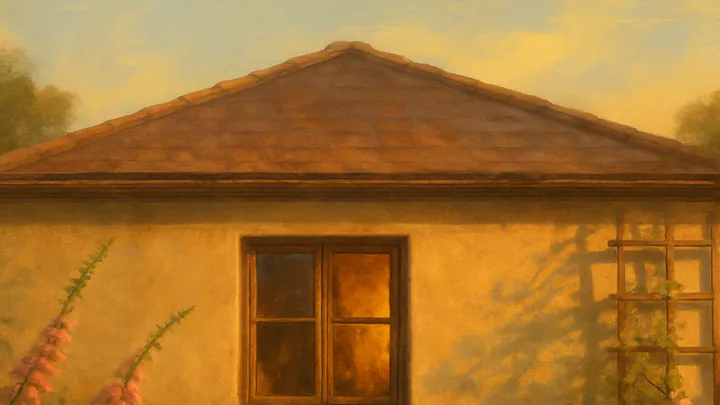
It was a low, sand-colored cottage with a green door and a garden that had gone to seed in a dignified way, foxgloves leaning against the porch rail like tired guests. The new owner, a soft-spoken man named Aldous Pell, met Rhea at the gate. He had bought the place three months ago and had not, he confessed, slept a full night since.
“It isn’t frightening,” he said quickly. “That’s the strange part. It’s just… waiting. As though it’s holding its breath for someone.”
“And you’ve tried talking to it?”
“I feel foolish saying it aloud. Yes. Every night. Nothing.”
Rhea nodded. She had brought her tin of smoky black tea and a small ceramic pot she trusted. “May I have a few hours alone with it?”
Aldous handed her the key and walked to the pub at the corner, looking relieved and slightly embarrassed, as people often did.
Inside, the bungalow was tidier than Rhea expected. Aldous had painted the walls a pale butter yellow and hung his own watercolors, unassuming studies of pears and teapots. The floors were original — narrow oak boards, dark at the edges. Rhea set her pot to steep on the kitchen counter and walked slowly through each room, letting her palm rest on doorframes, on the mantel, on the cool porcelain lip of the bathroom sink. She was not looking for cold spots. She was introducing herself.
Back in the sitting room, she poured her tea, took the armchair by the window, and said, in the voice she used for skittish cats and grieving widows, “Hello. My name is Rhea. I’m told you’ve been waiting for someone. Would you like to tell me about them?”
She waited. The clock in the hall ticked. A car passed on Ferngate Lane. A moth, disturbed from somewhere behind the curtains, blundered toward the lampshade and then away.
Nothing.
She tried again, softer. “I’m not here to move you along. I’m only here to listen.”
The house did not creak. The teaspoons stayed in the drawer. The photograph over the mantel — a black-and-white portrait of a young woman with a serious mouth, left by the previous owners and never claimed — remained facing forward, unmoved.
For two hours, Rhea sat with her tea and asked her gentle questions, and for two hours the bungalow said absolutely nothing. This had never happened to her before. Even the most reticent houses eventually offered something — a sigh in the pipes, a warmth against the shin. Ferngate was not sulking. It was not hiding. It was simply, profoundly, empty of the small pulse she had learned to feel under her palm.
What the Garden Knew
She went outside to think.
The garden smelled of crushed thyme and late sun. Rhea walked its narrow paths, past the leaning foxgloves, past a birdbath dry with pollen, to a low stone bench at the back wall. She sat, and she felt it immediately — the small, patient pulse she’d been searching for indoors. It was here, in the garden. Under her feet. Along the wall. In the trellis where a rose had climbed and given up.
“Oh,” Rhea said softly. “Oh, I’m sorry. I was looking in the wrong place.”
She set her palm flat on the stone bench. The pulse steadied under her hand, shy, grateful, and a little tired, like a dog that had waited on the porch too long.
She stayed there until Aldous came back, and then she asked him a question she rarely asked her clients: “Do you know if there was ever another building here? Before the bungalow?”
Aldous frowned. “I was told the cottage was built in nineteen-twenty-something. But the deed mentioned a previous structure. A gardener’s hut, I think. Torn down long before.”
“May I see the deed?”
He fetched it. There, in faded copperplate, was a line about a small outbuilding — the potting-house, of stone, situate against the eastern wall — removed in 1919. The eastern wall was where Rhea had sat.
“Your bungalow isn’t haunted,” she said. “It’s only quiet. It’s a very young house, and it hasn’t much to say yet. But there was a small stone building here once, and I think part of it is still awake. Under the garden. Waiting.”
“Waiting for what?”
Rhea considered. In her experience, buildings that outlived themselves waited for the same things people did. To be remembered. To be useful. To hear their own name spoken kindly.
“For someone to notice it,” she said. “And perhaps for something to grow again where it stood.”
A Small Restoration
Aldous, to his credit, did not laugh. He was, Rhea realized, a man who had bought a bungalow with foxgloves in the garden because he wanted a life quiet enough to notice things. Within a week he had cleared the eastern wall, set out a low bench of reclaimed stone, and planted a young climbing rose against the trellis. He wrote to Rhea to say he had started keeping his watercolor paints out there, in a little zinc box, and that on warm evenings he sat and painted the wall itself, its shadows, its lichen.
He also mentioned, almost as an aside, that the bungalow had begun to speak. Not much. A companionable settle in the joists at night. The kitchen tap warming a beat faster in the morning. The photograph above the mantel had, one Tuesday, turned itself gently toward the garden window, as though it wanted a better view.
“I think,” Aldous wrote, “the cottage was only waiting for the older one to be at peace. Now that the potting-house has its rose, the bungalow feels free to be itself.”
Rhea read the letter twice, smiling, and filed it in the drawer where she kept her aunt’s old notes.
That evening, in her own small flat above the greengrocer’s, she set the kettle on and thought about the pulse under the stone bench, patient as breath, and about how many quiet places in the world were only waiting to be sat with. She did not think she would ever run out of work. There were too many houses, and too many gardens, and not nearly enough people willing to bring their own tea and simply listen.
She poured her cup, sat down in the last of the light, and, out of habit, said hello to the walls.
They answered, as they always did, in the small pleased hum of a home being noticed.