The Repair Shop at the End of the Line
When a boy brings a broken toy soldier to the last stop on the tram line, the old repairman must decide what he can fix and what he must finally let go.
Drafted with AI and published automatically. Our editors set the standards and fix reported errors — how we work.
The boy came in on the last tram of the afternoon, holding the soldier by its one good leg. He was small enough that the shop bell rang twice — once for the door, once for the wind he brought in behind him.
I was oiling the escapement of a mantel clock that had been sitting on my bench for eleven days. Eleven days is not long, for a clock. Some of them wait years. The pendulum I'd set aside had a hairline crack I still hadn't decided how to answer.
“Are you the fixer?” the boy asked.
“I'm a fixer,” I said. “There are others.”
“Mum said you were the last one.”
I set down the oil. He was maybe seven, maybe eight, with a red scarf wound twice around his neck and a coat too big in the shoulders — the kind of coat a mother buys hoping the child will grow into it before the winter ends. He put the soldier on the counter with both hands, the way you might set down a sleeping cat.
The soldier was tin, painted once in blue and gold, now mostly the grey of old weather. One leg had snapped at the knee. The rifle was bent. The face had been rubbed smooth by a thumb, over years, until it was no face at all — just a pale oval where features used to be.
“My grandad had him,” the boy said. “When he was small like me. Then my dad. Then me.”
“And now he's broken.”
“He fell.”
“They do,” I said.
I picked the soldier up. The tin was thin as a fingernail at the ankles, and the solder that had once joined the knee had gone chalky. Not a repair job, really. A resurrection.
What the shop remembers
My shop sits at the end of the number 14 line, past the reservoir, past the fields that used to be a brickworks. People forget it's here until they need it. Then they remember, and they come with things that aren't quite worth the trip, and they apologise for troubling me, and I tell them, honestly, that trouble is what keeps the kettle warm.
I have been fixing things for forty-one years. Before that my father, in the same room. Before that his uncle, in a different room but with the same tools. There is a jeweller's loupe on my bench that has been used by four pairs of eyes and it still knows what to look for.
What the shop remembers, and what I have learned from it: most things that come in are not really broken. They are tired. They have been asked to be a certain shape for a long time, and the asking has worn them thin. You cannot fix tiredness. You can only offer rest, and sometimes a small brace, and sometimes a new part that is not quite the old part but does the old part's work.
The soldier, though. The soldier was broken.
“Can you?” the boy said.
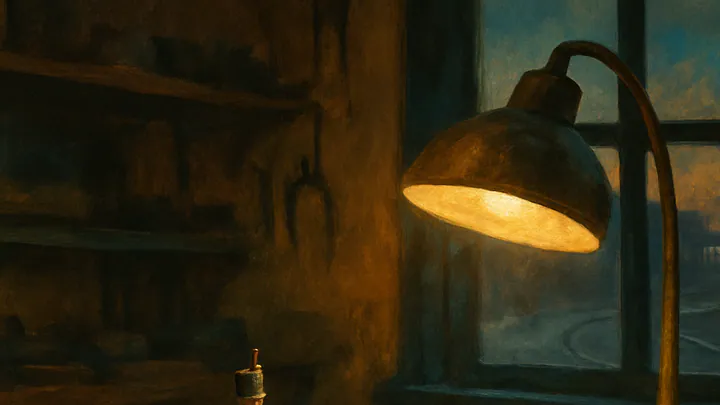
I turned the tin figure under the lamp. The break at the knee was clean, but the metal around it had gone brittle. If I soldered it, the joint would hold — for a while. Six months. A year, if he was gentle. Then it would go again, and go worse, taking more of the leg with it.
I could have told him that. Instead I said, “Where's your grandad?”
He looked at the counter. “He was in hospital. Then he wasn't.”
“Ah.”
“Dad said the soldier was his now. He gave him to me last week. Then I dropped him.”
“You didn't drop him on purpose.”
“No.” His mouth did the thing children's mouths do when they are trying very hard not to be children in front of a stranger. “But I did drop him.”
I put the soldier down between us, on a square of green felt I keep for delicate things. Outside, the tram had gone, and there wouldn't be another for forty minutes. I could hear the reservoir wind moving through the gap under the door.
“Listen,” I said. “I can solder this leg. I'll do it well. And in a year, maybe two, it will break again, and probably it will break where I can't fix it. Do you understand?”
He nodded, slow.
“Or,” I said, “we can do something else.”
“What else?”
I opened the low drawer under the bench, the one my father called the archive and I called the graveyard. Inside were pieces of things — a brass horse's head with no horse, half a music-box comb, the escapement wheel of a clock so old the maker's name had been swallowed by rust. Things I hadn't been able to save but hadn't been able to throw away either.
“We can put him here,” I said. “Somewhere safe. And we can make you a new soldier.”
“A new one isn't him.”
“No,” I said. “It isn't. But you could carry the new one. And you'd know the old one was resting, not in your pocket where he might fall again.”
The boy considered this with the full seriousness of a small person doing large arithmetic. Behind him the mantel clock, my eleven-day patient, made the little pre-tick sound it makes when it is about to try again.
“Would you make him look the same?” he said.
“I couldn't. I don't have that mould. But I have a soldier — here, look — a little different. Green coat instead of blue.”
I fetched it from the shelf. It had been in the shop since before my father died. Nobody had come for it. Nobody, perhaps, ever would have.
The boy took it. He turned it in his fingers. “He's got a face,” he said, surprised.
“Yes. He hasn't been loved yet.”
“Will he mind that I loved the other one first?”
“I think,” I said, “that's the only kind of soldier worth having. One who knows he came second.”
He held the green soldier against his chest, under the coat, where the pocket would be if the coat had been sized for him. Then he looked at the tin figure on the felt — the faceless one, the grandad-one, the one that had been carried through two wars of the small domestic kind: a father lost, a son grown, a boy's careless afternoon.
“Will you keep him here?” he said. “Where it's warm?”
“I'll keep him here. Top drawer. Not the graveyard drawer. The top one.”
“Can I come and see him?”
“The 14 tram runs every forty minutes,” I said. “And I am usually in.”
He paid me with a fifty-pence piece and three coppers, which was, he said, everything he had. I told him it was the exact right amount. He walked out into the blue hour with the green soldier in his coat and his red scarf trailing, and I watched the tram carry him back toward the town, back toward whatever kitchen was waiting with its lamp on.
Then I went to the bench and I did not solder the tin leg. I laid the old soldier in the top drawer, on a bed of felt, next to the loupe my great-uncle had used, next to a spring from a watch my father had loved. I closed the drawer gently.
The mantel clock, on its eleventh day, cleared its throat and began, at last, to keep time.