The Night Switchboard of Halberd Hill
On a hill above a sleeping town, a retired operator answers a switchboard that should not still be ringing. Sometimes the wrong number is exactly the right one.

The switchboard on Halberd Hill had not rung in thirty-one years, which was why Edie Marrow nearly dropped her thermos when it did.
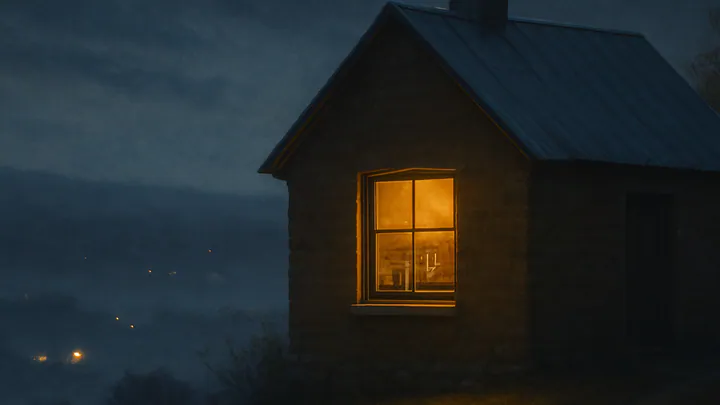
She was eighty-two and had climbed the hill on a dare from no one but herself. The exchange building was a one-room brick cottage with a tin roof, abandoned the year the new digital trunks went in. Edie had been its last operator. She still kept the key on a loop of green ribbon in her coat pocket, the way some women keep a wedding ring after the husband has gone.
That September night she had come up only to sit. The town below was a scatter of porch lights and the slow blink of the grain elevator. The air smelled of cut hay and the iron tang of an approaching frost. She unlocked the door, set her thermos on the bench, and pulled the dust cloth off the board out of habit, the way you might smooth a sleeping child's hair.
Then the lamp above jack 14 lit up. A small, stubborn amber bead.
Edie stared at it. The board had no power. The lines outside had been cut for decades; she had watched the crew coil the copper into the back of a truck and drive it away. And yet there it was, glowing the soft color of a held breath.
She sat down on the operator's stool because her knees decided for her. Then, because her hands knew the work better than her mind did, she lifted the headset, slid the answering cord into jack 14, and said the words she had said a hundred thousand times.
“Halberd Exchange. How may I direct your call?”
There was a long crackle, the sound of weather moving across a long distance. Then a child's voice, careful and bright.
“I need to talk to my grandma, please.”
“All right, sweetheart,” Edie said. Her voice did not shake; she was proud of that. “What’s her name?”
“Margaret Lowell. She lives on Pickerel Street. The yellow house.”
Edie knew the yellow house. She had known Margaret Lowell, too, who had baked apple bars for the church bazaar and died in 1994 of something the doctors could not name in time. Edie did not say this. She slid the calling cord into jack 7, which had once gone to Pickerel Street, and pressed the ring key.
Somewhere, impossibly, a phone rang.
“Hello?” The voice was an old woman’s, warm and a little out of breath.
“Grandma!” the child cried. “Grandma, it’s me, it’s Tomas, I—”
Edie pulled the headset gently away from her ear and set it on the bench, giving them privacy the way she always had. She stared at the amber lamp and felt the hill very quiet around her.
The Long List
The lamps came on one by one after that. Not all at once — the board was kind about it, or perhaps only tired. Jack 22 lit, and a man in his forties asked to speak to his father, who had died on a tractor in 1978. Jack 9, and a woman wanted to apologize to her sister for something she would not say aloud to Edie, only to the sister. Jack 31, a boy who simply wanted to hear his mother sing him the song about the moon and the milk pail.
Edie connected them all. She did not ask how. The board had always been a thing of cords and lamps and listening; the listening, it turned out, was the part that mattered.
Between calls she sipped her cooling tea and watched her own reflection in the dark window. An old woman with her hair pinned up, headset around her neck, smiling without quite knowing it. She thought of her husband Royce, who had passed in the spring. She thought of how she had not cried at the funeral and had been frightened of herself ever since.
Around three in the morning the board went quiet. Edie sat with her hands folded.
Then jack 1 lit. Jack 1 had always been the operator’s own line.
She put the headset on slowly.
“Halberd Exchange,” she said.
“Edie-girl,” Royce said.
She closed her eyes. The hill outside, the cooling tin roof, the smell of dust and bakelite, all of it folded itself small and went away.
“You shouldn’t be working this late,” he said. “You retired, remember?”
“I came up to sit.”
“You came up because the house is too quiet.”
“Yes,” she said.
He was silent for a moment. She could hear him breathing the way he had breathed beside her for fifty-one years, a little whistle on the inhale from an old break in his nose.
“I wanted to tell you,” he said, “that I found my reading glasses. They were in the pocket of the brown coat the whole time.”
Edie laughed. It came out wet and startled. “You drove me crazy looking for those.”
“I know. I’m sorry.”
“Royce.”
“Yes.”
“I didn’t cry. At the service. I couldn’t — I couldn’t find the place where the crying was.”
“Edie-girl,” he said, very gently, “you were the operator. You spent your whole life patching other people through to the ones they were missing. You don’t have to know where your own grief lives. You just have to pick up when it rings.”
She pressed the heel of her hand against her mouth.
“Is it ringing now?” he asked.
“Yes,” she whispered.
“Then sit down with it a while. I’ll wait.”
So she did. She sat on the operator’s stool in the brick cottage on Halberd Hill while the lamp on jack 1 glowed steady and warm, and at last she cried, not loudly, the way she had wanted to all spring. The board hummed faintly under her hands like a cat. Royce did not speak again, but he did not hang up either, and that was the gift.
When the sky went the color of weak tea, the lamps dimmed one by one. Jack 1 was last. It pulsed twice — like a hand squeezed and released — and went dark.
Edie lifted the headset off and laid it on the bench. Her cheeks were stiff with salt. She wiped them with the cuff of her coat and stood up carefully, holding the edge of the board until her knees agreed to the plan.
Outside, the frost had come after all. The grass crunched under her shoes. Below, the town was beginning to wake — a kitchen window glowing yellow, a truck door slamming, somebody’s dog barking at the milk crates.
She locked the cottage behind her and slipped the green ribbon back into her pocket. She did not know if the board would ring again tomorrow night, or in a week, or ever. But she knew she would come up the hill to check.
That, after all, was the job. You sat where the lines came in. You waited. And when something rang, however impossibly, however late, you answered.
Frequently asked questions
What does the switchboard come to represent for Edie?
It becomes a vessel for unfinished conversations — her own and others’. The board externalizes the act of listening that defined her working life and lets her finally apply that skill inward, to her own grief.
Why does the story let Edie cry only when Royce calls?
Her grief required permission from the one person she could not ask. By giving her that permission, the story suggests that mourning sometimes waits not for time but for the right voice on the line.
How does the setting of Halberd Hill shape the tone?
The cold air, tin roof, and sleeping town below create a hush that feels reverent rather than lonely. The hill becomes a threshold space — high enough to be apart from the world, close enough to still serve it.
What do you make of the ending’s open question about whether the board will ring again?
The uncertainty is the point. The story argues that meaning comes from showing up to the post, not from being guaranteed a call. Faithfulness, not outcome, is the quiet heroism on offer.