The Seed Librarian of Marrow Valley
In a valley where every plant grows from a borrowed seed, the town's quiet librarian discovers one envelope nobody remembers returning.

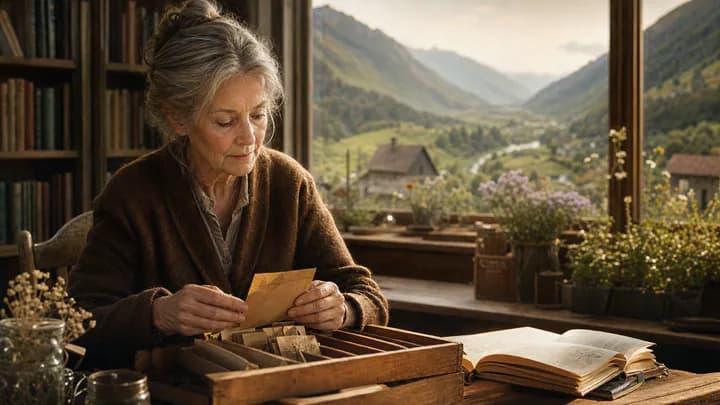
The envelope had no name on it, only a smudge of soil shaped like a thumbprint. Odile found it wedged behind drawer 44-C of the seed cabinet, where the pumpkin varieties slept in paper sleeves labeled in her grandmother's slanting hand.
She was alone in the library, as she preferred to be on Tuesdays. Marrow Valley was a small place, tucked between two hills that leaned toward each other like gossips, and its library was smaller still — one room of books, one room of seeds. People borrowed both. The rule, from the founding charter of 1897, was simple: Return more than you took. A borrowed novel came back with a pressed flower or a note in the margin. A borrowed seed came back as three, saved from the season's best fruit.
Odile turned the envelope in her fingers. It was old — not antique, but old the way a coat becomes old, softened by handling. She held it up to the window. Something rattled inside. Not the papery whisper of a tomato seed. Not the round tumble of a bean. Something denser. Something that sounded almost like a tooth.
She should have logged it. That was procedure. Unknown returns went into the quarantine drawer until identified. But her grandmother had died in this library, in the reading chair by the woodstove, with a seed catalog open on her lap, and Odile had been putting off certain drawers for eleven years.
She slit the envelope with her thumbnail.
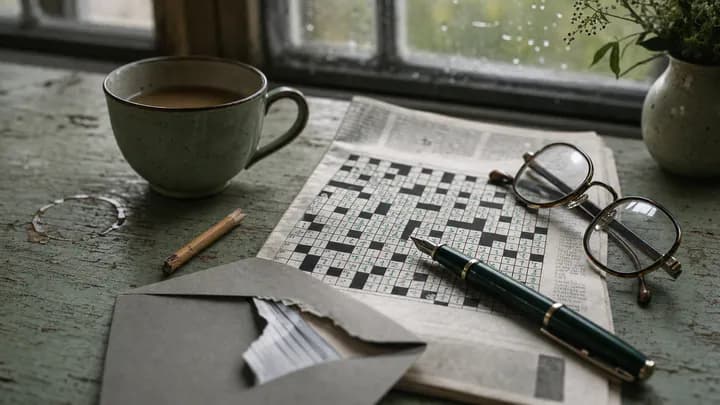
Inside was a single seed the color of river stone, and a slip of paper folded into quarters. The paper read, in her own handwriting: Do not plant until you are ready to remember.
The Ledger
Odile did not remember writing it. She would have remembered. Her handwriting was distinctive — the loops on her lowercase g's fell backwards, a habit her third-grade teacher had tried and failed to correct. This was her hand. It was also unfamiliar, the way a photograph of yourself from before you knew you were being watched is unfamiliar.
She placed the seed on the counter and opened the ledger.
The ledger was a green cloth-bound book that recorded every seed borrowed and returned since 1897. Odile knew it the way a shepherd knows a flock. She flipped to the back, where blank pages waited, then turned forward, and forward, searching for any entry marked Unknown or Unlabeled.
She found it on page 312. September 14th, eighteen years ago. The borrower's name had been erased — not crossed out, but scrubbed away, leaving only a pale rectangle where letters had lived. In the return column, someone had written, in pencil that had nearly faded to nothing: Pending.
Odile had been twenty that September. She had been away at agricultural college in the city, learning about hybrid vigor and the mathematics of pollination. She had come home for a weekend. She remembered that weekend the way one remembers a fever — in fragments, most of them warm and none of them precise.
She closed the ledger.
Outside, a truck passed on the valley road, and its sound moved through the library like weather.
She took the seed home.
Her cottage sat at the edge of the community garden, where the borrowed things of Marrow Valley grew in rows the neighbors tended in shifts. In April, the beds would be turned; in May, planted; in October, harvested and cataloged and returned in threefold to the drawers. It was a slow and patient economy, and Odile had spent her entire adult life inside it.
She set the seed on her kitchen table and made tea and did not plant it.
She did this for four days.
On the fifth day, her neighbor Aunt Persh knocked on the door with a jar of pickled beans and the news that the willows down by the creek were early this year. Aunt Persh was eighty-one and had been Odile's grandmother's closest friend, and she saw the seed on the table the way another person might see an open wound.
“Ah,” she said. “So you found it.”
Odile set the tea down carefully.
“You knew about it.”
“I knew your grandmother kept it. I didn't know where.” Aunt Persh sat down without being invited, which was her way. “She said you left it with her. That weekend you came home from the city. She said you cried in the kitchen and asked her to hold it until you could bear it back.”
“Bear what back?”
Aunt Persh looked at her for a long time. Then she said, gently, “What did you love, that autumn, that you thought you had to give up to be a serious person?”
Odile did not answer, because she was already remembering.
The Planting
His name had been Tomas. He had been a musician, or trying to be, and Marrow Valley had not been large enough for him, and she had not been brave enough to leave with him, and she had told herself, at twenty, that a life could be built out of the things you were sensible enough to refuse.
She had not thought of him in years. That was the strange part. She had not thought of him, and yet here he was, a stone-colored seed on her kitchen table, rattling like a tooth.
“What grows from it?” she asked.
Aunt Persh shrugged. “Whatever you're ready to have grow.”
“That's not how seeds work.”
“It's how this seed works. Your grandmother said so, and she was right about most things.”
Odile carried the seed to the garden that evening, when the light was going soft and the valley had begun its long exhale into dusk. She chose a corner nobody had planted in years, near the stone wall where the moss grew thick. She knelt. The earth was cold and giving.
She thought about writing another note to herself, one to be found in another eighteen years, but she had no more instructions to give. She had already been told the only thing that mattered: that remembering was a kind of readiness, and readiness was a kind of return.
She placed the seed in the soil and covered it and pressed her palm flat against the ground.
She did not know what would come up. Perhaps a tree with music in its branches. Perhaps only a weed, ordinary and green. Perhaps nothing at all, and the seed would sleep on, patient as her grandmother had been, patient as the valley itself, waiting for whichever version of her was ready next.
She stood, and brushed the dirt from her knees, and walked home in the last light, and by the time she reached her door she was already composing, in her head, the entry she would write in the ledger in the morning. In the borrower's column she would put her own name. In the returned column, at last, she would write: Yes.
Frequently asked questions
What does the seed itself symbolize in the story?
The seed operates less as an object than as a container for what Odile chose to defer. It embodies the idea that some feelings, unlike memories, do not fade — they simply wait, dormant, until we develop the capacity to hold them.
How does the library's founding rule — 'Return more than you took' — shape the story's emotional logic?
The rule quietly extends beyond horticulture into a moral principle about attention and repair. Odile has been a scrupulous returner of seeds and books but not of feeling, and the story asks what it costs a person to keep one debt outstanding for eighteen years.
Why do you think the author leaves Tomas mostly offstage?
His absence is the point. The story is not about lost love but about the self who did the losing. Bringing Tomas fully onto the page would have redirected the reckoning outward, when the work Odile must do is entirely interior.
What do you make of Odile's decision to plant the seed without knowing what will grow?
It is an act of faith rather than resolution. She isn't reclaiming a lost life; she is agreeing to remain a person who can still be surprised by her own soil. The ambiguity of what emerges honors how genuine change actually feels from the inside.