The Umbrella Repairer of Copper Street
When a young courier brings a broken umbrella to a shop rumored to fix more than fabric, she discovers what her grandmother left tucked inside the ribs.
Drafted with AI and published automatically. Our editors set the standards and fix reported errors — how we work.
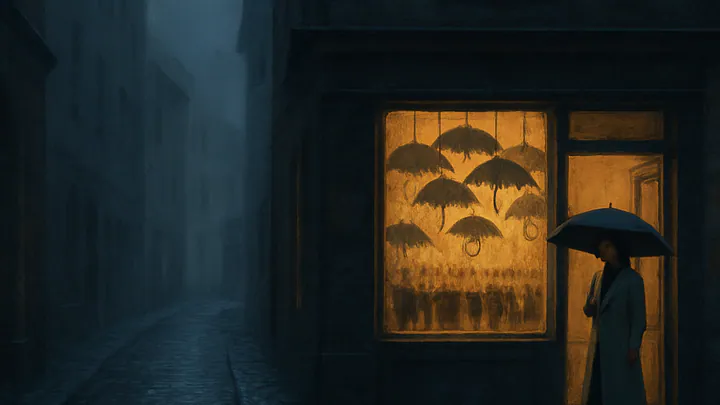
The umbrella came apart in Wren's hands halfway across the bridge, and for a moment she thought she'd broken something that wasn't hers to break. Then she remembered: it was hers now, in the sad, official way that things become yours after a funeral.
Rain hissed against the river below. She stood there with the ribs splayed like a startled bird, the black canopy flapping loose from one strut, and let herself get wet. It seemed the correct tribute. Her grandmother had walked in worse weather without complaint her whole life, delivering hemmed trousers and mended coats to half the neighborhood.
A woman passing in a yellow slicker paused. "Copper Street," she said, pointing with her chin. "Third door past the greengrocer. He'll fix that."
"Fix an umbrella?"
"Fix an umbrella," the woman confirmed, as if Wren had questioned whether water was wet, and walked on.
The Shop
Copper Street was narrower than Wren expected and smelled of wet stone and someone's onions frying. The third door past the greengrocer had no sign, only a small brass hook screwed into the lintel with a folded paper umbrella dangling from it, the kind children make in art class. She pushed the door.
A bell didn't ring. Instead, something tinkled softly overhead — a wind chime made of umbrella tips, she saw, the little metal ferrules strung on fishing line.
The shop was long and narrow and impossibly full. Umbrellas hung from the ceiling in loose constellations: black ones, striped ones, one enormous striped garden parasol tilted like a shipwreck. Bolts of fabric leaned in the corners. A whole wall was pegboard hung with ribs and runners and stretchers and springs, each labeled in a spidery hand.
Behind the counter sat a man with hair the color of wet slate and glasses pushed up onto his forehead. He was doing something intricate with a pair of tweezers and did not look up.
"Set it on the counter," he said. "Gently, please. She's had a long morning."
Wren obeyed. It felt strange to hear the umbrella called she, and stranger still that it felt correct.
The man finished his stitch, tied off the thread, and finally looked at her. His eyes were the mild grey of a well-used pencil. He picked up the umbrella, turned it in his hands, and made a small pleased sound.
"Ah. One of Ilse's."
Wren's throat tightened. "You knew her?"
"Everyone on Copper Street knew Ilse." He said it plainly, without sentiment, which somehow made it hit harder. "She brought her umbrellas here for forty-one years. This one — " he ran a thumb along the shaft " — she bought from me the winter her daughter was born. Would that be your mother?"
Wren nodded, not trusting her voice.
"Mm. Come back Thursday."
"Thursday? That's four days."
"Some repairs take four days." He was already reaching for a small paper tag and a pencil stub. "Name?"
"Wren."
He wrote it without asking her to spell it. "Thursday, Wren. After three. Before six."
Thursday
She almost didn't go. Thursday was a delivery day, and the courier company docked her for anything late, and there was a part of her — a tired, twenty-four-year-old part — that thought perhaps it was better to leave the umbrella broken, a relic in its unrepaired state, than to fetch it back and discover it was just an umbrella after all.
She went anyway. She went because her grandmother would have gone.
The shop smelled of oiled wood and something faintly floral. The repairer had the umbrella laid out on a green felt pad, open, as if sunning itself. It looked new. It looked, in fact, more like itself than it ever had — the black fabric deeper, the ribs quiet and even, the wooden handle polished to the soft shine of a river pebble.
"There she is," he said. "Try her."
Wren picked it up. The catch slid smoothly. The canopy bloomed with a small, satisfied whumpf.
And something fell out.
Not from the fabric, exactly. From the joint where the topmost rib met the shaft, a tiny folded square of paper drifted down and landed on the felt like a moth going to sleep.
Wren looked at the repairer. He was studying his fingernails with sudden interest.
She unfolded the paper. Her grandmother's handwriting — that careful, forward-leaning script that had signed every birthday card of Wren's life — filled the little square in miniature.
For whoever finds this, it read. The trick is not to fear the rain. The trick is to walk anyway, and to notice, along the way, who else is walking. I noticed a great many people. I hope you will too. — I.
Wren stared at it until the words blurred. Then she looked up.
"You knew," she said.
"I suspected." The repairer took his glasses off his forehead and began polishing them on his apron. "Ilse tucked notes into her umbrellas. She thought of them as little boats. She'd say — " he cleared his throat " — she'd say that an umbrella is a portable roof, and every roof ought to shelter a small kindness."
"How many notes did she leave?"
"I couldn't say. Dozens, over the years. She'd bring an umbrella in for a new rib, and I'd find one when I opened her up. I always put them back exactly where they were. It wasn't my business to read them, and it wasn't my business to lose them."
Wren thought of her grandmother walking Copper Street in every weather, delivering not just mended coats but tiny paper boats tucked into the bones of ordinary things. She thought of strangers, years from now, opening umbrellas she had never touched and finding messages from a woman they'd never met.
"How much do I owe you?" she asked.
The repairer named a figure so modest she suspected him of undercharging her out of respect for the dead. She paid it. She folded the note back into its little square and tucked it into her coat pocket, next to her phone.
At the door she turned. "Do you take apprentices?"
He looked at her for a long moment. His pencil-grey eyes did something that might have been a smile, if smiles happened mostly around the eyes.
"I take one," he said. "When the right person asks. Come Monday. Wear something you don't mind getting oil on."
Outside, the rain had thinned to a mist. Wren opened the umbrella — her umbrella now, in the good way, the way things become yours when you understand them — and started home. She walked slowly. She noticed a boy jumping puddles, and a woman closing a shutter, and an old man arguing tenderly with a pigeon.
She noticed a great many people. And under the small portable roof her grandmother had bought the winter her mother was born, Wren felt, for the first time since the funeral, entirely dry.