The Weather Station at Kite Hill
A retired meteorologist discovers his broken barometer is predicting something no instrument should be able to measure. What it forecasts changes everything he thought he knew about his neighbors.
Drafted with AI and published automatically. Our editors set the standards and fix reported errors — how we work.
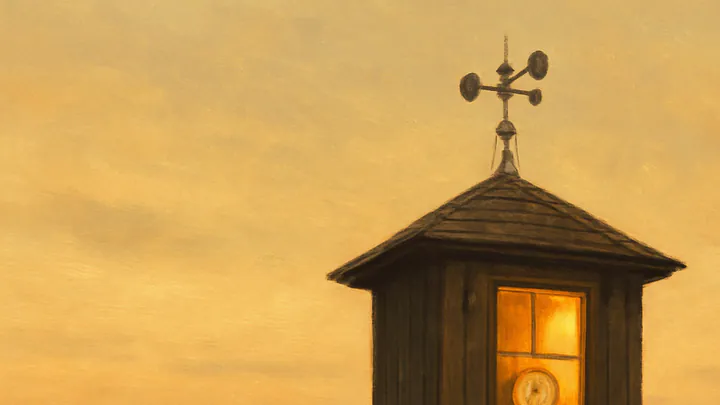
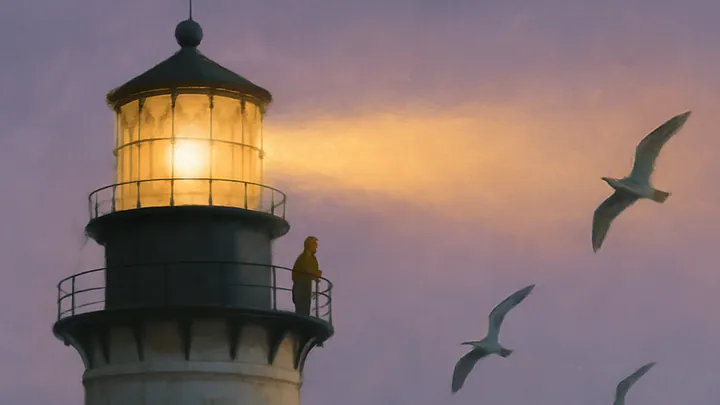
The barometer had been wrong for nine days, and Ivo Perlin was beginning to enjoy it. He stood in his slippers on the back porch of the little wooden weather station at the top of Kite Hill, watching the needle drift toward Stormy under a sky so mild it looked apologetic.
There was no storm coming. He had checked three other stations, two radio broadcasts, and the sky itself, which he trusted most of all. Forty-one years as a district meteorologist had taught him the shape of weather the way a violinist knows the shape of a bow. Today the shape was calm.
And yet: Stormy.
"You're embarrassing yourself," he told the barometer. It did not care. It had been made in 1932 by a man named Halliwell whose signature curled across the brass rim like a small confession. Ivo had inherited it from his predecessor, who had inherited it from hers. It had never been wrong before.
He tapped the glass, gently, the way one might tap a friend's shoulder to check if they were listening. The needle did not move.
The weather station was no longer official. The district had shifted its readings to an automated tower on the ridge six years ago, and Ivo had been offered a small ceremony and a smaller pension. He had accepted the pension and declined the ceremony, and then, because the station was scheduled to be dismantled, he had asked the district if he might keep it running as a hobbyist. They had shrugged. He had taken the shrug as a yes.
Now, most mornings, he opened the shutters, wound the hygrograph, replaced the ink ribbon on the recording drum, and wrote the day's actual weather in a leather notebook nobody would ever read. It was a small kingdom. He was its small king.
On the tenth day of the barometer's error, someone knocked on the station door.
The woman was perhaps sixty, wearing a raincoat over what looked like pajamas. Ivo recognized her from the lane below the hill — the house with the yellow shutters and the two apple trees.
"I'm sorry," she said. "This is going to sound strange."
"I collect strange," said Ivo. "Come in."
She stood in the middle of the small room, dripping slightly though it wasn't raining. "I woke up thinking there was a storm," she said. "Not the sound of one. The feeling. I haven't felt that feeling since — well. A long time. And I thought, the only person who might know about storms that aren't there is you."
Ivo looked at the barometer. The needle sat firmly at Stormy.
"When you say the feeling," he said carefully, "do you mean —"
"My husband died in March," she said. "It felt like this. The air did. I thought I was through it. And then I woke up today and the air was doing it again, and there was nothing outside to explain it."
Ivo did not say anything for a long moment. Then he offered her a cup of tea, which she accepted, and they sat by the window watching a sky that refused to misbehave.
The Second Visitor
Her name was Renata. She left after an hour, seeming lighter, as though naming a thing had loosened its grip on her shoulders. Ivo wrote in his notebook: Day 10. Actual: fair, 14°C, wind SW light. Barometer: Stormy. Human weather: one.
He did not know why he wrote that last line. He underlined it twice.
The next morning a man came up the hill. He worked at the bakery on Ferrer Street; Ivo knew him by his floury forearms. He stood in the doorway and said, without preamble, "Something is wrong and I don't know what it is. I thought maybe — I saw the smoke from your chimney and I thought maybe someone up here would know."
The barometer said Stormy.
The sky said nothing of the kind.
Ivo made another cup of tea.
By the end of the week, seven people had climbed Kite Hill. A schoolteacher whose sister had stopped answering the phone. A boy of nineteen who could not say what was wrong, only that something was. A retired ferry captain who described a pressure behind his eyes he had last felt the year his ship was lost. They came shyly, apologetically, as if aware they were bringing the wrong kind of weather to the wrong kind of station.
Ivo listened. He wrote each visit down in the leather notebook. He did not offer advice — he had never been qualified to give any, and knew it. He offered tea and the small dignity of being taken seriously. Sometimes he showed them the barometer and said, "You see? It knew before I did." They looked at the needle and something in them settled, the way a child settles when told that yes, they had really heard the noise in the hallway.
What Halliwell Knew
On the sixteenth day, Ivo took the barometer down from the wall.
He had never opened it. One did not open a Halliwell — it was like opening a cathedral to see where the singing came from. But he unscrewed the back plate carefully, laying each brass screw on a folded handkerchief.
Inside was the aneroid capsule, the levers, the hairspring — all of it exactly as he'd expected. And tucked behind the movement, wedged there by someone with a steady and secretive hand, a small folded paper.
He unfolded it. The ink was brown with age.
To whoever reads this: the instrument measures more than air. I have not been able to determine what. I have decided this is a feature rather than a fault. — H. Halliwell, 1932.
Ivo laughed once, quietly, and refolded the paper, and put it back exactly where he'd found it. Then he reassembled the barometer and hung it on the wall, and he did not tell anyone what he had read, though he thought about it every morning for the rest of that autumn.
By November, word had spread in the modest way words spread in a small town — not as rumor but as directions. If you're not right, go up Kite Hill. There's a man with a broken barometer. He'll make you tea.
The barometer was not, in fact, broken. It had simply chosen a different job, or been given one, or perhaps had always had it and only now, in the hands of a man with time enough to notice, had begun to do it aloud. Ivo could not say which. He was not a philosopher. He was a meteorologist, retired, with a leather notebook and a kettle and a hill.
On clear days he still wrote down the temperature and the wind. On other days, he wrote down the visitors. Both, he had come to believe, were the weather. Both deserved to be recorded by someone who was paying attention.
And in the corner of the little wooden station, the needle held steady at Stormy, faithfully, kindly, for as long as anyone needed it to.