The Lighthouse Keeper Who Stopped Time
On the night her replacement was meant to arrive, lighthouse keeper Vesna discovered that the lamp could do more than guide ships. It could hold a single minute open like a door.
Drafted with AI and published automatically. Our editors set the standards and fix reported errors — how we work.
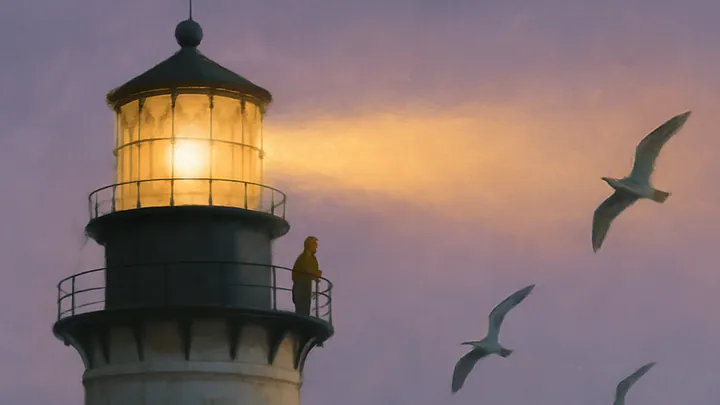
On the night her replacement was meant to arrive, Vesna climbed the ninety-four steps for what she believed would be the last time. The wind off the cape smelled of kelp and iron, and the gulls had already gone quiet, which meant weather.
She set down the thermos, unbuttoned her oilskin, and did what she had done every dusk for forty-one years: she lit the lamp.
The lens above her — a Fresnel beehive the size of a small car — caught the flame and threw it outward in slow, deliberate sweeps. White. White. Red. White. A pattern as familiar to her as her own pulse. She watched the first beam reach across the water and touch the horizon, and she thought, tomorrow this will be someone else's hand on the switch.
That was when the minute stopped.
She did not notice at first. The gulls were already silent; the wind was steady; the beam was mid-sweep. But the second hand on the brass wall clock had paused between fourteen and fifteen, and the steam curling from her thermos had stopped curling. It hung in the air like a question someone had forgotten to finish asking.
Vesna lowered her cup. She looked at the lamp.
The flame inside the lens was burning, but it was not moving. It was a flame held in a photograph. And inside the held flame, she could see — quite clearly, as if through clean glass — a young woman in a green coat standing at the foot of the tower, one hand raised to knock.
I.
The young woman's name, when the minute finally let go of itself a heartbeat later, turned out to be Mira. She came up the stairs cheerfully, apologizing for the ferry, apologizing for the wind, apologizing for being the person who was replacing someone who clearly did not wish to be replaced. She had a duffel bag, a folder of certifications, and the specific brightness of a person who has not yet learned which of her enthusiasms the world will accept.
"I read your logs," Mira said. "All of them. Going back to nineteen-eighty-four. You have beautiful handwriting."
"I have arthritic handwriting," Vesna said. "But thank you."
They drank tea. Mira asked the questions new keepers always ask — about the generator, about the fog signal, about whether the stairs ever got easier. (No.) Vesna answered them all and watched the lamp turn behind the girl's shoulder and tried to decide whether she had imagined the held minute or whether forty-one years of solitude had finally produced a hallucination worth keeping.
She decided to test it.
After Mira went to bed in the small downstairs room, Vesna climbed back up to the lamp. She placed her palm flat against the warm brass housing. She thought, very deliberately, hold this.
The wind stopped. The clock stopped. A moth that had been beating against the glass froze with its wings half-open, fragile as pressed paper. Below, in the keeper's cottage, she could see — by leaning out over the rail — Mira asleep in the narrow bed, one arm flung across her eyes, mid-breath.
Vesna stood inside the held minute and felt the strangest thing: she felt unhurried. For the first time in months, perhaps years, nothing was leaving. Nothing was arriving. The retirement she had been dreading and the girl she had been resenting were both suspended in amber, and she was free, briefly, to decide what she actually thought of them.
What she thought, it turned out, was: let her sleep. She had a long ferry.
Vesna released the minute. The moth resumed its soft thudding. The clock ticked on.
II.
In the morning she did not tell Mira about the lamp. Instead she taught her the log book, the fuel gauges, the trick with the south window that stuck in damp weather. She taught her which gull was the bully and which was only pretending. She taught her how to walk down the spiral stairs without looking, by counting with the hips instead of the eyes.
Mira learned quickly. She was, Vesna admitted to herself by the third day, a good keeper. Perhaps better than Vesna had been at that age — less haunted, more curious. She had questions about the rocks and the tides and the names of small fish, and she wrote the answers down in a notebook with a green cover that matched her coat.
On the fourth evening, the cape gave them weather: a real one, the kind that arrives sideways. They worked the fog signal together for six hours. Mira's hair came loose from its braid and stuck to her forehead. She laughed when a wave threw spray all the way up to the gallery rail, and Vesna found that she was laughing too, which surprised her enough that she stopped.
That night, after the storm settled, Vesna climbed alone to the lamp.
She placed her palm on the brass. She thought, hold this.
The wind paused. The sea paused. Mira, downstairs, paused mid-sip of cocoa.
And Vesna stood inside the minute and understood, finally, what the lamp had been offering her all these years and what she had been too busy to accept. It was not a way to stop time. It was a way to notice it. To take one ordinary minute and walk all the way around it, the way you might walk around a stone in a garden, to see it from every side before setting it back down.
She walked around this one slowly. The frozen spray on the window. The half-smile on the new keeper's face. Her own hand, knotted and capable, resting on warm brass. The forty-one years stacked invisibly behind her like cordwood.
She thought: I have been rich and did not know it.
She released the minute. The cocoa resumed its journey. The wind picked up where it had left off.
III.
On the morning of her departure, Vesna packed slowly. There was less to take than she had expected — a tin of photographs, two sweaters, a sea-glass jar, the brass key to the lamp room, which she would leave on the hook by the door for Mira.
At the bottom of the steps, Mira waited with the duffel and a thermos of fresh tea for the road.
"Will you come back to visit?" Mira asked. She was trying not to sound like she wanted the answer to be yes.
Vesna considered. The ferry horn sounded, distant and patient.
"I'll come back in storms," she said. "You'll want the extra hands."
Mira nodded, relieved, and held out the thermos.
Vesna took it. She looked up, one last time, at the top of the tower, where the lamp slept its daytime sleep. She thought about telling the girl — about the held minute, about the gift inside the brass — and decided, in the end, not to. Mira would find it on her own, or she would not. Either way, the light would keep doing what light does, which is to reach.
She turned toward the ferry.
Behind her, very faintly, she heard the gulls begin to argue about something ordinary, and she walked into the rest of her life with the warm thermos in her hands and a minute, somewhere up in the lamp, still holding open for her like a door she might one day step back through.