Both Parties Must Press the Button
In a transit station slated for renovation, a technician maintains kiosks that release an apology only if the other person offers one back. Most stay locked. His has stayed locked for four years.

The kiosk on Platform Four had been waiting eleven years for somebody's mother to forgive them, and in three weeks the city was going to unplug it. I knew this because I was the one hired to stick the notices on.
They were olive-green, the kiosks, about the height of a parking meter, with a hooded microphone and a screen the size of a playing card. One round glass button. Official name: Mutual Statements Program. Everyone called them sorry boxes.
The rules were printed on a plate that got polished smooth by thumbs. You pressed the button. You said who you were apologizing to. You said your piece. Nothing happened. Your light went amber, and it stayed amber — for a week, a decade, forever — unless the person you named came to any kiosk in the transit network and recorded something for you. Then both lights went green, both messages played, and the city's involvement ended.
Eleven years, one thousand four hundred and twelve locked messages, sixty-one matches. I knew the numbers because it was my job to log them, and because one of the fourteen hundred and twelve was mine.
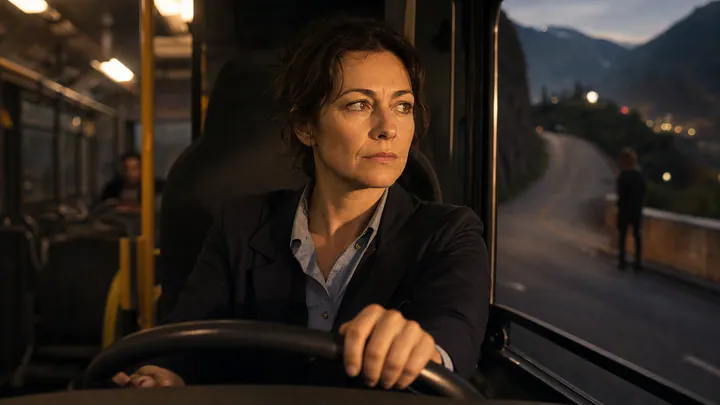
Ruta Milosz came Thursdays, between the 9:14 and the 9:26, with a folded cloth in her handbag to wipe the screen before she touched it. She was seventy-something, small, with a coat that had outlived three winters of fashion.
"Good morning, Desmond," she said. "You are under the machine again."
"Condenser mic. They fog up."
"Everything fogs up." She wiped the screen in two efficient circles, then pressed the button with the pad of her thumb and waited for the little amber eye to confirm that her message was still there, still unaccompanied. Eight years. Her son's name was Aleks. I wasn't supposed to know that either, but a man who spends his days inside these machines learns things he has to pretend not to have learned.
That Thursday I had the notices in my bag: This unit will be decommissioned. Unmatched statements will be permanently deleted. Adhesive corner, city seal, a phone number nobody answered.
Ruta read it twice, the way people read a diagnosis.
"Deleted," she said.
"There's a renovation. The platform's being widened."
"So I will record it again somewhere else."
"There isn't a somewhere else. The whole program's ending. Funding." I hated the word in my mouth. "Sixty-one matches in eleven years. On paper it looks like failure."
She folded the cloth back into quarters. "Then it is a very good machine," she said. "It counts the exact number of people who are still waiting. No machine has ever been so honest."
The 9:26 came in with that smell they have, brake dust and warm coins. She got on. I knelt back down to the condenser mic and didn't fix anything for a while.
My own message is in a kiosk at the Fenwick interchange, second one from the escalator, because four years ago I couldn't bear to say it into a machine I serviced.
Here is what I said, more or less. Tobi. I was supposed to drive Mum to her appointment and I didn't come. I told you my car wouldn't start. My car started fine. I sat in it outside my flat for forty minutes because I could not make myself go into that building again, and you sat with her in that corridor for nine hours by yourself, and then you sat there after. I have never once said that out loud. I'm sorry. Not for the car. For letting you be the only one in the room.
Then the light went amber, and for four years my brother and I sent each other the kind of messages that are about football and nothing.
I could have checked his side. I had an admin key. Every technician did, and every technician knew that using it to look up a personal match status was the fastest way off the contract. But that isn't what stopped me. What stopped me was that amber was survivable, and a hard answer might not be.
Two Thursdays before the shutdown, it happened.
I was up the stepladder with the housing off when the chime went — a soft two-note thing, like a spoon tapped on a jar. I'd heard it four times in my career. Ruta's hand was still on the glass. The light under it had gone green.
"Oh," she said. Just that.
I climbed down and walked twenty feet away and pretended to inventory my bag, because privacy on a public platform is something you have to be given by other people. I heard the tinny speaker anyway. A man's voice, quick, apologetic in the wrong places, the way we all are. I caught the kitchen, and I should have called on your birthday, and I don't know how to start this so I'm just going to say the thing about the kitchen again.
Then her own voice, younger than she was now, because she'd recorded it eight years ago. Then the light went dark, the way it does, having done its one job.
She stood there with her handbag hanging off her wrist.
"He apologized for the kitchen," she said. "Desmond. The kitchen. There was a kitchen, yes, there was shouting in it, but that is not the thing. The thing is the house and the lawyer and what he said about his father." She laughed, and it came apart halfway. "Eight years, and he apologizes for a kitchen."
"Is it enough?"
She thought about that longer than I expected. A train came and went without her.
"It is the wrong apology," she said, "from the right person. Yes. That is enough to begin with." She put the cloth in her bag and looked up at me with her chin set. "He lives forty minutes away. Forty minutes, for eight years. I am going to go and be very rude about the kitchen."
The last day, I pulled the units myself. Unbolt the base, disconnect the loom, lift — they're heavier than they look, all that steel around a small confession. Platform Four's went out at eleven in the morning. By two I'd done the Fenwick interchange except for the second one from the escalator.
I sat on the floor in front of it with the admin key in my palm, thumb over the slot, and the tiled wall breathing warm air at the back of my neck.
Green would mean my brother had come here, sometime in four years, and stood where I was standing, and said my name into a hood. Amber would mean he hadn't. And either way the machine was going into a truck at the end of my shift, and either way it would have told me something about Tobi and nothing whatsoever about me.
I put the key back in my pocket.
Then I pressed the button, waited for the tone, and said: "Delete statement. Confirm. Delete."
The amber eye blinked out. I unbolted the base, coiled the loom, and carried the thing up the escalator on my shoulder like a man carrying a door.
Tobi's town is an hour north. I got the 4:40 with grease on my knuckles and no speech prepared, and I stood on his step in the blue part of the evening with my whole chest going like a struck bell.
I rang the bell and stayed there, amber the entire time, waiting to be let in the ordinary way.
Frequently asked questions
Why does the machine require both people to speak before either message unlocks?
The rule protects the speaker from the humiliation of being unheard, but it also lets everyone postpone the harder act indefinitely. Safety and cowardice share the same architecture here.
What does Ruta mean when she says her son apologized for the wrong thing?
Reconciliation rarely arrives shaped the way we rehearsed it. Her son apologized for a kitchen, not a betrayal — and she discovers that a clumsy, mismatched apology can still be enough to reopen a door.
Is Dez's decision at the end a rejection of the kiosks or a result of them?
Both. Eleven years of amber lights taught him exactly what the machine could never do for him, so the program's last useful act is to send him past it and onto a train.
Why is the amber light such an effective image in the story?
Amber is the color of waiting: not refusal, not welcome, just a message held in suspension. It lets the story render years of silence as a single small glow you can stand in front of.