Rug Size Guide 2026: Pick the Right Rug for Any Room
A room-by-room rug sizing guide with standard dimensions, the 24-inch dining rule, bed layouts, material trade-offs, realistic 2026 costs, and the painter's tape test that stops expensive mistakes.

TL;DR: Most rooms need a bigger rug than people buy. In a living room, put at least the front legs of every seat on the rug. Under a dining table, add 24 inches on all sides. Under a king bed, use 9x12; under a queen, 8x10. Leave 8 to 18 inches of bare floor around the rug's edge.
An area rug is a portable floor covering that defines a zone, softens sound, and sets the color temperature of a room — which means the wrong size undoes all three jobs at once. Our team has watched more decorating budgets wasted on undersized rugs than on any other single purchase, because an 5x8 in a room that needs a 9x12 looks like a bath mat that got lost. This guide gives you the numbers, the exceptions, and a free five-minute test that prevents the mistake entirely.
What size rug do I actually need?
Start from the furniture, not the room. Measure the footprint of the arrangement you want to unify — the sofa plus chairs, or the table plus pulled-out chairs — then choose the closest standard size that covers or slightly exceeds it. Rugs come in a small set of near-universal dimensions, so your real decision is usually between two adjacent sizes.
| Size (feet) | Best for | Notes |
|---|---|---|
| 2x3 / 3x5 | Entry door, sink, bedside | Accent only; too small to anchor furniture |
| 4x6 | Reading nook, small office chair zone | Works under a single armchair and side table |
| 5x8 | Small apartment living room, coffee table zone | Front legs only; often the size people regret |
| 6x9 | Compact seating group, small dining for 4 | Good middle size for condos |
| 8x10 | Medium living room, under a queen bed | The workhorse size in US homes |
| 9x12 | Large living room, king bed, dining for 6 | Most common upsize; price jumps here |
| 10x14 and up | Open-plan great rooms, long dining tables | Often needs custom or broadloom cut-to-size |
| 2.5x8 runner | Hallways, galley kitchens, bedside | Runners also come in 10 and 12 foot lengths |
One border rule ties all of these together: aim to leave roughly 8 to 18 inches of visible floor between the rug edge and the walls. Less than that and the rug reads as wall-to-wall carpet you installed badly. More than about two feet in a normal room and the furniture starts to float.
How do I pick a living room rug size?
Choose the size by how many furniture legs land on the rug. There are three legitimate layouts, and only one of them is a mistake.
- All legs on. Every piece of seating sits fully on the rug. This looks the most deliberate and expensive, and it is the quietest underfoot. It usually requires a 9x12 or larger.
- Front legs on. The front legs of the sofa and chairs rest on the rug, back legs on the floor. This is the best value in most rooms and still visually links the group. An 8x10 covers most standard sofas plus a coffee table.
- Floating. The rug sits under the coffee table only, touching nothing else. This is the version to avoid unless the space is genuinely tiny and the rug is purely decorative.
What about sectionals and open-plan rooms?
For an L-shaped sectional, the rug should reach past the inside corner of the L and extend under the front legs of both runs — otherwise the short leg of the sectional looks orphaned. In open-plan spaces, use rugs as zone markers: one under the seating group and a separate one under the dining table, sized independently, with at least a couple of feet of bare floor between them so they read as two rooms rather than a seam.
Should the rug be wider than the sofa?
Yes. The rug should be at least as wide as the sofa and ideally 6 to 12 inches wider on each side. A rug narrower than the sofa it sits in front of is the most visible sizing error in a photograph, and it is instantly obvious in person too.
What size rug goes under a dining table?
Add 24 inches to every side of the tabletop, minimum. That margin is not decorative — it is the distance a chair travels backward when someone stands up. If the back legs drop off the rug edge mid-pull, the chair catches, the rug creeps, and the corner curls within a month.
| Table | Approximate top | Rug size |
|---|---|---|
| Round, seats 4 | 48 in diameter | 8 ft round or 8x8 |
| Rectangular, seats 4–6 | 60 x 36 in | 8x10 |
| Rectangular, seats 6–8 | 72 x 40 in | 9x12 |
| Rectangular, seats 8–10 | 96 x 42 in | 10x14 |
If your chairs are heavy, armed, or upholstered, push the clearance to 30 or 36 inches. And choose a flatweave or low-pile construction here: crumbs, wine, and chair legs are a bad match for deep pile.
What size rug fits under a queen or king bed?
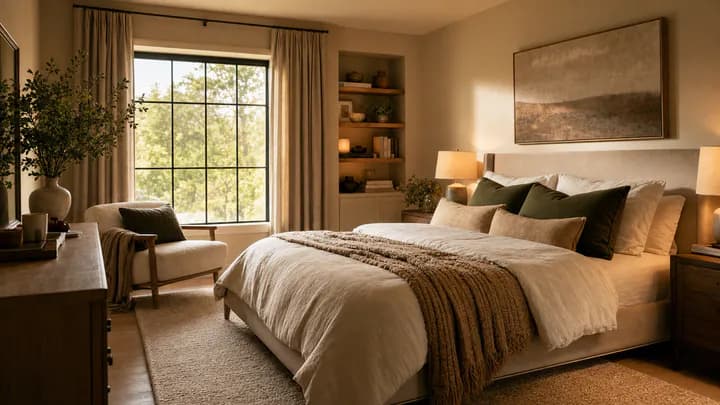
Use 8x10 under a queen and 9x12 under a king, positioned so the rug starts just below the nightstands and runs past the foot of the bed. You want roughly 24 to 36 inches of rug showing on each side so your feet land on something soft when you get up. The area under the headboard is wasted coverage, so sliding the rug forward is a legitimate way to size down.
There are two cheaper alternatives that work well. Place two runners on either side of the bed, or set one wide runner across the foot. Both suit rentals and rooms where a 9x12 would swallow the budget. If you are rethinking the whole space, our guide to calm bedroom upgrades that actually work covers how textiles, lighting, and layout interact.
How wide should a hallway runner be?
A runner should leave 4 to 6 inches of bare floor on each side of the hall, and stop 18 to 24 inches short of the walls or doorways at each end. Standard runners are about 2 to 2.5 feet wide, which suits most residential halls of 3 to 3.5 feet. In a long hallway it is better to use two runners with a deliberate gap than one runner that awkwardly stops 8 inches from the end wall.
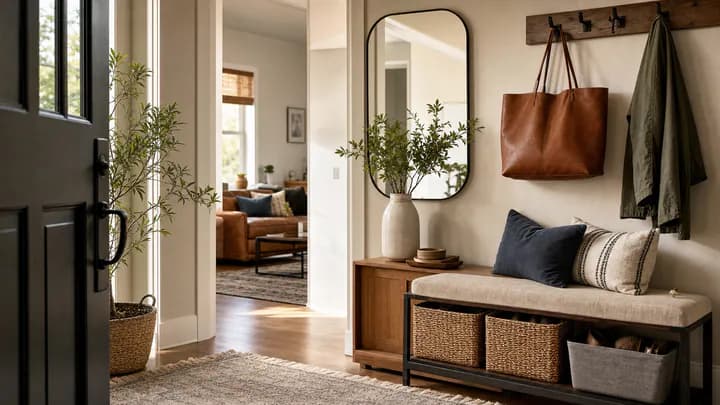
Entry rugs follow their own logic: they are working surfaces first, so prioritize a washable, low-pile piece wide enough to catch two pairs of feet. We go deeper on that zone in our breakdown of how to make the first three feet of your home work harder and in these small-space entryway ideas.
Which rug material should I choose for each room?
Match material to traffic and mess, not to price. Wool is the durability benchmark, polypropylene is the stain benchmark, and viscose is the one that quietly ruins itself in the wrong room.
| Material | Feel | Durability | Best room | Watch out for |
|---|---|---|---|---|
| Wool | Soft, resilient | Very high | Living room, bedroom | Sheds at first; costs more |
| Polypropylene | Slightly synthetic | High | Dining, kids' rooms, outdoors | Can flatten under heavy furniture |
| Jute / sisal | Coarse, textural | Medium-high | Layering base, entry | Stains badly; not for bathrooms |
| Cotton (washable) | Thin, flat | Medium | Kitchen, kids, laundry | Needs a grippy pad; can wrinkle |
| Viscose / bamboo silk | Silky, shiny | Low | Low-traffic accent only | Water marks permanently |
Machine-washable rugs have become genuinely good rather than merely convenient, and in 2026 they are the default answer for households with toddlers, dogs, or an open kitchen. Check the washing width against your machine drum before buying — many 8x10 washables only fit a commercial-size washer.
How much does an area rug cost in 2026?
Expect broad ranges rather than fixed prices, because construction matters more than size. As a working frame for an 8x10:
- Machine-made synthetic: commonly a few hundred dollars, sometimes less on sale.
- Machine-made or hand-tufted wool: typically in the mid hundreds to low thousands.
- Hand-knotted wool: usually starts around a thousand dollars and climbs steeply with knot density.
- Rug pad: budget roughly 10 to 20 percent of the rug price; it extends the rug's life enough to pay for itself.
A practical decision rule: spend on size before you spend on construction. A correctly sized synthetic rug looks better in a room than an undersized hand-knotted one, and you can upgrade the material later when the layout is settled.
What mistakes make a rug look wrong?
- Buying one size down to save money. The single most common and most visible error. If you are between sizes, go up.
- Ignoring door clearance. Measure the gap under every door that swings over the rug. Pile height plus pad thickness must be less than that gap, or you will be shaving a door.
- Skipping the pad. Without one, rugs slide, buckle, and grind grit into the backing and the floor beneath.
- Putting viscose in a dining room. Water spots on viscose do not come out. Save it for a bedroom corner or skip it.
- Centering the rug on the room instead of the furniture. Rugs answer to the seating arrangement. An off-center rug that unifies the furniture always beats a perfectly centered one that does not.
How do I test a rug size before buying?
Tape the footprint on the floor with blue painter's tape and live with it for two days. It costs a few dollars and catches every problem a product photo hides.
- Mark the full rectangle at the size you are considering — say 8 by 10 feet.
- Move your furniture into place and check leg positions against the tape.
- Pull each dining or desk chair all the way back and see whether the rear legs stay inside the line.
- Open every door that swings into the area and note the clearance.
- Walk the traffic path at night, in socks, to feel where an edge would sit.
Worked example: a 12 by 15 foot living room with a 84-inch sofa, two armchairs facing it, and a coffee table. Taping 8x10 puts the armchair front legs barely on the edge and leaves the sofa's outer arm hanging over. Taping 9x12 captures front legs on all three pieces with about 18 inches of floor showing at the walls. The 9x12 is correct, and the tape proved it before any money moved.
Key takeaways
- Size to the furniture footprint, then leave 8 to 18 inches of bare floor at the perimeter.
- Living rooms need at least the front legs on; dining rooms need 24 inches of clearance past the table on every side.
- Use 8x10 under a queen bed and 9x12 under a king, sliding the rug forward past the nightstands.
- Buy the correct size in a cheaper material rather than the wrong size in an expensive one.
- Always use a rug pad, and always check door clearance before ordering.
- Five dollars of painter's tape and two days of living with the outline prevents the most expensive mistake in the room.
Frequently asked questions
What is the most common area rug size?
The 8x10 foot rug is the most commonly bought size in American homes because it fits the majority of medium living rooms and sits under a queen bed with walking margin. The 5x8 and 9x12 sizes follow closely behind.
Should all furniture legs be on the rug?
No — only the front legs of your seating need to sit on the rug for the arrangement to read as one connected zone. All-legs-on looks the most luxurious but requires a larger, more expensive rug, and no-legs-on makes a room look smaller and unfinished.
How much bigger than my dining table should the rug be?
The rug should extend at least 24 inches past every edge of the table, and 30 to 36 inches is better if your chairs are wide or heavy. That margin lets chairs slide back without catching a rear leg on the rug edge.
What size rug goes under a king bed?
A 9x12 foot rug is the standard choice under a king bed, placed so the top edge starts just below the nightstands and roughly 24 to 36 inches of rug shows on each side. An 8x10 works if you pull the rug forward and skip covering the headboard wall.
Do I need a rug pad under an area rug?
Yes in almost every case — a pad stops slipping, cushions the rug, and keeps the backing from abrading hard floors. Use a thin 1/4-inch pad in doorways and under dining chairs, and a thicker 3/8-inch pad where you want softness underfoot.
Can you put an area rug over carpet?
Yes, and it works well for zoning a large carpeted room, but choose a low-pile rug and use a rug-on-carpet pad so the edges do not ripple or curl. Avoid thick shag over plush carpet, since the layers shift and create a tripping edge.
How do I know a rug will clear my door?
Measure the gap between the bottom of the door and the finished floor, then compare it to the rug's pile height plus pad thickness. If the combined height is greater than the gap, the door will drag, so choose a flatweave or a thinner pad.