Entryway Makeover 2026: A Calm, Functional Welcome Zone
An entryway makeover works when it removes daily friction, not when it looks styled. Here is the four-part checklist, the clearance math for narrow halls, materials that survive wet shoes, real 2026 cost ranges, and a weekend plan.

TL;DR: A 2026 entryway makeover succeeds when it removes friction, not when it looks styled. Install four things first — a landing surface, hooks, a seat for shoes, and two layers of light — then choose washable materials and add exactly one focal point. Even three feet of wall can do the job.
What is an entryway makeover actually trying to fix?
An entryway makeover is a targeted redesign of the threshold zone just inside your front door so that arriving and leaving take fewer steps and leave less mess behind. It is a workflow project disguised as a decorating project. The measure of success is not how the corner photographs — it is whether shoes, bags, and mail stop migrating into the living room.
That transition zone earns its keep because it absorbs the items, grit, and noise of outside life before they reach the rest of the house. Designers call it a threshold space, and its job is buffering. In 2026 the load is heavier than it used to be: hybrid work schedules mean laptop bags come and go on irregular days, delivery volume means boxes both arrive and leave, and pets, reusable totes, and seasonal outerwear all compete for the same square footage. A setup that was adequate five years ago is probably overwhelmed now.
What are the four essentials every entryway needs?
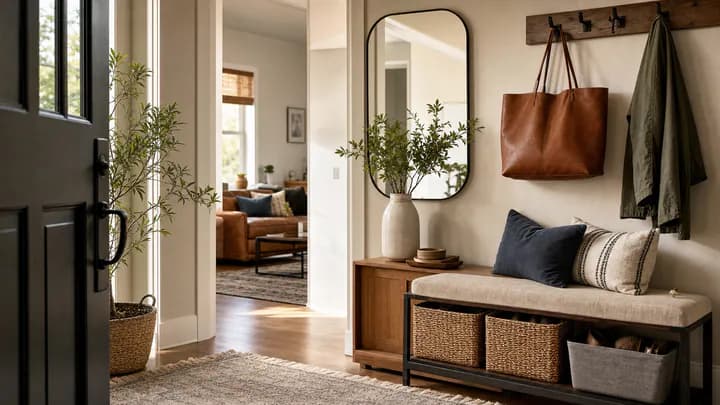
Every functional entryway has a landing surface, hanging space, a seat for shoe removal, and layered lighting. If any one of the four is missing, the space will fail no matter how good it looks — the missing function simply relocates to a kitchen counter or the floor.
1. A landing surface
You need somewhere to set keys, sunglasses, mail, and a phone within a step of the door. A narrow console, a floating shelf, or a wall-mounted tray all work. Depth matters more than length: eight to ten inches is enough to hold a wallet and a stack of mail, which means even tight halls can accommodate one. Give the surface a lip or a bowl so small metal things stop sliding off.
2. Hanging space
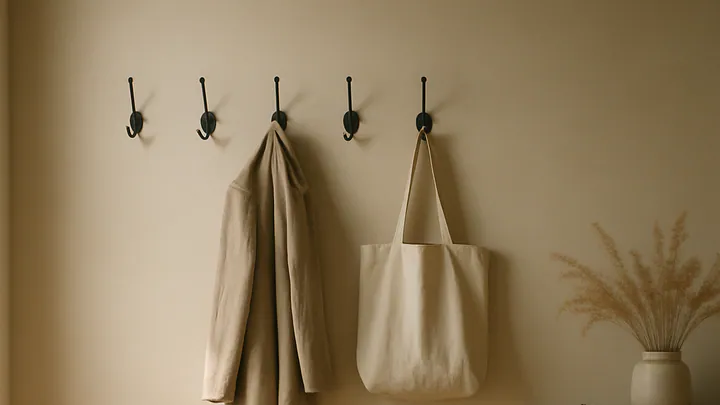
Hooks beat a closet rod for daily use because they remove a step, and removed steps are the whole point. Mount adult hooks around 60 inches from the floor and add a second row near 42 inches if kids live there. Reserve one hook exclusively for your everyday bag — the moment a bag shares a hook with a coat, one of them ends up on the floor permanently.
Hardware matters more than people expect. A wet wool coat is dramatically heavier than a dry one, and the failure usually happens in February, at speed, with a gouge in the drywall. Anchor into studs where you can; where you cannot, use toggle anchors rated well above the load you expect.
3. A seat for shoes
Sitting or leaning to remove shoes prevents the hopping-on-one-foot routine that scuffs walls and scatters footwear. A bench, a sturdy stool, or even a shallow step works. Storage underneath — open cubbies or two baskets — is a bonus, but the seat itself is the functional part.
4. Layered lighting
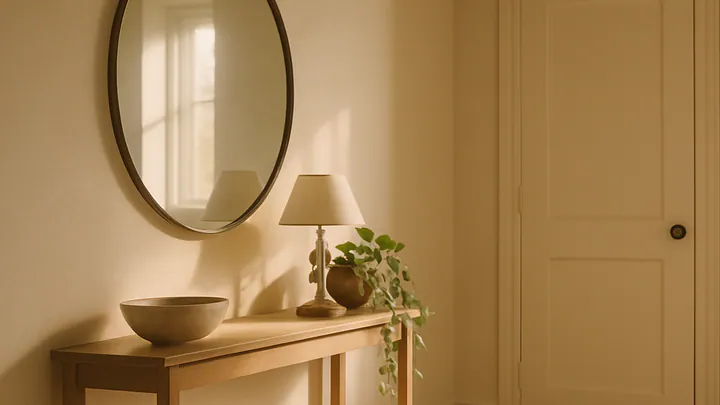
Entryways are often the darkest spot in the home because they are interior spaces without windows. One overhead fixture is rarely enough. Add a warm lamp on the console or a small sconce so the space reads as welcoming after dark rather than clinical. Warm bulbs in the 2700K range flatter skin and wood; cool white LEDs make a small hall feel like a corridor in a clinic.
How do I design an entryway when my door opens into the living room?
Claim the first three to five feet inside the door and define the zone visually instead of structurally. A small rug draws the boundary, a shallow wall-mounted shelf with hooks beneath it handles landing and hanging, and a single basket on the floor handles shoes. The entire arrangement can live in under 12 inches of depth.
The trick is committing to the edge. A defined rectangle — rug, shelf, hooks — reads as intentional; the same objects scattered along a wall read as clutter. If you want a deeper walkthrough of that boundary-drawing approach, our guide to making the first three feet work covers the layout math in more detail.
Which entryway layout fits my space?
Match the solution to the shape of the space you actually have, not to the foyer you wish you had. The four situations below cover almost every home our readers write in about.
| Situation | Maximum furniture depth | Highest-impact move | Skip this |
|---|---|---|---|
| Door opens into living room | 10–12 in (wall-mounted) | Rug plus shelf-with-hooks to define the zone | Any freestanding console |
| Narrow hallway (under 42 in wide) | Hallway width minus 36 in | Go vertical: slim shoe cabinet, stacked cubbies, mirror on one long wall | Benches deeper than 14 in |
| True foyer or alcove | 16–18 in | Storage bench plus console with a drawer | Oversized furniture that blocks the door swing |
| Side or back mudroom entry | 20–24 in | One cubby, hook, and basket per household member | Shared bins that nobody owns |
The clearance rule we use: keep 36 inches of clear walking path, then let whatever remains be your furniture depth. In a 46-inch hall, that allows a 10-inch console. In a 36-inch hall, it allows nothing on the floor — go wall-mounted. Then check the door swing separately: an inward-swinging door needs its full arc plus a few inches of margin kept empty, and a bench parked in that arc will chip both pieces within a month.
Per-person cubbies are the single most effective family upgrade we know. When every person has a named hook, basket, and shoe spot, the daily search for the second mitten simply ends. More small-footprint tactics live in our roundup of small entryways that work hard.
Which materials survive wet shoes, road salt, and dog paws?
Choose surfaces you can scrub and floors that tolerate moisture and grit. Entryways absorb more abuse per square foot than any other part of the home, and the damage is cumulative rather than dramatic.
- Flooring: tile, sealed stone, luxury vinyl plank, and matte-finish engineered hardwood all handle water and sand better than glossy wood. Glossy finishes show every scratch from trapped grit.
- Rugs: low-pile, washable, dark or patterned to hide dirt between washes. Indoor-outdoor rugs are excellent here. Keep the pile under about a half inch so an inward-swinging door clears it.
- Walls: scrubbable paint in eggshell or satin at hand height. A half-wall of beadboard or a durable wallcovering takes the bag-scuff abuse in a narrow hall.
- Hardware: solid metal hooks with real anchors. Plastic hooks and adhesive strips fail under a heavy, damp winter coat.
- Boot tray: pick one with a raised lip. Road salt and de-icer will etch unsealed stone and dull wood finishes over a single winter, and a flat mat just spreads the brine around.
How much does an entryway makeover cost in 2026?
A focused refresh — hooks, a washable rug, a tray, and a warm lamp — generally lands in the low-to-mid hundreds of dollars in the US. Adding a storage bench and better lighting pushes toward the high hundreds. Built-in cubbies, new flooring, or a hardwired fixture move the project into the thousands because labor dominates the bill.
| Tier | What you get | Typical spend | Time required |
|---|---|---|---|
| Reset | Declutter, deep clean, reuse what you own, add hooks and a tray | Under $100 | Half a day |
| Refresh | Hooks, washable rug, boot tray, table lamp or plug-in sconce, baskets | Low hundreds | One weekend |
| Furnished | Adds storage bench or slim shoe cabinet, mirror, upgraded lighting | High hundreds | Two weekends |
| Built-in | Custom cubbies, new flooring, hardwired fixture (licensed trades) | Thousands | Weeks, scheduled |
Worked example. A 34-inch-wide rental hallway: the clearance rule rules out floor furniture entirely, so the budget goes to a 10-inch wall shelf with five hooks below it, a 2x3 washable runner, a boot tray, and a battery-powered motion sconce. Total spend sits in the refresh tier, nothing is permanent beyond four anchor holes, and the daily friction drops to near zero.
Which 2026 upgrades are actually worth adding?
A handful of modern additions earn their place because they solve a specific arrival problem. Skip anything that needs an app to turn on a light.
- Motion-sensor lighting: a plug-in or battery sensor light removes the fumble for a switch when your arms are full.
- A charging drawer: a power strip hidden inside a console drawer keeps phones and earbuds charging out of sight and off the landing surface.
- A two-basket package zone: one basket for incoming deliveries, one for outgoing returns. The flow is constant now, so it needs a home rather than a floor.
- A tote hook: reusable grocery bags only leave the house if they hang within reach of the door.
- A seasonal rotation rule: cap hooks at one per person plus one guest hook, and store off-season outerwear elsewhere. The same editing logic behind a 30-piece capsule wardrobe works on a coat rack.
How do I do this in one weekend?
Work in this order: empty, clean, install function, then decorate. Reversing the sequence is why most entryway projects stall.
- Friday evening: empty the entryway completely. Sort into keep, relocate, donate, and discard. Anything that has not moved in three months does not live here.
- Saturday morning: clean thoroughly — baseboards, walls at hand height, light fixture, floor. Touch up paint now while the walls are bare.
- Saturday afternoon: install hooks at the correct heights, lay the rug, place the bench or stool, set up the landing surface.
- Sunday: add the second light source, the mirror or one piece of art, and a single natural element.
- The following week: live with it before buying anything else. You will discover exactly one missing hook or basket, and that is the only thing left to buy.
What mistakes make an entryway fail?
Five errors account for most of the entryways we see that never settle down, and four of them are decisions made at the store rather than at home.
- Too many hooks. Twelve hooks become twelve coats. Fewer hooks force the seasonal edit that keeps the wall readable.
- Furniture that is too deep. A 16-inch console in a 36-inch hall leaves a 20-inch squeeze. Measure, subtract 36, then shop.
- One harsh overhead light. Cool white LEDs flatten the space. Warm bulbs and a second source fix it for the price of a lamp.
- No floor protection. Skipping the rug and tray means water, sand, and salt travel into every other room.
- Decor before function. A beautiful entryway that does not hold your bag will annoy you twice a day, every day.
When does this advice not apply?
Three situations change the rules. First, if your door opens outward or sits flush against a return wall, there may be no usable adjacent wall at all — in that case the landing surface moves to the opposite wall or to a slim cabinet, and hooks go on the back of a nearby closet door. Second, in apartment buildings, corridors and doorways are often part of a required egress path; do not place furniture, shoe racks, or hooks in shared hallways without checking your building rules. Third, if the entry contains an electrical panel, a radiator, or a heat register, keep the manufacturer-specified clearance and never hang wet coats over a heat source.
Once the entry is calm, the same subtraction-first thinking transfers well to other rooms — our bedroom refresh guide applies it to sleep spaces, and there are more compact-entry examples in our piece on small entries that make a big first impression.
How do I keep it looking like this?
Run a two-minute reset before bed: clear anything that does not live here, hang the one coat on the floor, and square up the shoes. Systems decay without a reset, and no amount of storage substitutes for the habit.
Once a season, edit the hooks. Off-season outerwear moves to a closet, the rug goes through the wash, and the boot tray gets rinsed. That is the entire maintenance plan.
Key takeaways
- Install the four essentials — landing surface, hooks, a seat, layered light — before you buy any decor.
- Keep 36 inches of clear walking path and let the leftover width set your maximum furniture depth; check the door swing separately.
- Three to five feet of wall is enough for a real entryway if the pieces are wall-mounted and the zone is visually defined.
- Choose scrubbable, washable, moisture-tolerant materials, and use a lipped boot tray to contain road salt.
- Limit the wall to one or two focal points; empty surface area reads as calm, not unfinished.
- A weekend and a few hundred dollars changes the daily experience of arriving home more than most renovations do.
Editorial note: this reflects general design and organization guidance from our team. For structural changes, electrical work, or built-in cabinetry, consult a qualified contractor, licensed electrician, or interior designer familiar with your local building codes and, if you rent, your lease terms.
Frequently asked questions
What should every entryway have?
Every entryway needs four things: a landing surface for keys and mail, hanging space for coats and bags, somewhere to sit or lean while removing shoes, and at least two layers of light. Decor comes after all four exist, because those elements are what absorb the daily mess of arriving and leaving.
How do I design an entryway when I don't have one?
Claim the first three to five feet inside your door and define it with a rug, a shallow wall-mounted shelf, hooks below it, and one basket for shoes. The whole setup can live in under 12 inches of depth, which is why it works even when the door opens straight into a living room.
What size rug works best in an entryway?
Choose a rug at least as wide as your door opening and long enough to stand on with both feet — roughly 2x3 feet for a tight entry and 3x5 feet for a wider foyer. Check that the pile is thin enough for the door to clear it; anything over about a half inch will catch on an inward-swinging door.
How high should entryway hooks be mounted?
Mount adult hooks around 60 inches from the floor and a second row near 42 inches for kids. Keep at least 14 inches of clear wall below the top row so a long coat does not drag on a bench, and anchor into studs or use toggles rated well above the weight of a soaked winter coat.
How much does an entryway makeover cost in 2026?
A hooks-rug-tray-lamp refresh typically lands in the low-to-mid hundreds of dollars in the US, a furnished version with a storage bench and better lighting runs into the high hundreds, and built-in cubbies or new flooring move into the thousands. Costs vary widely by region and by how much you already own.
How do I stop my entryway from getting cluttered again?
Give every recurring item one named home — a hook per person, a tray for keys, a basket for shoes, a bin for mail — and cap the number of hooks so coats have to rotate seasonally. A two-minute reset before bed is what keeps the system alive; storage alone never does.
Can renters do this without drilling?
Yes, with caveats. Freestanding pieces — a narrow shoe cabinet, a stool, a leaning ladder shelf, a plug-in or battery sconce — do most of the work, and an over-door hook rack handles coats. We do not recommend adhesive hooks for wet outerwear; they tend to release under sustained damp weight and take paint with them.
What is the most common entryway mistake?
Buying furniture that is too deep for the walkway. A 16-inch console in a 36-inch hall leaves only 20 inches of clear passage, which is too narrow to walk through with a bag. Measure the hallway, subtract 36 inches of clear path, and let the remainder be your maximum furniture depth.