Entryway Ideas 2026: Small Space, Big First Impression
A working entryway is a sequence, not a square footage problem. Map four stations - sit, hang, drop, step - measure before you buy, and even 30 inches of wall can absorb coats, keys, and wet boots without spilling into the rest of the house.

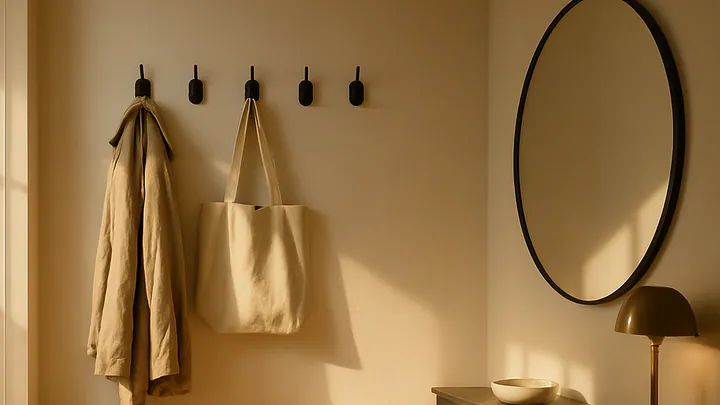
TL;DR: A great entryway in 2026 is a sequence, not a square footage problem. Give arrivals somewhere to sit, hang, drop, and step - in that order - and 30 inches of wall will out-perform a grand foyer with nowhere to put a coat. Measure first, buy second.
An entryway is the transition zone where outdoor clothing, weather, packages, and the residue of the day get filtered out before the rest of the home has to absorb them. When it works, you stop noticing it. When it doesn't, the clutter migrates: coats colonize dining chairs, shoes wander to the living room, and mail becomes an archaeological layer on the kitchen counter.
The good news is that entryways respond dramatically to small, targeted work. Unlike a kitchen or bathroom, you rarely touch plumbing or electrical. You mostly need to make deliberate decisions about a very small piece of real estate - and then stop buying things that don't serve them.
What are the four stations every entryway needs?
Map your entry around four stations before you buy anything. If a purchase doesn't serve one of them, skip it.
- Sit - a bench, stool, or ledge for putting shoes on and off.
- Hang - hooks or a rod for coats, bags, and leashes.
- Drop - one tray or shallow shelf for keys, wallet, sunglasses, and mail.
- Step - a floor surface that handles grit, water, and daily traffic.
The order matters. A seat changes behavior more than any other single item, because people who can sit down actually take their shoes off at the door instead of dragging debris across the floor. Everything else - mirror, art, plant, scent - is decoration layered on a working system. If you want the granular version of this, our guide to making the first three feet of your entry work hard goes deeper on the threshold zone specifically.
How much space do you actually need, in inches?
Roughly 30 to 36 inches of wall width and 14 inches of depth. That is enough for a slim bench, a four-hook rail, and a drop tray, while leaving the 36-inch clear path that keeps a hallway from feeling like a squeeze.
Useful numbers our team works to:
- Bench depth: 12 to 14 inches is enough for most adults. Deeper is more comfortable but eats walkway width fast.
- Seat height: 17 to 19 inches. Lower looks sleek and is miserable for anyone with stiff knees.
- Hook height: 60 to 66 inches for adults, 36 to 40 inches for kids and leashes.
- Hook spacing: 4 inches minimum, 6 inches if you own bulky winter coats.
- Shelf above hooks: at least 6 inches of clearance above the hook line, or coat shoulders jam.
A worked example: 34 inches of blank wall
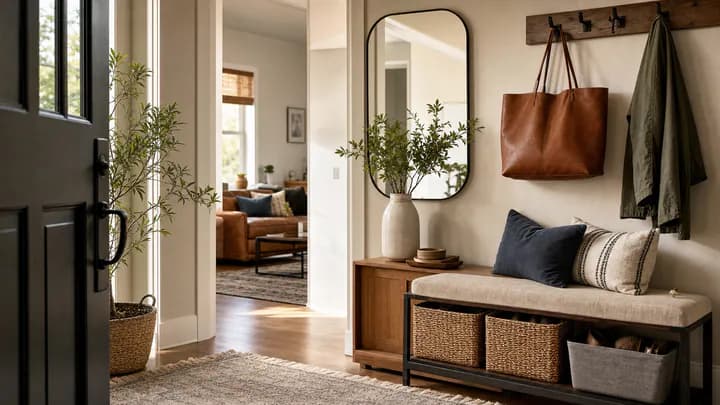
Say you have a 34-inch stretch between the front door and a closet. Install a 30-inch shelf-with-hooks unit: shelf at 66 inches, four hooks beneath it at 60 inches. Put the drop tray on the shelf, not on the bench. Slide a 28-inch by 13-inch bench underneath with two lidded baskets below it - one for gloves and hats, one for dog gear. Lay a 2-by-3-foot flat-weave rug in front. That is a complete four-station entry in less than three square feet of floor, and nothing in it requires a contractor.
Which layout fits the entry you actually have?
Most homes don't have a proper foyer, and the right move depends on which awkward situation you're in. Find yours below.
| Situation | Priority move | Minimum footprint | Skip |
|---|---|---|---|
| Narrow hallway | Go vertical: wall rail with hooks, slim floating shelf, folding stool | 30" wide x 10" deep | Console tables, deep benches |
| Door opens into living room | Build a psychological boundary: rug that stops where the entry stops, console placed perpendicular | 36" wide x 14" deep | Matching the living room finishes exactly |
| Apartment with a coat closet | Closet for the season, wall outside it for today's coat and bag | Existing closet + 24" wall | Adding a second full storage unit |
| Side or garage entry available | Let the working door carry boots and gear; keep the front door light and decorative | Split across two doors | Duplicating storage at both doors |
| Door opens onto a stair landing | Wall-mounted only: hooks plus a small ledge; use the third or fourth stair as a seat | 24" of wall | Any freestanding furniture |
One honest caveat: this framework does not apply cleanly if your front door opens directly into a room with no adjacent wall at all - a studio where the door sits flush against a kitchen run, for example. In that case, move the four stations to the nearest closet interior and accept that the drop station lives on a kitchen shelf. Forcing a bench into a doorway you have to walk around is worse than no bench.
What materials survive wet boots and dropped bags?
Choose for abrasion, moisture, and wipeability, in that order. Entryways take more physical abuse per square foot than any room except the kitchen.
- Floors: tile, luxury vinyl plank, or sealed hardwood with a hard-wearing finish. Avoid unsealed stone at a wet-climate door - salt and water will etch it.
- Rugs: washable flat-weaves, indoor-outdoor polypropylene, or short-pile wool blends. The test is whether you'd genuinely put it in a machine.
- Walls: eggshell or satin paint wipes; flat paint burnishes where bags rub. A durable panel or chair rail at bag height behind the bench saves repainting.
- Furniture: solid wood, powder-coated metal, or high-pressure laminate. Thin veneer swells where wet boots touch it.
The rug mistake almost nobody measures for
Before buying any entry rug, measure the gap between the bottom of your inward-swinging front door and the finished floor. Many interior and exterior doors clear roughly half an inch. A plush 3/4-inch rug will either jam the door or get shoved into a wrinkle every time someone comes in - and a wrinkled rug at a threshold is a genuine trip hazard. Either stay under the clearance or position the rug outside the door's swing arc entirely.
How should you light a small entryway?
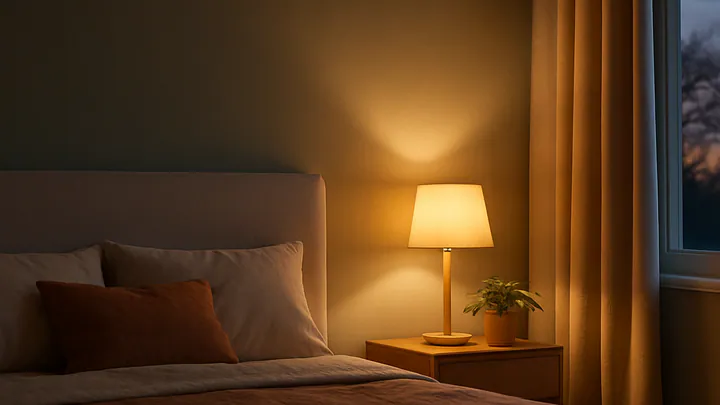
Layer two sources and keep both warm. Put a 2700K to 3000K bulb in the overhead fixture, ideally on a dimmer, then add one accent light at eye level - a plug-in sconce, a compact console lamp, or a battery puck inside the closet.
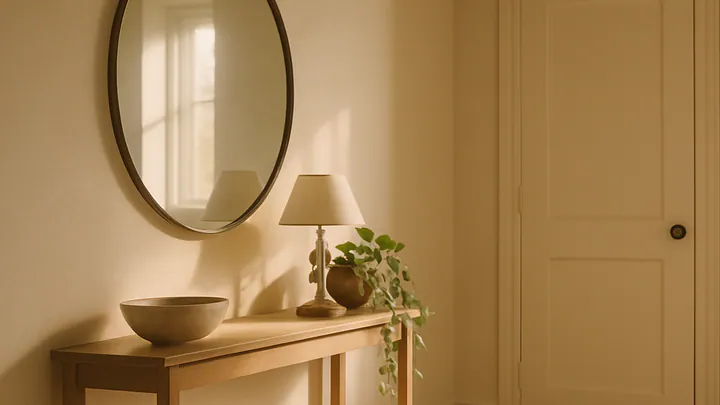
Warm, layered light makes a five-square-foot entry read as a room. Cool, overhead-only light makes even a generous foyer read as a lobby. The other trick: place the mirror where it bounces light from a window or fixture across the space, not directly behind the light source, where it only produces glare.
Light temperature is also a quiet behavioral cue. A warmer, dimmer entry at night signals the day is over, in much the same way that a bright start supports the morning sunlight habit at the other end of the day. If you're already thinking about how light shapes mood at home, our bedroom refresh guide covers the same principle in the room where it matters most.
Which small upgrades deliver the most for the money?
These six punch far above their price, and none require tools beyond a drill and a level.
- A mirror near the door. Bounces light, doubles perceived depth, and lets you check yourself on the way out.
- A boot tray with a raised lip. Contains snowmelt and road salt in winter, sand in summer. The lip is the whole point - flat mats just spread water.
- One labeled outgoing basket. Returns, library books, dry cleaning. Items parked by the door actually leave the house.
- A charging spot that isn't your phone's usual home. Encourages putting the phone down on arrival rather than carrying it to the couch.
- A subtle, consistent scent. A reed diffuser creates a reliable "you're home" cue without competing with cooking smells.
- Cable-free surfaces. Cord channels or a tray with a pass-through. A tidy surface reads as calm even when the rest of the room isn't.
A seasonal coat rotation helps more than extra hooks ever will. If three of the five coats on the rail haven't been worn since March, the rail isn't undersized - it's storing the wrong things. The same edit logic behind a capsule wardrobe works on outerwear: keep what the current season needs at the door, and the rest in the closet.
What are the costliest entryway mistakes?
The expensive errors aren't aesthetic - they're the ones that force a second purchase.
- Buying storage before mapping the stations. You end up with a beautiful 20-inch-deep bench in an 18-inch hallway.
- Too many hooks, all overloaded. Compressed wet coats stay damp and start to smell. Three to five good hooks beat ten crowded ones.
- Hanging a hook rail into drywall with no anchor. A wet wool coat with a bag over it can approach ten pounds. Find a stud or use a rated toggle - a rail that tears out takes a patch of wall with it.
- A decorative bowl as the drop zone. Bowls hide their contents, so they fill with receipts, coins, and mystery items nobody sorts. A shallow tray shames you into emptying it.
- Delicate natural fiber at the threshold. Jute and sisal wick water and stain fast. Save them for two feet inside.
- Ignoring vertical space above eye level. The wall above 70 inches is free real estate for labeled seasonal boxes.
How do you fix an entryway in one weekend?
Empty it Friday, sort it Saturday, install it Sunday. The order matters because measuring a cluttered entry gives you the wrong numbers.
- Friday evening: take everything out. Vacuum, wipe the baseboards, wash the door and the handle.
- Saturday morning: sort the pile into keep-here, keep-elsewhere, donate, and toss. Be strict about keep-here.
- Saturday afternoon: sketch the four stations, measure twice, and shop for what's missing. Check the door swing and the rug clearance now, not later.
- Sunday: install hooks into studs or anchors, set the bench, place the tray, lay the rug, swap the bulbs.
By Sunday night the entry does its job. Layer in art, a plant, or a mirror over the following weeks, once you've seen how the space actually gets used. For more compact configurations and product categories that suit them, our companion piece on small entryways that work hard covers the tight-footprint variations in detail.
Key takeaways
- Design around four stations in order: sit, hang, drop, step. If a purchase serves none of them, don't buy it.
- Thirty to thirty-six inches of wall is enough - measure bench depth, hook height, and door clearance before shopping.
- Fewer, better-anchored hooks beat a crowded rail; wet coats need air and a stud or rated anchor.
- Pick materials that shrug off water, salt, and bag scuffs: wipeable paint, washable flat-weaves, solid or laminate furniture.
- Layer warm 2700K-3000K light on a dimmer instead of relying on one cool overhead fixture.
- Adapt the plan for stair landings, studios, and mobility needs rather than forcing furniture into a path that needs to stay clear.
Editorial note: product suggestions here are general categories, not endorsements. We do not run affiliate links in Home content. Prices, availability, and specific product lines change frequently - verify current details before purchasing, and consult a qualified electrician or contractor for any work involving wiring or structural changes.
Frequently asked questions
How much space do I need for a functional entryway?
About 30 to 36 inches of wall width and 14 inches of depth is enough for a fully working entryway. That fits a slim bench, a hook rail, and a small drop tray without narrowing the walking path below the 36 inches most hallways need.
What should every entryway include?
Four things: a place to sit, a place to hang, a place to drop keys and mail, and a floor surface that tolerates grit and water. Cover those and everything else - mirror, art, plant, scent - is optional decoration layered on top.
How high should entryway coat hooks be mounted?
Mount adult hooks 60 to 66 inches from the floor and children's hooks 36 to 40 inches. Space them at least 4 inches apart so coats hang free instead of compressing into a single damp block.
How do I keep shoes from taking over the entryway?
Limit floor-level storage to current-season shoes only and give it a hard edge - one boot tray or one bench shelf. When the tray is full, a pair goes back to the closet. Open-ended shoe storage always fills to capacity.
What kind of lighting works best in an entryway?
Layered warm light: an overhead fixture with a 2700K to 3000K bulb on a dimmer, plus one small accent light at eye level such as a plug-in sconce or console lamp. Single cool overhead light flattens the space and makes it read as a corridor.
Will an entryway rug stop my front door from opening?
It can. Measure the gap between the bottom of your inward-swinging door and the finished floor before buying. Most doors clear roughly half an inch, so choose a flat-weave under that thickness or place the rug outside the door's swing arc.
How can renters upgrade an entryway without damage?
Use freestanding furniture, leaning mirrors, peel-and-stick wallpaper, and a floor-standing coat rack rather than wall hooks. Adhesive hooks are fine for a tote or a leash but struggle with a wet wool coat, which can weigh six to eight pounds.
Does this advice change if someone in the home uses a wheelchair or walker?
Yes. Prioritize clear floor space over furniture: keep a 36-inch path, allow a 60-inch turning circle where possible, and mount hooks and shelves in the 44 to 48 inch reach range instead of at shoulder height.