The Balloon Vendor at the Border Fair
Every autumn a fair sets up on the border, and Odile sells balloons that briefly show you the country you didn't choose. This year, one balloon refuses to rise.
Drafted with AI and published automatically. Our editors set the standards and fix reported errors — how we work.
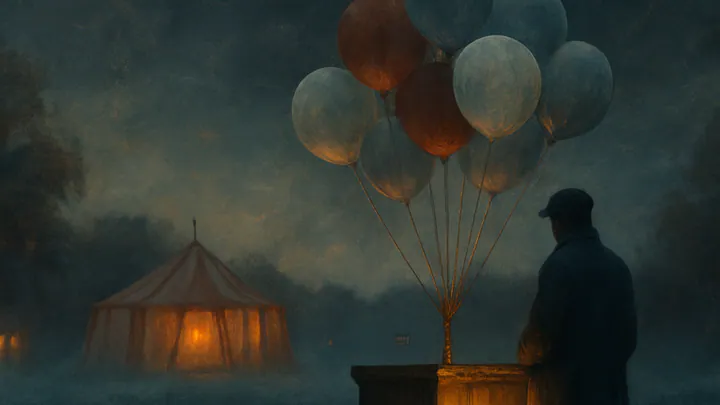
The fair only opens on the three nights when the border isn't sure where it is. Odile knows because her balloons know: they lean, very slightly, toward whichever side has more forgetting to do.
She arrives the way she always arrives, pulling her cart across the frost-brittle grass, the ropes over her shoulder biting like a harness. The balloons ride above her in a great trembling bouquet, silver and rust and pale winter-blue, each one whispering to itself in the language of the country it holds. To an outsider they look ordinary. To her they weigh nothing and everything at once.
The other vendors nod as she passes. The woman who sells apples dipped in something like regret. The man with the accordion that only plays songs you almost remember. A boy roasting chestnuts he insists are from the other side, though nobody has crossed since the war that wasn't quite a war.
Odile sets up between the shooting gallery and the fortune wheel. She hammers her sign into the ground with the flat of her palm.
ONE BALLOON, ONE MINUTE. SEE THE LIFE YOU DIDN'T CHOOSE.
The first customer comes before she has finished tying her apron.
I.
He is old, or old enough. A wool coat, a face like a folded map. He does not ask what the balloons do; people at this fair rarely do. They know. They come precisely because they know.
“How much?”
“A coin,” Odile says. “Any coin. Even one you found.”
He drops something copper into her tin. She unhooks a balloon the color of wet slate and offers him the string. He holds it the way one holds a child's hand in traffic.
The balloon dips. Then, for exactly sixty seconds, the old man is not at the fair. His shoulders soften. His eyes go somewhere behind his eyes. Odile has watched this happen ten thousand times and still she looks away, out of courtesy.
When the minute ends, the balloon shivers and goes ordinary. He hands the string back with steady hands.
“Well?” she asks, because sometimes they want to be asked.
“A baker,” he says. “I would have been a baker. With a wife named something with an L in it. Three children.” He smiles at nothing. “The bread was good.”
“And your life now?”
He considers. “Also good. Different bread.”
He walks off into the lantern light and Odile marks the sale on her wrist with a stub of blue chalk.
II.
By midnight she has sold nineteen balloons. A woman in a good coat wept quietly and then laughed. A pair of teenagers held one balloon between them and afterward would not look at each other. A soldier from the garrison paid with a button; Odile accepted it because at this fair a button and a coin weigh the same.
Then the small one comes.
Odile has been ignoring it all evening. A balloon on the far left of the bouquet, no larger than a fist, the color of milk left out too long. It has not lifted once. It hangs down like a piece of fruit refusing to ripen. When she tugs its string, it tugs back.
“Not tonight,” she tells it, under her breath. “Behave.”
A girl approaches, perhaps twelve, alone. She wears mismatched gloves and the serious expression of someone rehearsing adulthood.
“I want that one,” the girl says, pointing directly at the small stubborn balloon.
“That one isn't for sale.”
“Why?”
Odile opens her mouth and finds, to her surprise, no answer waiting there. In forty-one years of this cart she has never refused a customer. The rule of the fair is that any coin buys any minute. She has bent the rule for widows, for children too young to understand what they would see, but she has never refused.
The girl produces a coin. It is the plain, dull kind, the sort found in gutters.
Odile hesitates. Then she unties the small balloon and hands the string over.
Nothing happens.
The balloon does not rise. It does not glow. The girl waits, patient as a stone, string wrapped once around her wrist. A full minute passes. Two. Three.
“It's broken,” the girl says, without accusation.
“It isn't,” Odile says, and hears her own voice as if from far away. “It's mine.”
The girl looks up. Her eyes are the same milk-pale color as the balloon.
“Oh,” she says. And then, softer: “Do you want to see it?”
III.
Odile has never used one of her own balloons. It is the first rule, older than the fair. A vendor who looks at what she sells will stop being able to sell it.
She takes the string anyway.
The fair does not disappear. That is the first strange thing. She is still standing behind her cart, still smelling roasted chestnuts and lamp oil, still hearing the accordion two stalls down. But beside her, quite clearly, is a small house with yellow shutters. A garden gone to seed in the good way, the way that means someone lives there and has other things to do than tidy. Inside the house, a kettle. Outside the house, a child — not the girl, another child, perhaps a grandchild — drawing chalk shapes on flat stones.
There is no husband in this vision. No great romance. There is only a woman who stayed in one place, who learned the names of her neighbors' dogs, who never once crossed a border, never once carried a cart of impossible things through frost. A woman who has never sold anyone a minute of anything.
Odile watches this woman lift the kettle. She watches her call the child in. She watches her set two cups on a table, one for herself, one for a friend expected shortly.
The minute ends.
The balloon in Odile's hand is only a balloon.
“Well?” the girl asks, gently, the way Odile herself asks.
Odile finds she cannot speak for a moment. Not from grief. From something more careful than grief.
“A house,” she says at last. “With yellow shutters. And a kettle. And nobody had to leave.”
“Was it better?”
Odile thinks. All around her the fair goes on being the fair, its lanterns swaying, its coins changing hands, its small brief windows opening and closing above the frozen grass. Somewhere the old man with the folded-map face is walking home to a life he decided, forty years ago, was enough.
“It was a life,” Odile says. “This is also a life.”
The girl nods, as if she had suspected this all along. She returns the string. She does not ask for her coin back.
Odile ties the small balloon carefully to the far left of the bouquet, where it hangs now a little lighter, a little less stubborn. Not gone. Just answered.
She marks the sale on her wrist in blue chalk, though she isn't sure, this time, which of them was the customer.
The fair has two more nights. She will need her voice for them.
She turns to the next person in line — a young man twisting his cap in his hands, already halfway to weeping — and she says, kindly, the way she has said it ten thousand times: “One coin. One minute. Which country would you like to see?”