Bedroom Refresh 2026: Small Upgrades That Create Big Calm
A bedroom refresh in 2026 is mostly editing, not buying. Four levers — lighting, bedding, storage, and color — plus a weekend and a small budget can change how the room feels the same night you start.
Drafted with AI; reviewed by Najam Kausar on . How we work.
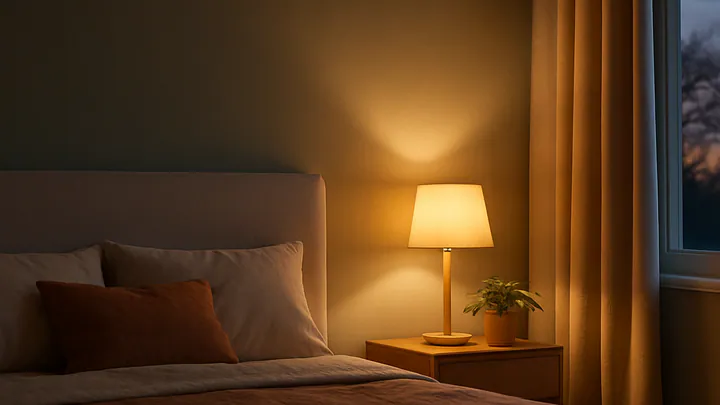
TL;DR: A 2026 bedroom refresh is editing, not shopping. Pull four levers — lighting, bedding, storage, color — one at a time. A warm 2700K dimmable bulb, breathable sheets, a cleared nightstand, and curtains hung high and wide will change how the room feels in a single weekend, without a renovation budget.
A bedroom refresh is a low-cost redesign that changes how a room feels by adjusting light, texture, storage, and color rather than replacing furniture. That definition matters, because the most common mistake is treating a tired bedroom as a furniture problem. It usually isn't. It's a lighting problem wearing a furniture costume.
The bedroom is the room people spend the most hours in and think about the least. It becomes a laundry drop zone, an office overflow, and — somewhere underneath all that — a place to sleep. Below is the approach we recommend when the goal is calm. Not a magazine shoot. Just a room that feels good to walk into at 10 p.m.
Where should I start if my bedroom feels off but I can't say why?
Start by deciding what the room is not. For most people a bedroom is not an office, not a gym, and not long-term storage. The more functions you stack into one space, the harder it is to associate that space with rest — and the harder it is to walk in and relax without a small mental to-do list firing.
Do the five-minute audit before you spend a dollar:
- Stand in the doorway and count every visible surface — nightstands, dresser tops, the chair, floor piles.
- Name the three loudest visual elements. Nine times out of ten it's cords, bright packaging, or a stack of something.
- Ask what you'd remove first if a guest were arriving in ten minutes.
That last item is where your refresh starts. Not the thing you'd buy — the thing you'd hide. If an object genuinely has to stay, give it a container, a curtain, or a closed door so it visually disappears after dark.
Where should the bed go?
Give the bed a focal wall other than the door wall, with access on both sides if possible. Keep nightstands at or just below mattress height, and protect the sightline from the door: a made bed and a lamp, not the laundry chair. If the bed must go under a window, a tall headboard and lined curtains beat wedging it into a corner.
What single change makes the biggest difference?
Lighting, by a wide margin. A single overhead fixture with a cool white bulb is the most common reason a bedroom feels harsh, and it is also the cheapest thing on this entire list to fix. Replace it, then build the room's light in layers so you can dial it up at 7 a.m. and down at 9 p.m.
- Overhead: A warm bulb around 2700K, on a smart or plug-in dimmer. Renters: plug-in dimmers and smart bulbs require no wiring and leave with you.
- Bedside: Two matching table lamps with fabric shades. Fabric diffuses; glass and metal shades throw glare at the ceiling.
- Ambient: A small floor lamp in a corner or a warm strand behind the headboard adds depth after sunset so the room isn't a single bright pool surrounded by darkness.
The mistake almost everyone makes: confusing color temperature with brightness. People buy a 2700K bulb, find the room still feels clinical, and give up — when the actual problem is 1,500 lumens overhead with no way to reduce them. Warm and dimmable is the combination. One without the other only half works.
The second mistake: mixing warm and cool bulbs. A 2700K lamp next to a 4000K closet bulb makes the warm lamp look dingy, so replace every bulb in the room in one pass, closet included.
| Temperature | Reads as | Best use in a bedroom |
|---|---|---|
| 2200K | Candlelight, amber | Accent lights, hallway nightlight, late evening |
| 2700K | Soft warm white | Bedside lamps, floor lamp; the workhorse choice |
| 3000K | Warm white, slightly crisp | Closet interior, vanity or mirror lighting |
| 4000K+ | Neutral to cool | Avoid in a bedroom |
Dimmable LEDs on an old incandescent dimmer buzz and flicker; use a smart bulb on a standard switch or an LED-compatible dimmer. Renters: no hardwired dimmer without a licensed electrician and the landlord's written approval.
Smart bulbs earn their price here. A nightly "wind-down" scene that warms and dims automatically around 9 p.m. works because you stop having to remember it. If you're also trying to fix your body clock from the other end, pair it with a morning sunlight habit — bright light early and dim light late are two halves of the same lever.
What about screens?
A TV in the bedroom is a personal call. If you keep one, put it behind a cabinet door or a fabric panel when it's off; a dark rectangle is visually loud even when nothing is playing. Phones are the bigger issue, and a $15 charging dock on the far wall does more for wind-down than any decor purchase.
Which bedding upgrade should I buy first?
Pillows, then sheets, then a duvet cover — in that order, because that's the order of cost-per-night-felt. You do not need a new mattress to feel a real difference. Replace pillows every one to two years; fold one in half and release it, and if it stays folded, it's done.
For sheets, ignore thread-count marketing and choose by fiber and weave, matched to how hot you sleep.
| Material | Feels like | Best for | Watch out for |
|---|---|---|---|
| Percale cotton | Crisp, cool, matte | Hot sleepers, warm climates | Wrinkles heavily; softens slowly |
| Sateen cotton | Smooth, slightly warm, subtle sheen | Cold sleepers, winter beds | Can feel clammy if you sweat |
| Linen | Textured, airy, gets softer yearly | Year-round, humid rooms | High upfront cost; rumpled look isn't for everyone |
| Lyocell / TENCEL | Silky, cool, drapey | Night sweats, sensitive skin | Pills if washed hot; needs gentle cycles |
| Cotton jersey | T-shirt soft, stretchy | Cold rooms, kids' beds | Traps heat; loses shape over time |
Use a washable duvet cover over an insert rather than a one-piece comforter — it's easier to clean and lets you change the look seasonally for the price of laundry. Add a lightweight quilt folded at the foot of the bed; it gives visual weight and a temperature option at 3 a.m.
Keep the palette calm: two neutrals plus one accent. Loud bedding is the single most common reason a tidy bedroom still reads as busy.
How do I store things without the storage itself becoming clutter?
Aim for storage the eye skips over — closed, matched, and low. Visible bins in six colors are nearly as distracting as the pile they replaced.
Nightstand rule: a lamp, a small tray, one book, a glass of water, a charger. That's the ceiling, not the target. Everything else goes in a drawer, or in a lidded box if your nightstand has none.
- Under-bed: Low-profile bins for off-season clothing and spare linens. Label the short end, since that's the end you'll see.
- Closet: Match your hangers. It sounds fussy; a closet of forty identical hangers reads as calm every single time you open the door. If you're also thinning the contents, our capsule wardrobe framework pairs well with this step.
- Hamper: Get one with a lid. Open hampers are visual noise even at half full.
The landing strip problem
Nearly every bedroom has one surface — a dresser top, a chair — where everything lands. Don't fight the habit; contain it. A shallow tray catches keys, jewelry, and change. A lidded basket on the chair holds worn-once clothes that aren't dirty enough to wash. It's the same logic that makes a well-designed entryway drop zone work: give the habit a home and it stops spreading.
How do I change the color of the room without repainting?
Use textiles and window treatments, in this order: curtains, rug, one large artwork. Hang curtains high and wide — rod mounted several inches above the window frame and extending well past it on both sides — so the ceiling reads taller and the window reads larger. It is the cheapest upgrade with the biggest visual payoff, and renters can do it with tension rods or removable brackets.
Blackout curtains mounted inside the window frame leak light around all four edges. Mount the rod high and wide and overlap the panels, or add a blackout liner behind curtains you already like.
The costly mistake: buying a rug too small. A 5×7 floating in the middle of a bedroom makes the room look smaller, not cozier. The rug should extend at least 18–24 inches past the sides and foot of the bed, or run as two runners along each side. Undersized rugs are a common furnishing regret, and they're rarely returnable once unrolled.
| Bed | Rug size | Budget alternative |
|---|---|---|
| Twin | 5×8 placed to one side | One 2.5×8 runner along the open side |
| Full | 6×9 or 8×10 | Two runners flanking the bed |
| Queen | 8×10 | Two 2.5×8 runners plus one at the foot |
| King | 9×12 | 9×12 flatweave; avoid going smaller |
Exception: if anyone uses a walker, cane or wheelchair, or gets up often at night, loose edges and high pile are trip hazards. Choose low pile on a full-coverage non-slip pad, or skip the rug.
One large piece above the bed reads calmer than a gallery wall of small frames. If you are painting, muted low-saturation tones — soft greens, warm off-whites, dusty blues, clay pinks — age well and photograph poorly, which is exactly right for a room built for rest rather than a feed.
What about air, sound, and scent?
These are the senses people skip, and they often do the most work. A quiet HEPA purifier reduces circulating dust and allergens, which many allergy-prone sleepers notice within a week. A small white-noise machine or a fan masks hallway and street sound more reliably than earplugs for most people, because it fills the gaps rather than blocking them.
Keep scent subtle. One low-scent candle or a light linen spray is plenty; heavy fragrance can be genuinely disruptive for sensitive noses and for anyone with asthma. If congestion, snoring, or persistent poor sleep is the real issue, no amount of room design substitutes for a conversation with a qualified professional.
What does a realistic weekend refresh plan look like?
One Saturday and a modest budget is enough. Here's the sequence we'd use, ordered so each step makes the next one easier.
| Tier | Rough spend | What you buy | What changes |
|---|---|---|---|
| Zero-dollar | $0 | Nothing — you edit, wash, and rearrange | Clutter drops; the room reads bigger |
| Essential | $80–$150 | 2700K dimmable bulb, one bedside lamp, two pillows, one sheet set | Light and touch both improve the same night |
| Full refresh | $250–$500 | Above plus curtains, a correctly sized rug, a lidded hamper, one large artwork | Color, scale, and acoustics all shift |
- Friday night: Five-minute audit. Remove everything that belongs to another part of your life.
- Saturday morning: Wash all bedding. Swap the overhead bulb. Strip the nightstand to five items.
- Saturday afternoon: Add or reposition lamps. Rehang curtains higher and wider.
- Sunday: Sleep in it. Note what still feels wrong, and make exactly one more change.
This doesn't apply if you work night shifts or sleep during daylight. Your priority inverts: blackout coverage and daytime sound masking come before ambience, and the wind-down lighting scene should key to your actual bedtime rather than to sunset. One caution we'd add for everyone — full blackout curtains in a room with no morning light cue can make waking harder, not easier. A sunrise-simulating bulb on a timer solves that trade-off better than compromising on the curtains.
Shared rooms: separate bedside lights on independent switches prevent most conflict, pillows of different firmness can sit under matching shams, and two twin-size duvets on a queen beat one compromise weight for sleepers who run at different temperatures.
The point of a refresh isn't to finish. It's to notice that small, deliberate edits change how a room feels almost immediately — and to keep editing from there. If you want a second pass on the same subject with different examples, our companion piece on calm, cozy bedroom upgrades approaches it from the texture side.
Key takeaways
- Decide what your bedroom is not, and relocate or hide what doesn't belong there.
- Warm and dimmable is the lighting rule — 2700K alone won't fix a bright overhead fixture.
- Upgrade pillows and sheets before the mattress; choose sheets by fiber and weave, not thread count.
- Contain the clutter you can't eliminate with trays, lidded baskets, and matched hangers.
- Hang curtains high and wide, and size the rug to extend 18–24 inches past the bed.
- Refresh in small edits across several weekends rather than one exhausting overhaul.
Frequently asked questions
How much does a basic bedroom refresh cost in 2026?
You can meaningfully refresh a bedroom for roughly $150–$250 by focusing on a warm dimmable bulb, one or two bedside lamps, new pillows, a fresh set of sheets, and a lidded container for clutter. Curtains, a rug, or a new duvet cover can be added later as separate small projects rather than one large purchase.
What is the fastest way to make a bedroom feel calmer?
Change the light. Swap a cool overhead bulb for a warm 2700K one, add a dimmer or two bedside lamps, and clear your nightstand down to a lamp, a book, and a glass of water. Most people notice the difference the same evening, and the whole change takes under 20 minutes.
Should I buy a new mattress or new bedding first?
Buy bedding first unless your mattress is the actual source of pain. Our decision rule: if you wake up comfortable but the room feels hot, scratchy, or flat, that is a bedding problem; if you wake with hip, shoulder, or lower-back pain that fades within an hour of getting up, that points to the mattress. Persistent pain or disrupted sleep is worth discussing with a qualified professional.
What bedroom colors feel most restful?
Muted, low-saturation tones — soft greens, warm off-whites, dusty blues, clay pinks — tend to read as restful because they reflect less contrast back at you in low light. Keep the overall palette to two neutrals plus one accent; the number of colors in a room affects calm more than which colors you choose.
How do I refresh a bedroom I'm renting?
Focus on everything that leaves with you: bulbs, plug-in dimmers, lamps, bedding, curtains on a tension or renter-safe rod, a rug, art, and storage. Peel-and-stick wallpaper and adhesive hooks add personality without touching the walls permanently — test any adhesive on a hidden patch first, since older paint can lift.
Is a TV in the bedroom a bad idea?
It depends entirely on your wind-down habits, not on the TV itself. If it is pushing your bedtime later, hide it behind a cabinet door or fabric panel when off and stop watching at least 30 minutes before sleep. For most people, moving the phone charger across the room helps more than removing the television.
How often should I replace pillows and sheets?
Replace pillows every one to two years; fold one in half and let go, and if it stays folded, it is finished. Good sheets last several years if you rotate between two sets, which halves the wash cycles each set endures and gives the fibers time to recover between uses.
Does this advice work for a studio or a bedroom that doubles as an office?
Yes, but the goal shifts from removing the desk to hiding it. Use a folding screen, a curtain on a ceiling track, or simply a desk lamp you switch off at a fixed time so the work zone goes dark while the sleep zone stays lit. The visual boundary matters more than the square footage.