The Glassblower Who Owed the Sea a Debt
For thirty years, Ilma has shaped glass in a shed above the cliffs. Today, a stranger arrives with a wet paper bag and a very old promise.
Drafted with AI; reviewed by Azka Shahid on . How we work.
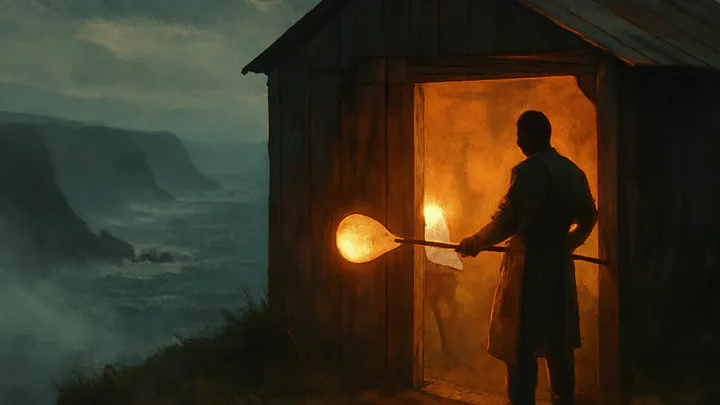
Ilma had not lit the furnace in eleven months, and she would not have lit it today either, except a stranger was climbing the cliff path with a wet paper bag in his hand.
She watched him from the shed window. He was young — younger than her grandson would have been — and he moved like someone who had been walking a long time and had decided not to be tired anymore. The wind pulled at his jacket. The paper bag darkened in his grip.
She opened the door before he knocked.
“You’re Ilma Vasar,” he said. Not a question.
“I was, last I checked.”
He held out the bag. “My grandmother said to give you this. She said you’d know what it meant.”
Ilma did not take it. She looked at the bag, at his hands, at his face — searching for a resemblance she was afraid to find. “Who was your grandmother?”
“Sofi Larren. She passed in the spring.”
The name went through Ilma like a small clean blade. She stepped back from the doorway, which he took, correctly, as an invitation, and came inside.
The Bag
The shed smelled of cold ash and linseed oil. Ilma had kept it swept out of habit, but the tools on the bench were dulled with a fine coastal dust, and the color rods in their wooden rack had gone chalky at the ends. She cleared a space and he set the bag down carefully, like it might complain.
Inside was a piece of green sea glass the size of a plum, worn to a soft frost, and a folded letter, and, wrapped in oilcloth, a small blue bottle stopped with wax.
Ilma sat down.
“I’m sorry,” the young man said. “I’m Teo. I should have said. She talked about you. Not often. But when she did, it was like she was reporting weather from another country.”
Ilma almost smiled. It sounded like Sofi.
She unfolded the letter. The handwriting was the same as it had been at seventeen — leaning, impatient, dotting its is with little circles even in old age.
Ilma, it said. I am dying, which is neither surprising nor important, but it means you should not wait any longer. You owe the sea a bottle. You have owed it since the summer we were nineteen. I have carried this glass since then in case you needed reminding. Please finish it. Yours in all the ways that count, S.
Ilma set the letter down and pressed the heels of her hands into her eyes.
“Do you know what she meant?” Teo asked.
“Yes.”
“Would you tell me?”
She thought about it for a long time. Outside, a gull was arguing with the wind. Inside, the furnace stood cold and patient, a black iron animal waiting to be woken.
“Light the fire,” she said. “Kindling’s in the crate. I’ll tell you while it heats.”
The Debt
“When we were nineteen,” Ilma began, “Sofi and I swam off the point at midsummer. It was stupid. The current there takes you sideways before you know it’s taken you at all. We both went under. I came up. She didn’t, not for a long time.”
Teo fed a splinter of pine into the little iron mouth. He did not look at her, which she appreciated.
“I made a promise in the water,” Ilma went on. “You have to understand — I wasn’t a superstitious girl. My mother had beaten that out of me by ten. But down there, with my lungs full of salt and my best friend gone, I promised the sea a gift. A proper one. A bottle of my own glass, sealed, with something worth keeping inside. If it would only give her back.”
“And it did.”
“It did. She came up ten yards from me, coughing like a cat. We crawled onto the rocks and lay there until the stars came out.”
“Did you make the bottle?”
“I started it. A hundred times. I’d get the shape and lose the color, or get the color and crack the neck. Nothing was good enough. Nothing was worth what I’d been given.” She laughed once, dryly. “Then I got busy. Then I got married. Then I got old. Then Aris died, and after that I couldn’t light the furnace at all.”
“Your husband.”
“My husband. Eleven months ago.” She looked at the blue bottle on the bench. “Sofi always kept one of my failed attempts. That one, I think. She used to say I’d finish it when I was ready to be finished with it.”
The kindling caught. Teo added a split of oak, then another, and the shed began to remember what it was for.
“What goes inside?” he asked.
Ilma picked up the sea glass. It was warm from the bag, or from her hand. “This does,” she said. “And a little of what I meant to say to her, and never did.”
She worked into the evening.
Her hands remembered before her mind did — the roll of the pipe, the breath held and released, the quick clean cut of the shears. The color she chose was a deep marine green, threaded with a single ribbon of gold. She shaped the body round and low, like a river stone. She made the neck narrow enough to trust.
Teo watched from a stool, silent, occasionally feeding the fire. He did not offer to help, which was the correct thing not to offer.
When the bottle was annealing in the small kiln, she wrote on a strip of paper: Thank you for the years. I’m sorry I took so long. She rolled the paper around the sea glass and, when the bottle had cooled enough to touch, slid them both inside and sealed the neck with wax the color of wet slate.
“Now,” she said.
They walked down the cliff path together. The tide was going out, which she took as courtesy. At the water’s edge she waded in to her knees — the cold shocked her breath loose — and set the bottle on the surface with both hands, the way you release a small bird.
It bobbed. It turned once, considering. Then the current took it sideways, the way currents do, and carried it out past the point where the water went dark.
She stood watching until she couldn’t see it anymore, and then a while after that.
Teo waited on the shingle with her boots.
“Was that all right?” he asked, when she came out. “What she wanted?”
“It was all right,” Ilma said. She sat down on a rock to pull her socks on, and found her hands were steady for the first time in almost a year. “Come up to the house. I’ll make you supper, and then I’ll teach you how to bank the furnace properly, so it’s ready in the morning.”
“In the morning?”
“I have work to do,” she said. “I’ve had work to do for eleven months. It turns out I only owed the sea one bottle. The rest were for me.”
Behind them, the tide went on about its business, carrying what it had been given, as tides do.