The Woman Who Rewound Wedding Videos
Marisela runs a tiny shop that transfers old wedding tapes to modern formats. One afternoon a client asks her to find something the camera never meant to record.
Drafted with AI. This version has not been reviewed by an editor, so it carries no ads — how we work.
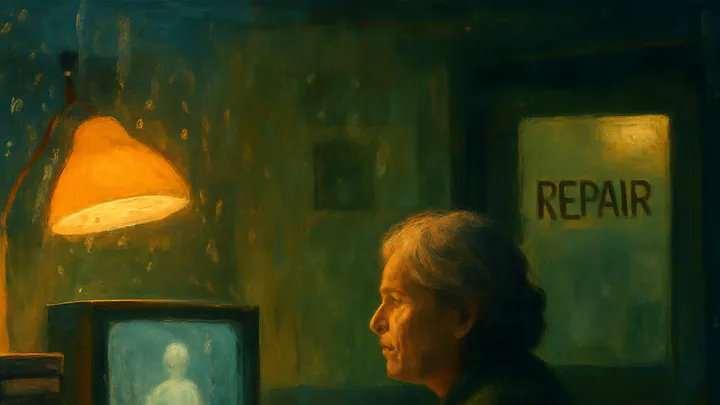
Marisela's shop smelled like warm dust and old ribbon, which is what magnetic tape smells like when you love it long enough. The bell above the door rang twice before she looked up, because the first ring, she had learned, was almost always the wind.
The woman standing in the doorway was maybe sixty, wearing a raincoat too heavy for April. She held a shoebox against her chest the way people hold sleeping cats.
"Are you the one who fixes the tapes?" the woman asked.
"I transfer them," Marisela said. "Fixing is a strong word. Sit, please."
The shop had one chair for customers, upholstered in a green that had once been brighter. The woman sat and set the box on the counter as if it might tip. Inside were four VHS cassettes, their labels handwritten in blue ballpoint: Elena & Tomas, Reception 1. Reception 2. Ceremony. Morning.
"My daughter's wedding," the woman said. "Nineteen ninety-four. I want them on something I can keep. A stick. Whatever people use."
"A drive," Marisela said. "Or a file I can put in a cloud for you. Both, if you like."
"Both." The woman folded her hands. "And I want to ask something else. Something maybe you can't do."
Marisela waited. She had learned that the second request was always the real one.
"There's a moment," the woman said. "After the ceremony. My husband kissed our daughter on the forehead. Just for a second. He died the year after, so — that was almost the last time I saw him do it. But the videographer was turned the other way. He caught the flowers instead."
"You want the moment."
"I want to know if it's anywhere. In the corner of a mirror. In a reflection. Anything. My eyes aren't good enough to look anymore."
Marisela nodded slowly. She had been asked stranger things — to remove a cousin from a christening, to isolate a grandmother's laugh from a christening choir — but never quite this. To find a thing the camera had missed on purpose.
"I'll look," she said. "I can't promise."
"I know," the woman said. "That's why I came to you and not the chain store."
The Transfer
That night Marisela threaded the first cassette into the deck she kept under a velvet cloth like a sleeping instrument. The machine hummed, warmed, and then the screen flickered awake into 1994: a church basement strung with paper bells, an aunt adjusting her hat, a flower girl eating cake with both hands.
Marisela watched at half-speed. She had trained herself, over twenty years, to see a wedding the way an editor sees one — not as a story but as a field of small evidence. The way a groom's thumb moves against his own palm when he is nervous. The way a mother-of-the-bride never quite lets her handbag down.
She found Elena on the second tape. A tall girl with her mother's mouth, laughing at something outside the frame. Beside her stood a man in a gray suit, his tie already loosened, his hand at the small of her back with the gentleness of someone who had held her since she was a baby.
"Hello," Marisela said to him, softly. She always greeted the ones she was looking for.
She watched all four tapes twice. She watched the ceremony three times. The videographer had been enthusiastic and clumsy — he loved sweeping pans, he loved the ceiling, he loved the flowers the mother had mentioned. When Elena and Tomas turned from the altar, he swung wide to catch the bouquet toss rehearsal in the vestibule, and for eleven full seconds the camera showed nothing but lilies.
Behind the lilies, faintly, Marisela could hear a father's voice say something she couldn't make out, and a daughter laugh a small wet laugh, and then a pause of the exact length of a kiss on a forehead.
But no picture. Not in any mirror. Not in the brass of a candlestick. Not in the polished side of the unity cup. She checked. She checked for two evenings.
On the third evening she sat back in her chair and pressed her hands against her eyes until she saw green.
What the Camera Kept
She almost called the woman to say she was sorry. Then she watched the Morning tape.
The Morning tape was the one nobody watches. It was the videographer arriving early, testing his levels, filming the empty church while someone tuned a violin in the next room. Bored footage. Marisela had transferred hundreds of these and knew that they were often the most beautiful things on the reel, because no one was performing.
At minute nine, the camera was set down on a pew, probably while the videographer went to find coffee. It faced the side aisle. For a long time nothing happened. A custodian crossed with a mop. A pigeon negotiated a windowsill.
Then Elena came in, in jeans and a sweater, her wedding dress over her arm in a plastic sheath. Her father followed with a garment bag and a paper cup. They didn't know the camera was recording. They probably thought it was off.
He hung the garment bag on the end of a pew. She set the dress down carefully. He said something — the audio was poor, but Marisela could read the shape of it: you sure? Elena laughed and nodded and leaned toward him, and he kissed her on the forehead, and held her there for a moment with his hand on the back of her head the way you hold something you are about to give away.
It lasted four seconds. The camera caught all of it.
Marisela sat very still. Then she rewound it and watched again, because that is what she did for a living, and because some things you watch twice out of respect.
She clipped the four seconds and, around them, thirty on each side — the walking in, the walking away — so it wouldn't feel stolen from context. She burned it to a small drive and slid the drive into a paper envelope. On the envelope she wrote, in pencil, Morning tape, 00:09:14.
The woman came back on Friday. She was wearing the same raincoat. Marisela gave her the drive with all four tapes transferred, and then, separately, the paper envelope.
"I couldn't find it during the ceremony," Marisela said. "I'm sorry. But there was a morning tape. Before anyone was ready. I think you should watch that one alone first."
The woman looked at the envelope for a long time without opening it. Then she pressed it against her chest, the way she had held the shoebox.
"How much do I owe you?" she asked.
Marisela named her usual price for four tapes. The woman paid in cash, in bills that had been folded and unfolded many times, and left without saying anything else, because some thank-yous are too big to fit in a shop.
Marisela locked up early that evening. She stood for a while at the window watching the street lamps come on one by one, the way they always did, in an order she had never quite been able to predict. She thought about all the tapes still waiting under her counter, each one holding at least one moment nobody had thought to save.
Then she turned off the light, and went home, and slept better than she had in weeks.