The Hyena Who Asked the Gate for a Name
A short story about a young hyena outside the walls of Harar who refuses to eat until the hyena man calls her by name, told by a grandmother to an argumentative grandson during a power cut.
Drafted with AI. This version has not been reviewed by an editor, so it carries no ads — how we work.
Story Time is original short fiction. The characters, places and events in this story are invented.
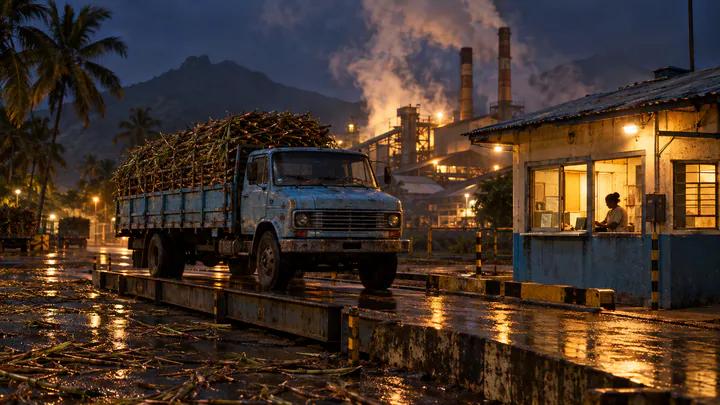
The refrigerator gave its last shudder and the whole of the old city went dark at once: every window down the lane, the light on the minaret, the television in the middle of a goal. Hamza said a word he had learned at school, and his grandmother said, "Hand me the matches, and then say that again so I can tell your mother."
He handed her the matches. Ayo Rahma lit the kerosene lamp, then the charcoal in the clay brazier, because if the power was going to be gone for three hours she might as well roast tomorrow's coffee now. The green beans went into the flat pan and began to tick.
"It'll be all night," Hamza said. "Abdirahman's brother says the dam is low because there's no rain."
"Then it's a story night."
"I'm eleven."
"Then it's a story for an eleven-year-old." She shook the pan. "Outside the walls, a long time ago, before electricity—"
"Everything was before electricity."
"—there was a young hyena who came every night to the old gate to be fed. And she had no name."
"Everybody has a name."
"Her clan called her Thin One. Last One. Get Back. Those aren't names. Those are directions."
Hamza pulled his knees up onto the cushion. He thought about it the way he thought about penalty kicks. "I'm calling her Qorrax," he said. His friend Abdirahman had taught him the word; it meant the sun. "Until she gets a real one."
Ayo Rahma considered this over the pan. "For now," she said.
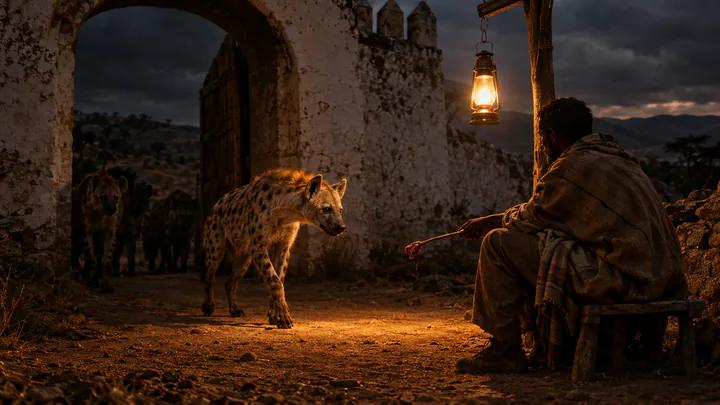
Qorrax lay in the dust below the wall, where the stones still held the day's heat, and watched the man come out through the gate. It was always the same. The lamp on its hook. The basket of scraps from the butchers in the market lanes, bones and fat and the parts nobody's wife would cook. The short stick. And then the calling.
"Bariso!"
The old matriarch rose, heavy in the shoulders, and walked into the light like someone going to collect a debt she was owed. She took the meat from the end of the stick, close enough to the man's face that he could have counted her whiskers, and walked back without hurrying.
"Kuluu! Dhaddacha! Gurracha!"
One by one the named ones went, and came back licking their lips. Then the man threw what was left into the dark for the rest, and the rest fought for it, and Qorrax, being last, got what the others dropped.
That season the rains were late. The hills beyond the walls had gone the colour of a lion's back. The herds came thin to market, the butchers kept more of every animal, and the basket was lighter each week. Qorrax could feel her own ribs when she lay down.
On the first night of the new moon she stood up before the scraps were thrown and said to the clan, "I'm not eating what goes into the dark any more. I'll eat when he calls me."
Kuluu laughed, the long rising laugh that carries over walls and makes children in their beds pull the blankets higher. "He called me after nine years," Kuluu said. "You'll be bones in nine days."
The meat landed. Her brothers were on it. Qorrax lay down with her chin on her paws and did not move.
"That's stupid," Hamza said. "She should eat the scraps and ask later. You can't ask for anything if you're dead."
"You think the old ones didn't tell her that?"
"So why's she doing it?"
The beans had gone brown and were beginning to smoke and crack. Ayo Rahma carried the pan across and waved it under his nose, the way she did for guests, so the smell would be the first thing they took. "Because she'd been eating what was thrown for two years," she said, "and nobody ever looked up."
The hyena man noticed her on the third night, because she was the only one in the dark not moving.
His name was Yusuf, and his father had fed the hyenas at that gate before him, and his father's father before that. The old man had told him one thing about names that he had never forgotten: a name is not a gift. It is a promise. When you call a name, you are saying, I will be here tomorrow, and I will have something for you.
He had nine names already. Some nights in this dry season the basket held enough for six. He sat on his stool with the stick across his knees and looked at the thin one lying apart from the others, and he thought: I cannot make promises I may not keep. Not this year.
So instead he threw a good piece of fat, deliberately, so that it landed a paw's length from her nose. She did not lift her head. Her brother came out of the dark and took it, and she let him.
Yusuf went home and told his wife about it over the last of the coffee. "She's waiting for something," he said.
"Then give it to her."
"It isn't that simple."
His wife turned the cup in her hands. "It never is, with you," she said, and went to bed.
"He's mean," Hamza said.
"He's careful. Careful looks mean from the outside."
"If I were her I'd go to a different gate. Go round to the other side. Different man, different basket."
"There were hyenas at every gate," said Ayo Rahma, pounding the roasted beans in the wooden mortar. "Every gate has its last one."
By the sixth day Qorrax walked to the stream in the ravine and found it gone to a string of puddles, green at the edges. She drank, and the drinking made her legs shake. In the afternoons she lay under the thorn trees and listened to the market through the wall: the women calling prices for onions and baskets, the donkeys, the clatter of coffee being sorted on trays. Everyone in there had a name. Even the donkeys.
Kuluu came and stood over her. "Go on, then," Kuluu said. "Starve properly. It's more entertaining than you've ever been."
On the seventh evening the clouds piled up over the eastern hills, dark and tall, and did not break. Qorrax climbed the slope to the gate slowly, stopping twice. She lay down closer to the lamp than she had ever lain.
"Bariso!" the man called. "Kuluu! Dhaddacha!"
Nine names. Nine pieces. Then there was one scrap left on the stick, and the man held it there, and looked into the dark straight at her, and did not say anything at all.
"Does he call her?" Hamza said. He had stopped pretending to look at his phone, which was dead anyway.
"What do you think she does?"
"Waits."
"She'd waited seven nights," said Ayo Rahma. "She'd waited two years." She tipped the ground coffee into the jebena and set it on the coals, and for a while there was only the sound of the water beginning to move.
Qorrax stood up.
She walked into the lamplight past Bariso, who rumbled low in her chest and did not stop her. She walked past Kuluu, who had nothing to say. She came so close to the man that she could smell the market on his hands and the coffee on his breath, and she took the last meat off the end of the stick. Nobody had called her. She had simply come.
Yusuf felt the tug on the stick, and the teeth close a finger's width from his face, and he did not flinch. He watched her chew, standing in his light as if she had always stood there.
And he understood that the promise had been made after all. Only not by him. She was telling him she would be here tomorrow.
He took the stick from his mouth, and he said something to her.
"What?" Hamza said. "What did he say?"
Ayo Rahma poured the coffee into the small cups, the first round, the strong one. "I don't know," she said. "You decide."
"You have to know. It's your story."
"It's hers now." She set a cup in front of him, though his mother said he was too young for the first round. "And yours."
Hamza turned the cup without drinking it. He thought about Strong, and Brave, and names from football. They all sounded like things a man would say to a dog.
"He called her Qorrax," he said.
His grandmother raised her eyebrows. "In a year with no rain, he named her after the sun?"
"The sun doesn't wait for anybody to call it up," Hamza said. "It just comes."
Ayo Rahma looked at him for a long moment over her cup, and said nothing, which from her was more than a compliment.
The refrigerator shuddered back to life. Out in the lane the windows came on one by one, and the television burst into the middle of a different match, a crowd roaring about something that had already happened. Hamza got up, crossed the room, and switched it off. Then he switched off the overhead bulb as well and sat back down in the lamplight.
"So what did she do the next night?" he said.