The Fog Nets on the Hill Above Lima
A short story about a Lima seamstress who has tended her hillside's fog-catching nets for thirty years, told backwards from the vote that could hand the hill to a water company.
Drafted with AI; reviewed by Azka Shahid on . How we work.
Story Time is original short fiction. The characters, places and events in this story are invented.
August 2049
Yesenia chalked the last five-bar gate onto the blackboard and stepped back so the hall could see it. Two hundred and twelve for the Brumal contract. One hundred and forty-one against. Rosaura, at the trestle table in front, finished the hem she had been stitching through the whole count, bit the thread, and folded the trousers over her knee.
“The motion carries,” she said. Her voice did the job. It always had.
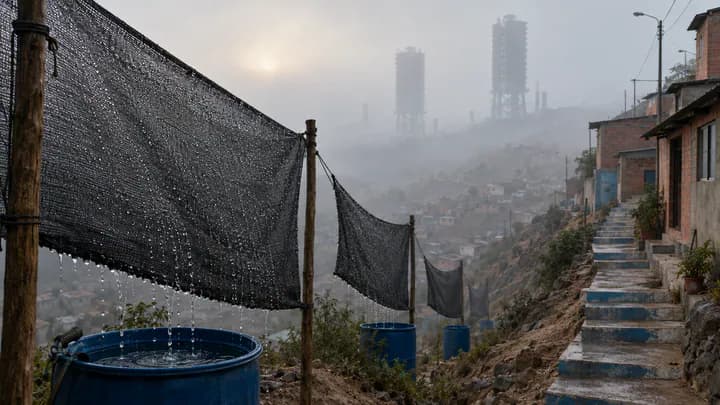
The comedor smelled of wet wool and the quinoa from lunch. The garúa pressed against the windows, the same grey as every winter of her life, and somewhere above the roofline thirty-one nets were drinking it.
Wilmer Ccori stood first, cap in both hands. “Señora Rosaura. Nobody here is ungrateful.”
“I know, Wilmer.”
People filed past to sign the register. Some touched her shoulder. Some didn’t look at her at all, which was worse. The contract lay open at clause nine: the upper slope, from the painted stairs to the ridge, transferred to Brumal Hídrica for the siting of eleven condensation towers. Clause fourteen, read so often the page had gone soft: piped water to every registered household, metered, the first eight cubic metres each month fixed at this year’s tariff for twenty-five years.
Joaquín waited until the hall was nearly empty. He had worn his own jacket, not the blue one with the company’s droplet on the chest, and she loved him for it and was angry that he’d thought he needed to.
“Mamá.”
“You recused yourself very nicely.”
“Eight cubic metres,” he said. “Fixed. Nobody else in Lima got that. Brumal’s lawyers still don’t know how you got that.”
“I got a price,” Rosaura said, “on something that used to fall out of the air.”
She put the trousers in her bag, took the yield book from under the table, and went up the stairs into the mist to tell the nets.
March 2046
The office on the nineteenth floor in San Isidro had no smell at all, and Rosaura kept the rice sack on her lap so it wouldn’t touch the carpet.
“Our satellite models put the condensation band between three hundred and forty and four hundred metres,” said Ingeniero Bustamante. His tablet showed her hill in false colour, orange and violet, as if it were sick. “Give or take.”
“Give or take what?”
“Where the towers should go. Which is the expensive part.”
Joaquín sat by the window, very straight, a first-year engineer being allowed into a room. On the phone he had said: Mamá, just listen to them. Don’t bring the books.
She untied the sack and stacked them on the glass table: twenty-seven school exercise books, then nine ledgers, their covers furred with damp. “Every net. Every morning. Litres, wind, which way the garúa came in. My mother started it. My son kept it for six years when he was little. You can tell his numbers because his sevens wear hats.”
Bustamante opened one. He turned the pages more slowly than he meant to.
“We’d pay for a digitised copy, of course.”
“I don’t want money.”
“Señora—”
“The first eight cubic metres,” Rosaura said. “Every household. A fixed price. Twenty-five years. In writing, before anybody votes.”
Joaquín looked at her as if she had taken off a mask. In the lift he said, “You were negotiating.”
“I was refusing,” she said. “Slowly.”
October 2038
Somebody had pegged out the hillside in the night. Rosaura found the stakes at six, pine sticks tied with orange ribbon, running in neat rows between the nets where the tara saplings were coming up green on fog water.
Joaquín, seventeen and all elbows, was already yanking them out and throwing them into a drum. “Don Pascual’s people. They’re selling lots at the bottom for four thousand soles. Lots on our hill.”
“On the community’s hill.”
“That’s what I said.”
Don Pascual came up himself at nine, in a white shirt the mist was slowly turning grey. He admired the nets as if he had strung them. “Beautiful work, señora. Shame the municipality has never recognised—”
Rosaura took the folder from her apron. The title had come three weeks earlier, after nine years of hearings: the upper slope, communal property of the Asociación Atrapanieblas Nueva Esperanza, on proof of continuous productive use. The proof was the yield books. The proof was a clerk reading nineteen years of litres aloud until her supervisor told her to stop.
Don Pascual read it, and for a moment his face did something private.
“Paper,” he said. “Paper can be bought.”
“Then you’ll have to buy it from us,” Rosaura said, “and we’re very slow.”
When he had gone, Joaquín sat on an upturned drum with an armful of stakes. “When I’m an engineer I’m going to build something that does this properly. Not knots. Not you on a ladder at sixty.”
“I’m forty-five.”
“You know what I mean.”
She did. She took the stakes from him and used them to prop the drip channel under net twelve.
June 2029
The treadle machine jammed on the third seam, and Rosaura swore at it in Quechua, the way her mother used to. The new mesh was coarse green shade cloth from a market stall, not the fine black raschel the foundation had brought ten years ago, and it fought the needle.
“Net four, Tuesday, eleven litres,” Joaquín read from the exercise book, cross-legged on the roof. He was eight and took the job seriously. “Net four, Wednesday, nine. Mamá, why do we write it down if it’s already in the drum?”
“Because the drum forgets.”
Downstairs, Yesenia and three other women were arguing over forms spread across the cutting table. Statutes. A founding act. Seven signatures and a notary who charged three hundred soles.
“It’s paper for paper’s sake,” Yesenia called up the stairwell. “The water doesn’t care if we’re an association.”
“The municipality cares.”
“The municipality has never climbed these stairs.”
“Then we carry the paper down to them.” Rosaura freed the bobbin and ran the seam. Her mother’s nets had lasted six winters each, near enough; the poles less, because people burned eucalyptus when the cold came. Every year since the funeral she had restrung alone, and every year the hill had stayed exactly as poor as it was.
“Net four,” said Joaquín. “Friday. Seventeen. That’s the best one.”
“Put a hat on the seven,” she said, “so nobody mistakes it.”
She went down and signed first.
July 2019
Her mother had the wire between her teeth and both hands on the pole, and was not going to let go to say anything, so Rosaura tied the top corner herself and got it wrong.
“Again,” said Felícita, around the wire.
It was five in the morning. The bus to the garment workshops left the bottom of the stairs at ten past six, and a hundred and forty collars were waiting for Rosaura with a supervisor who docked by the minute. The garúa was so thick she couldn’t see the second pole, only hear the man from the foundation somewhere above them, tamping earth.
She retied the knot. The black mesh, four metres by eight, filled with wind and stood up off the hill like a sail.
“There,” said her mother, spitting the wire into her palm. “Now we wait.”
“How long does it last?”
“The cloth? Five years, six. The sun eats it.”
“Then what’s the point?” Rosaura heard herself, twenty-six and tired and already late. “The truck still comes. We’ll still pay him.”
Felícita looked down to where the city’s lights showed through the mist in patches, then back at the net.
“It isn’t meant to last, hija. It’s meant to buy time. Nobody bargains with people dying of thirst. They just sell to them.” She tapped the pole. “One day somebody will want this hill. When they come, I want people up here who don’t need them yet.”
“And then?”
“Then you make them pay properly. And you take the nets down.” She shrugged. “You’ll hate it.”
The first drop gathered on a thread at the bottom of the mesh, swelled, and ran down the split-pipe gutter into the blue drum with a sound like a fingernail on tin. Felícita took a school exercise book from her bag and held it out with a pencil.
Thirty years later, standing among thirty-one nets with the tally still chalked on the board below, Rosaura would turn back through every page to this one and understand that she had never been refusing. She had been keeping the hill alive long enough to name its price, and it had.
Now she wrote the date at the top of the page, and under it the first number, a zero, round and careful. Then she ran for the bus.