Reel Seven Arrives a Day Early in Baku
A short story about a widowed projectionist in 1971 Baku who finds that one reel of every film shows his seafront street as it will look tomorrow, and must decide what to do with it.
Drafted with AI. This version has not been reviewed by an editor, so it carries no ads — how we work.
Story Time is original short fiction. The characters, places and events in this story are invented.
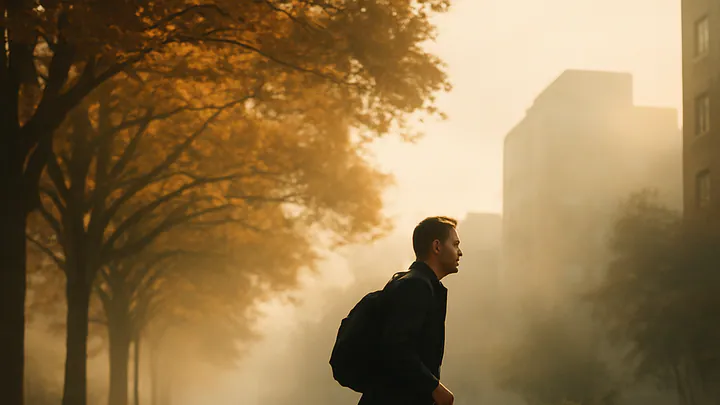
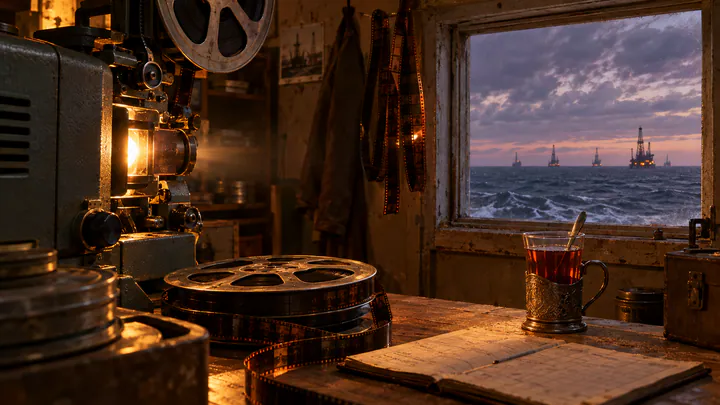
4 October 1971. Delivery from the regional film distribution office: Spring on the Kura, reels 1–6 and 8. Reel 7 was already in the rack when I came up at noon. I did not see who brought it. The tin is ours, the label is theirs, the footage card says 980 feet. I measured 1,046. At 610 feet, after the agronomist drives off on the tractor, there are 66 feet that belong to no film. They show our street. Ilyas and his pomegranate barrow at the corner, the barrow dragging on one wheel. Novruz's café with the awning half down. The number 2 tram at the top of the hill. Grey light, wind from the north. Ten seconds, then forty, then the agronomist again. Cemented both joins. Carbons changed at 21:10. Tea.
5 October. Ilyas's barrow lost a wheel at eleven this morning. He pulled it to the corner with a rope, swearing at it, exactly as on the strip. The khazri came up at four. Novruz wound the awning halfway and it jammed. I cut the 66 feet out of reel 7 and re-joined it to the original 980. The loose piece is in Saadat's old biscuit tin under the rewind bench. She would have asked me what I was going to do about it. I am going to do nothing. I am a projectionist.
11 October. The Lighthouse Keeper's Son, seven reels. Reel 7 arrived yesterday, a day before the others, in the rack again. Inside it, 59 feet of tomorrow. The number 2 tram comes down the hill and does not slow at the stop. The driver, the young woman with the plait, Sevda, pulls the handle with both arms. The tram runs through the corner where Ilyas stands. The strip ends before it reaches him. I ran it three times on the bench to be sure. Then I sat with the tea going cold.
12 October. Went to the depot at six. Told Sevda I had heard a grinding from the brakes on her car yesterday, that my late wife's brother was a tram fitter. I have no such brother-in-law. She looked at me as if I had come to propose. The fitter took the car off the line anyway and found a cracked brake shoe. At eleven a different tram came down the hill and stopped where it should. Ilyas sold me two pomegranates and asked why I was standing in the street instead of sleeping. Cut 59 feet from reel 7. Biscuit tin.
14 October. Comrade Qasimov came up during reel 4. He had the footage cards from the office and his reading glasses. "Three new joins in reel 7 this fortnight, Tofiq. The office counts feet. The office will ask me what my projectionist eats." I said the stock was brittle, the joins had been weak. He said the joins were the neatest he had ever seen, and that was the problem. He stayed for the change-over to watch me. I did not miss the cue.
19 October. Bread and Salt, eight reels. Reel 7 early, as I now expect. The tomorrow-piece is 34 feet. Shorter. I measured twice. Firuza khanum on her balcony on the second floor of the house with the green shutters, shaking out the red carpet over the railing. The railing leans. The carpet goes first. The strip ends there, on the carpet falling, and her hand still holding a corner of it.
20 October. Knocked at seven. Told her I had seen rust at the base of the railing from the street. "Since when does Tofiq look at balconies?" she said. "Since when does Tofiq look at anything but his machines?" Her grandson tested the railing with his boot and a section came away in his hand. They tied it with wire and she shook the carpet off the side of the stairs instead, giving me a look the whole time. By evening the courtyard knew that the widower from the cinema had been at Firuza khanum's door before breakfast. Novruz poured my tea at the café and said nothing, which is how Novruz says a great deal.
Thirty-four feet is twenty-three seconds. Fifty-nine feet was forty. Sixty-six was forty-four. I have been doing the arithmetic on the back of the carbon order.
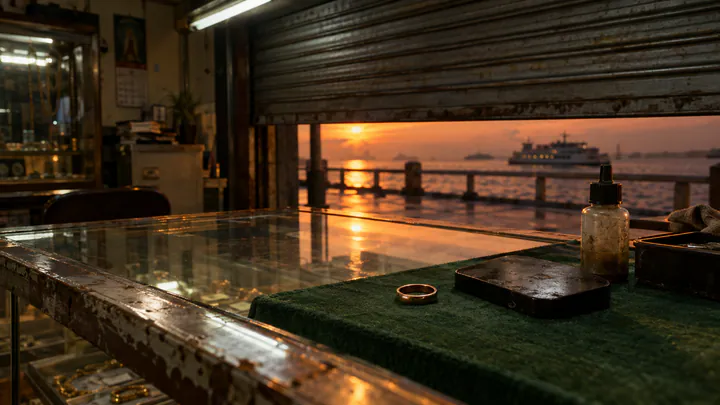
26 October. Night Ferry to Krasnovodsk. Reel 7 early. Eleven feet. Seven seconds and a half. A red scarf on the sea wall below the boulevard. The scarf is Gülnar's, Novruz's girl, who goes to the wall after school to look at the derricks and count the flares. The water comes over in a grey sheet. The strip ends. The light in the strip is late, orange, so after five. There is no time in it to understand anything.
27 October. At half past four I went down to the café and asked Novruz if Gülnar would like to see how a carbon arc is struck. He looked at me for a long time, then called her. She is fifteen and was bored by the booth for about two minutes, then not bored. I showed her the rods, how to feed them, the positive and the negative, how the crater forms and goes white. She burned her finger on the lamphouse and did not cry. At 17:40 from the booth window we watched the water come over the wall below the boulevard and drag a bench six metres. She said, "I sit there." I said, "Not today."
Qasimov found her in the booth at the change-over for reel 3. Unauthorised person, fire regulations, a girl, a widower. He used all these words. He said one more irregularity and he would write to the office and ask for someone younger who sleeps at night. I did not argue. Cut 11 feet. Biscuit tin.
28 October. Novruz would not take money for the tea. He did not ask how I knew. Gülnar did. I said the wind had told me. She said that was a stupid answer for a man who writes down every single thing. She is right.
2 November. The Orchard Keeper, eight reels. Reel 7 early.
I expected one foot, or nothing. It is 412 feet. Nearly five minutes.
It is our lane. Not one accident, the whole lane. Morning, a lorry from the city executive committee at the corner, a crane with a ball, men in orange vests. The house with the green shutters. Novruz's café, the awning down for good. Firuza khanum's carpet rolled and tied with string on the pavement beside her wardrobe and a sewing machine. Ilyas's barrow full of someone's plates. The plane tree in the courtyard where Saadat used to hang the washing. The crane swings. The ball does not hit anything in the strip; it only swings. Then the people standing on the pavement, every one of them, looking up at their own windows, for a long time. The camera, if there is a camera, does not move.
Everyone knew the order had been signed. A new block of flats, nine storeys, with lifts. Everyone also knew such orders take years. This one does not take years. It takes until tomorrow.
There is no brake shoe here. There is no railing to wire. I cannot go to the executive committee at six in the morning and tell them I heard a grinding.
I sat with the tin open on the bench until the tea was cold and the khazri had stopped.
2 November, continued, 18:50. I did not cut it.
I took the 412 feet out of reel 7 and spliced them onto a leader and laced them on projector one as a short before the feature. I did not tell Qasimov. I did not put a card in the window. The hall was half full: Novruz and Gülnar, Firuza khanum and her grandson, Ilyas with his hands stained red, Sevda from the depot, the families from the lane who come on Tuesdays because it is cheap.
Struck the arc at 19:02. Lights down. Our lane came up on the screen.
No one spoke for the first minute. Then Firuza khanum said, "That is my sewing machine," in an ordinary voice, as though pointing it out at a market. Someone laughed, and stopped. Gülnar stood up to see better and nobody told her to sit down. When the people on the screen stood looking up at their windows, the people in the hall were very quiet, and I could hear the projector, the shutter, the hiss of the carbons, as I never hear them.
The leader ran out. I put the feature on. Nobody watched the feature. They went out in pairs and threes during the first reel. Qasimov came up the stairs and stood in the door of the booth with his glasses in his hand. I thought he would say "irregularity." He said, "My mother lives on that lane," and went back down.
Ran the feature to the end for eleven people and the cleaner. Carbons changed at 21:15. I did not have my tea.
3 November. Up at five. When I came down, the lane was already awake. Lamps in every window. Novruz had carried his tables out into the courtyard under the plane tree, and the samovar, and somebody had brought a gramophone. Firuza khanum was wrapping her plates in newspaper and telling everyone which ones were from her wedding. Ilyas had brought a whole sack of pomegranates and was splitting them with his thumbs. Gülnar went from house to house with her father's camera, the old one, photographing every door before the lorry came. She photographed mine. She photographed me at it, holding a glass of tea someone had put in my hand.
The lorry came at nine, as on the strip. The foreman got down and found forty people sitting at tables in the courtyard, eating, with their furniture stacked neatly on the pavement and their papers in order. He did not know what to do with his hands. Novruz poured him a glass too.
They did not stop it. I do not think anyone thought they could. But no one was asleep when it came, and no one was surprised, and no one stood looking up at their windows for very long.
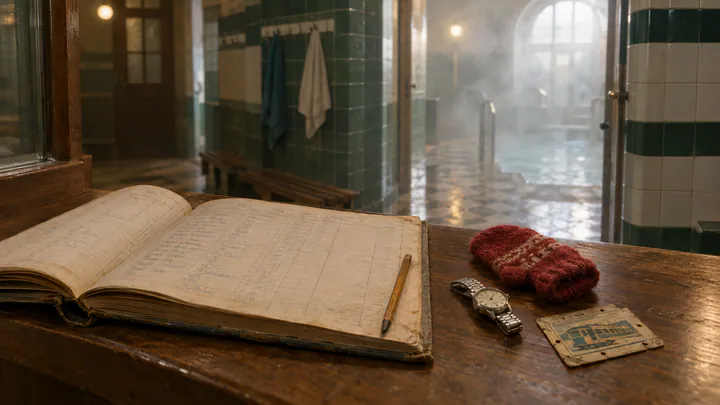
I have put the biscuit tin, all of it, the 66 feet and the 59 and the 34 and the 11, on the shelf beside the logbook where anyone can see it.
4 November. Delivery from the office: The Long Summer, reels 1–8, all eight together in the van, all labelled. Reel 7, footage card 1,000 feet. I have not measured it yet. It is on the rewind bench. Qasimov has asked to be told what is on it before I cut anything. I said I would tell the whole hall.