The Bishop Moves Again from a Closed Address
A short story about a retired customs clerk in 1996 Asunción who receives a chess move by postcard from a club member buried three months ago, and follows the postmark across the city.
Drafted with AI. This version has not been reviewed by an editor, so it carries no ads — how we work.
Story Time is original short fiction. The characters, places and events in this story are invented.
The postcard came up the stairs pinched between Don Pancho’s thumb and forefinger, smudged with contact cement from the shoe repairer’s bench below, and Ramiro knew the handwriting before he read the move. Square capitals, the A for alfil drawn like a little tent with a crossbar.
23. Ab5. Saludos, A. Giménez.
“Your ghost again,” Don Pancho said, and went back down to his heels and soles.
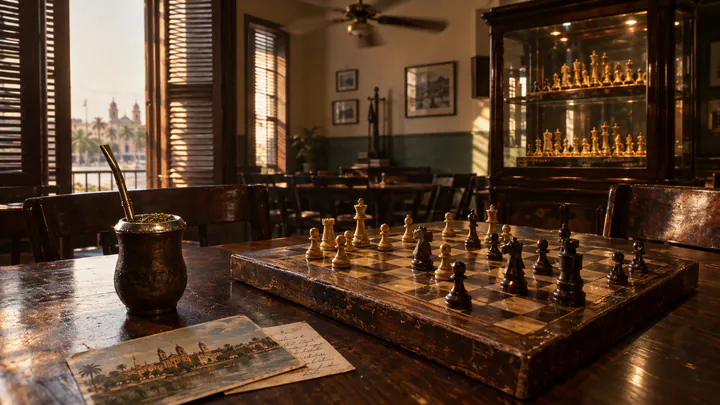
Ramiro laid the card beside the board on the corner table, where the game had stood untouched under a sheet of newspaper since August. The ceiling fans turned without conviction. Outside on Calle Palma a colectivo ground its gears and coughed black at the pigeons. Néstor Villalba sat by the window with the horn guampa between his knees, the bombilla in his mouth, cold water and crushed mint and burrito leaves sweating through to his trousers.
“He’s playing from Recoleta now,” Néstor said around the straw. “Say what you like about the cemetery, the post is faster than from Encarnación.”
Gustavo Insfrán, who was president because nobody else would be, came out of the back room holding a folded paper as if it smelled. “Señor Duarte came by the shoe shop this morning. Three months. Four hundred and fifty thousand guaraníes by the thirtieth or he gives the room to a man who repairs televisions.” He tipped his head at the glass case on the far wall, where Anselmo’s boxwood set stood in its two armies, the kings with their little carved crosses, older than anyone in the room. “There is a dentist in Villa Morra who will give six hundred for it. Anselmo left it to the club. The club needs a roof. I don’t see the mystery.”
“The game isn’t finished,” Ramiro said.
“The man is buried, che ra’a. That is about as resigned as a person gets.”
Ramiro lifted the newspaper off the board and set the white bishop on b5. He had spent forty-one years at the customs house on the river opening crates that were declared as one thing and contained another, and he had learned that people lied most comfortably about small things. He looked at the bishop. Two moves ago Anselmo had put it on c4. Now it went again.
Anselmo Giménez had a saying he repeated so often the members used to mouth it with him: Moving a piece twice is paying for the same stamp twice. He was a cautious, grinding player who liked to build a position the way a mason builds a wall, and in eleven months of postcards he had never once wasted a tempo on a piece already working. Ab5 was not a bad move. It was a sharp one. It went looking for trouble on purpose. It was, Ramiro thought, a young move.
He turned the card over. The postmark was the Correo Central, the seventh of November. The first two cards after the funeral he had let himself blame on the mail, which in Paraguay could take a week to cross a street. Not this one. And the return address, as always, was the house in Sajonia, number 1140, which Gustavo had walked past in September and reported nailed shut.
Ramiro put on his hat.
“Where are you going in this heat?” Néstor asked.
“To post a reply,” Ramiro said, which was nearly true.
The Correo Central on El Paraguayo Independiente smelled of floor wax and damp paper. The girl at the second window, Liz, had sold him stamps for six years and still called him señor as if it were the first time. He showed her the card.
“Thursdays,” she said at once. “After school, half past one. A boy in the Colegio Nacional uniform. He pays in coins and counts them twice.” She looked at Ramiro over her glasses. “He asks for the cheapest stamp that will get to Calle Palma. Every time. As if it might have changed.”
“Tall? Short?”
“Thin. Ears like a taxi with the doors open.” She smiled despite herself. “Is he in trouble?”
“Not yet,” Ramiro said.
He took the Line 9 out toward Sajonia, standing because the seats were sticky, the bus windows propped open with folded cardboard. The sky over the bay had gone the colour of a bruise, the heavy yellow-grey that meant rain by four. The chivato trees along the avenue were coming into their red, dropping petals on the bonnets of parked cars.
Number 1140 was as Gustavo had described: planks across the front windows, a padlock on the iron gate, the paint peeling off the shutters in curls like pencil shavings. But Ramiro had not spent four decades in customs for nothing. The weeds along the side path were trodden flat in a single narrow line. The tin mailbox on the gatepost was empty. A grey cat sat on the wall above it, well fed, washing a paw with the air of someone expecting dinner on schedule.
Somebody was collecting his postcards.
Next door, a woman in an apron was watching him through a kitchen window full of basil in coffee tins. When he raised his hat she opened the side door before he could knock.
“You’re the one from the chess,” she said. “Ramiro. He described you. He said you’d come eventually.” She stood aside. “Come in before it starts. I’m Celestina Ojeda.”
Her kitchen was hot as a bread oven and smelled of onion and cheese; a tray of sopa paraguaya was cooling on the table under a cloth. She set out a chair for him without asking whether he wanted to sit.
“Anselmo’s grandson,” she said. “Tadeo. His mother took him to Lambaré after the funeral, and the house is in the courts with the brothers, so they nailed it up. But the boy comes every afternoon on the bus. Feeds the cat. Sits on the back step with that little magnetic board his grandfather gave him.” She cut a square of sopa and put it in front of Ramiro on a saucer. “He asked me not to say anything. I said I wouldn’t say anything unless someone asked. You’re asking.”
The rain arrived all at once, hammering the corrugated roof so loudly they stopped talking. Through it came the clang of the gate next door, and then a thin figure in a white school shirt went past the window at a run with a plastic bag held over his head. Celestina leaned out and called his name, and after a long moment the boy came to the side door, dripping, and saw Ramiro, and went the colour of the chivato flowers.
“I wasn’t cheating,” Tadeo said, before anyone had accused him of anything.
“I know.”
“He dictated the moves from the hospital. I wrote them out because his hand shook. He had a notebook with the whole plan.” The boy’s ears stuck out exactly as advertised. He did not sit down. “The notebook stops at move twenty. After that it was me.”
“Ab5,” Ramiro said.
Tadeo’s chin came up. “Is it wrong?”
“It’s not his. He’d never move a bishop twice.”
“‘Paying for the same stamp twice.’” The boy said it in his grandfather’s gravel, and for a second the kitchen held both of them. “I know. But the bishop was doing nothing on c4. He would have seen it, if he’d had time.”
Ramiro thought he might have. He thought Anselmo, given another year, might have learned something from this boy. “You play a sharp game. You should come to the club. Thursdays and Saturdays. There’s a table by the fan nobody wants because Néstor talks.”
“It’s a place for old men who already know everything.” Tadeo looked at the floor, then made himself look up. “And it costs money. My mother has enough to think about.” He pushed his wet hair back. “I’ll come when I can beat you. Not before.”
“Then we should keep playing.”
The boy nodded. Then, carefully: “Are they going to sell his set?”
Ramiro took a bite of the sopa, which was very good and too hot, and gave himself time to swallow. “Not while the game is alive,” he said.
By the time he climbed the stairs past Don Pancho’s bench again the rain had stopped and Calle Palma was steaming. Gustavo was still there, adding columns on the back of the rent notice.
“Well?” Gustavo said. “Did you find the ghost?”
“I found the player. White is not resigning. And we have a new member from this month.”
Gustavo put down his pencil. “A member who pays?”
Ramiro took out his wallet, counted fifteen thousand guaraníes into the cash tin, and wrote in the ledger in his customs-house hand: Giménez, Tadeo. Noviembre. Pagado.
“Fifteen thousand,” said Gustavo. “Only four hundred and thirty-five to go.”
“The set stays until the game ends,” Ramiro said. “Put it to a vote if you like.”
Gustavo looked at the glass case, and at Néstor, who had become very busy refilling the guampa, and did not put it to a vote.
Ramiro sat at the corner table and studied the position for half an hour while the fans turned. There was a gentle reply, a quiet knight move that would let the boy keep his bishop and his pride a while longer. There was also rook takes e6, which opened the file and would cost White the bishop in four moves if he didn’t see it coming. Anselmo would have wanted the rook. The boy, Ramiro suspected, would want it more.
He wrote 24. Txe6 on a fresh postcard, then took a blank membership card from the drawer, filled in number forty-eight, and slid both into an envelope addressed to the house in Sajonia, care of the cat. He licked the stamp, the cheapest one that would get there, and went down the stairs to catch the evening collection.