You Paint the Letters, and Then They Happen
A short story about a Kathmandu sign painter whose lettering tends to come crookedly true, and a widow who asks him to sign a brass workshop that never opened.
Drafted with AI. This version has not been reviewed by an editor, so it carries no ads — how we work.
Story Time is original short fiction. The characters, places and events in this story are invented.
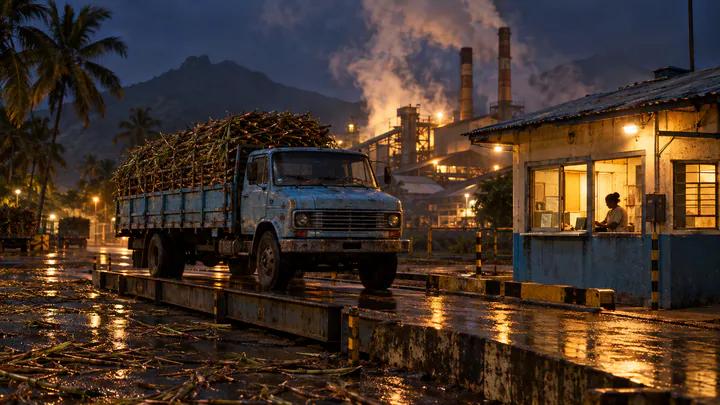
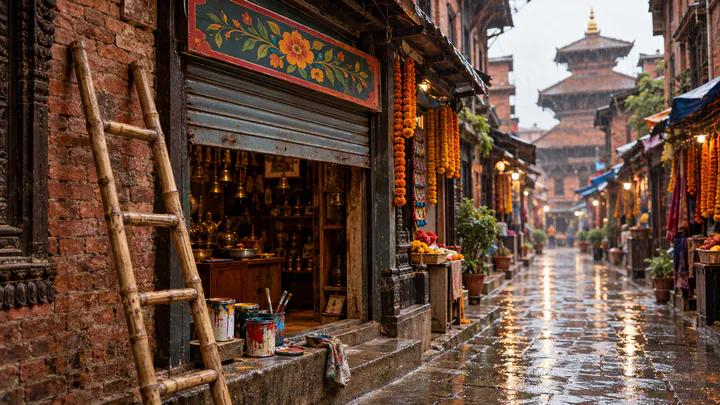
On Sunday the pharmacist at the corner of Asan wants three words, OPEN ALL NIGHT, and you give them to him in red enamel with a white drop shadow, each stroke pulled once and never patched, the way your guru beat into you thirty years ago. Suman holds the bamboo ladder. Rain ticks on the tarpaulin you have lashed over the shutter, and below the Annapurna shrine the marigold sellers shout prices at one another as if prices were insults.
"Now he'll be open all night," Suman says, not looking up. "Poor man."
You both know what he means. In 1988 you lettered CLOSED SATURDAYS for the cloth merchant in Indra Chowk, and since then he has not sold a single metre on a Saturday, even with the shutter up and the bolts of cotton stacked on the step; people walk past as if his shop were a wall. You lettered FRESH DAILY for the sweet-maker on the Bhotahiti side, and he has not slept past four in eight years. Things arrive. They never arrive in the shape asked for.
The pharmacist pays you two hundred rupees and mentions, while counting, that the vinyl man would have done it for one-forty.
The vinyl man is Rajan, who opened in Baisakh with a machine from Singapore that cuts letters out of coloured sticky sheet. Since Baisakh your commissions have halved. Since Baisakh, Suman has been going to a manpower agent in Putalisadak about a fitter's job in Doha, two years, sixty thousand rupees in fees that his mother, your sister, is ready to borrow against her bit of land in Bhaktapur. He is twenty-two. Last month he resoldered the cracked lids of your enamel tins with a bicycle-spoke iron heated on the kerosene stove, and the lids close now like they were bought yesterday. You have not told him that these are not sign-painter's hands. You need him to believe they are.
On Monday a woman in a white sari with a mustard-coloured shawl over her head stands at your stall and waits for you to finish a number on a door frame before she speaks. You know her a little. Hira Maya Shrestha. Her husband Purna had the brass shop that was meant to open behind the Ganesh shrine, the shutter that has been padlocked since spring.
"He paid six months ahead," she says. "Then Asar came and his heart stopped on the stairs. The landlord says the rent is the rent." She takes a folded paper from her blouse. On it, in Purna's careful schoolboy hand: SHRESTHA & SONS, BRASS REPAIRED.
"You had sons?" you ask, though you know.
"We had no sons." She looks at the paper rather than at you. "He said the sons would come once the sign went up. He was a man who believed in signs. Everybody in this bazaar says you are the one to do it. You know why they say that."
You tell her the rain is bad for enamel, that in this weather the paint stays tacky for days. You tell her to come back. She offers five hundred rupees, which is two weeks of work you do not have, and you still tell her to come back. When she has gone, Suman picks up the paper and reads it twice.
"Five hundred," he says.
"I heard."
On Tuesday Rajan comes by with a cob of roasted corn, salt and chilli on his fingers, and leans on your ladder without asking.
"I heard about Shrestha-ni's sign," he says. "Let me take it, dai. Overnight. Hundred and fifty. My letters don't peel in rain." He chews. "And you, come and run the machine for me. You know letters better than anyone in Kathmandu. Why waste your hands on tins?"
He is not unkind. That is the worst of it. When he leaves, Suman says, very carefully, that a salary is a salary.
"And then you could go to Doha with a clean conscience," you say.
He wipes a brush on a rag for a long time. "Medical's on Thursday," he says.
On Wednesday it rains so hard the gutters of Asan run brown with turmeric dust from the spice sacks, and nobody wants a sign. Hira Maya finds you under the tarpaulin and takes you both to the shutter behind the Ganesh shrine. She works the padlock with both hands. Inside it smells of metal and old oil. Purna's anvil sits on a block of sal wood. Files hang in order of size on nails. A blowpipe, a pot of borax, a tin of rosin. On the bench a brass water jug, a karuwa, split along its seam.
Suman picks it up and turns it toward the grey light from the lane.
"This only needs a solder," he says. "Silver, maybe. Not much."
"Purna would have done it in an hour," says Hira Maya. "It's mine. My mother's."
That night you lie awake listening to the rain on the tin roof and running through the shapes that & Sons might take when it arrives for a sixty-year-old widow. Men from a village nobody has heard of, claiming Purna as their father and the shutter as their inheritance. The landlord's sons, come for the rent. Twenty years ago you lettered POKHAREL BROTHERS TRANSPORT and eleven cousins came down from Gorkha and ate the profits until the truck was sold. You cannot letter sons. Nobody can. You get up, light the lamp, and draw the sign on the back of a calendar page six different ways, and none of them look right, and all of them look like something you would be responsible for.
On Thursday Hira Maya comes back. Suman has gone to Putalisadak for his blood test and chest X-ray, wearing his good shirt.
"Rajan says he can do it tonight," she says, and waits. She is asking you to tell her why not.
"His letters will say exactly what you ask," you tell her. "Mine won't."
She considers this, holding her shawl closed at the throat. "Purna's never did either," she says. "He wrote me letters for a year before we married and not one of them said what he meant." She puts the five hundred on your bench, under a tin so it won't blow away. "Tomorrow, if the rain stops."
Suman comes back after dark and eats his rice without talking. There is a cotton swab taped inside his elbow. You do not ask, and he does not say.
On Friday the rain breaks a little before noon, the way it sometimes does in Saun, an hour of thin yellow light that dries nothing but at least stops falling. You prime the board on two trestles in the lane. You rule your lines with a chalked string and Suman snaps it for you, the way he has done a thousand times. You pencil in the whole of it, the way Purna wrote it: SHRESTHA & SONS, BRASS REPAIRED.
Then you open the black enamel and paint SHRESTHA across the top, the letters broad and square-shouldered, a little old-fashioned, the way a brass man would want them. You paint BRASS REPAIRED below, smaller, in red. You take the turpentine rag and wipe out the pencil between them, the ampersand and the four letters, until all that is left is a faint grey bruise in the primer that no one will see from the street.
Suman watches you do it. He opens his mouth, and closes it.
Hira Maya comes at dusk, when the board is on the brackets above the shutter and the marigold sellers are packing up. She stands in the lane with her head back for a long time, the sign catching the last light.
"He would have argued with you," she says.
"I know."
"I'm not going to." She lowers her eyes to the padlock. "What will come?"
"Brass," you say. "Repaired. That's all I wrote."
She nods slowly, as if this is a price she has agreed to. Suman steadies the ladder while you come down, and takes it from you, and carries it home without being asked, both ends of it, which he has never done.
On Saturday the bazaar is half asleep, shutters down for the holiday, only the tea stall by the shrine hissing. You go out early because you cannot help it, the way a man goes back to look at a pot he has left on the fire.
The enamel has dried overnight, which it should not have in this weather. The shutter behind the Ganesh shrine is up. Hira Maya is sitting on an upturned crate inside with a steel tumbler of tea. And Suman is standing on the step beneath the sign, in yesterday's shirt with the cotton swab gone from his arm, unrolling his tools across the wet stone: your bicycle-spoke iron, a tin of rosin, three of Purna's files laid out in order of size, and beside them, waiting, the split brass jug.