
How the Pelican Paid the Fishermen's Toll
A short story about an old Danube Delta reed-cutter who tells his grandson why a fish is left on the jetty each dusk, by way of a proud pelican who tried to cheat the river.
Drafted with AI. This version has not been reviewed by an editor, so it carries no ads — how we work.
Story Time is original short fiction. The characters, places and events in this story are invented.
"Head toward the water, Andrei, not toward the house. The river likes to see its face."
My grandson set the carp down the way I told him, a little one, no longer than his hand, still shining from the box. He wiped his fingers on his trousers and looked at me with the face his mother makes when she thinks I am going to say something foolish and wants me to get on with it.
"Why do we leave it, Bunicule? Every night. Uncle Serghei does it too. Everybody does."
The frogs had started in the ditches behind the reed stacks, that sound like a hundred men running their thumbs along combs. The boats were drawn up, their tar still warm and stinking from the day. Somewhere down toward the lighthouse someone had the smokehouse going, and the carp smell came over the water thick enough to chew. I sat down on a reed bundle, because my knees had cut reeds since before the war and they do not take orders anymore.
"Sit," I said. "It's a pelican's fish. I'll tell you which pelican."
His name was Dobrin, and he was the handsomest bird between Tulcea and the sea, and if you had doubted it he would have told you so himself.
This was a long time ago, when the channels still had their own opinions. Dobrin was young. His feathers were so white the gulls squinted at him, and in spring a pink came up through them like the inside of a shell. His pouch could hold a bucket. His wings, when he opened them, threw a shadow you could have rested a boat in.
Now, there was one channel the old people called the Fat Water, a bend behind the willows where the carp lay so thick you could hear them turning over at night. The herons fished the edges. The fishermen set their nets across the mouth. The cormorants came and went. And there was enough, because there was always enough in the Fat Water, as long as nobody took it all.
Dobrin decided it was his.
"A heron," he said, "is a stick that eats. What has a heron ever done for the river?" And he flapped at them until they lifted off grumbling, all knees and neck. He drove off the cormorants. And when the fishermen's nets came up heavy, he would come down out of the evening on those big wings, plunge his beak into the net, and be gone with three fish in his pouch before a man could find his oar.
"Thief!" shouted old Pavel Zaharia, who fished the mouth with his two nephews. "You owe for that!"
Dobrin swallowed, which for a pelican is a long and showy business, and said, "I owe nothing to herons, nothing to fishermen, and nothing to the current. The current only goes one way. It can't even come back for what it drops."
Andrei, the river heard him.
"Rivers can't hear," my grandson said.
"This one could. Be quiet or you'll get the version with no ending."
The next morning Dobrin flew to the Fat Water and found the mouth of it grown shut with reed. Not new green reed, either, but old gold reed, tall as I am, the kind it takes three summers to make. Overnight. He went around by the side cut, and the side cut had dropped a hand's depth and turned to mud, and the carp in it had gone somewhere else. He tried the long way behind the island, and a willow had laid itself down across the water like a gate.
So he went to the next channel, which was not as good, and by noon the water lilies had come up so thick he could not get his beak between them. He went to the one after that, and the wind turned the water to chop and the fish went deep where a pelican cannot follow. Every place he landed, the river closed like a hand.
Four days of this. Five. A pelican looks big, but he is mostly feathers and air and opinion, and Dobrin was getting light. His pouch hung empty and flapped when he walked. The herons stood at the edges of the little ditches with their little fish and watched him the way you watch a man who has been thrown out of the tavern.
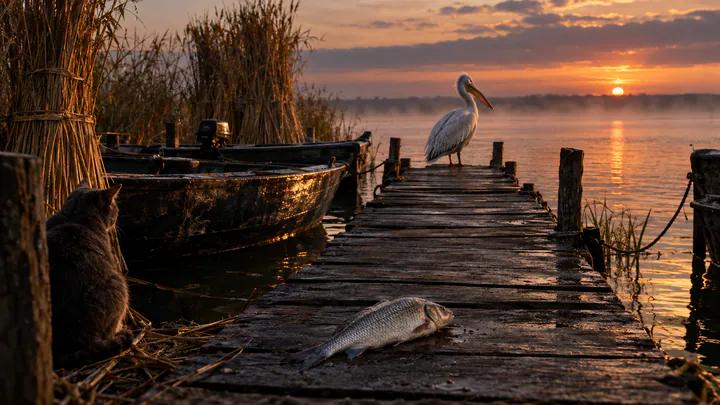
On the sixth evening he came down on Pavel Zaharia's jetty. This jetty. These same planks, more or less. He folded himself up, which took a while, and he said, without looking at anybody, "I find myself prepared to discuss terms."
Pavel was mending a net with a wooden needle. He did not stop. "Terms."
"The river is being unreasonable. You people have dealings with it. Tell it I'm hungry."
"It knows you're hungry," Pavel said. "Everybody on the arm knows you're hungry. The frogs are making songs about it." One of the nephews laughed and turned it into a cough. "The river isn't unreasonable. You took and you didn't pay. Everybody who takes from it pays something. We sing when we haul. Did you know that? Every net. We sing it a song, so it knows we're grateful and not just greedy. What did you ever sing?"
"Pelicans don't sing."
"No," said Pavel, "you don't." He bit off a thread. "So you'll pay the other way. You owe us too, remember, for all the fish out of our nets. Here is the toll. You stand on the end of this jetty. You stand still. You face the sea. You are taller than anything out here but the lighthouse, and you see farther than any of us. When weather is coming off the Black Sea, you open those great wings and clap that beak until we hear you in the boats. That's your song. Do it, and every dusk there'll be one fish on these planks, and I'll speak to the river."
Dobrin was so offended his pouch went red.
"Stand still," he said. "Like a post. Like a heron."
"Herons eat," said Pavel.
Well. He was hungry. He took the job.
The first week he hated it. He stood on the end of the jetty with his beak pointed at the sea and his feathers tight with insult, and every time a boat went past he turned his head away so nobody could say he had been watching them. He counted the hours by the bells at Sulina. He told himself he was only doing it until the river forgot.
But you cannot stare at the sea for a week and learn nothing. He learned that the bad weather comes with a smell first, like a cellar door opening. He learned that when the gulls stop shouting and all fly the same way, you have the time it takes to smoke one carp. He learned the long grey line on the horizon that means rain and the low yellow one that means wind, and the yellow one is worse.
On the ninth day the yellow line came. Dobrin saw it before anyone. He opened his wings, all of them, every white feather, and he clapped his beak like a man knocking at the gates of heaven with a plank. Out on the water the nephews looked up, saw that great white flag on the end of the jetty, and pulled for home. They were tied up and swearing at their knots when the squall came through and flattened the reed beds for a mile.
That night there were two fish on the planks. And the nephews' wives came down to look at him, and the children came, and an old woman from the smokehouse brought him a carp head and told him he had the bearing of a bishop.
He began to enjoy it, Andrei. That is the part he would never admit. He liked being the tallest thing on the arm. He liked that boats came round the bend and the first thing the men did was look for him. He liked the clouds, even, the way they piled up and argued out over the sea and how he was the one who knew what they meant. A bird that thinks the world owes him nothing does not have much to do all day. A bird with a jetty has a profession.
The river opened the Fat Water again that autumn. Dobrin went once or twice. But he always came back before dusk, because by then it was his jetty, and it was not right to leave a place like that unattended.
Andrei was quiet for a moment. The frogs were in full voice now, and the smokehouse door down the bank banged twice and stopped.
"Bunicule."
"Mm."
"There's no pelican."
"Not tonight. Pelicans have commitments."
He pointed. Out from between two reed stacks, low and unhurried, came Cocoloș, the smokehouse cat, grey as an old net, with one ear torn and the walk of a creature that has never once been late for dinner. He went straight up the planks, put his face to the little carp, and looked at us as if we were the ones who had interrupted something.
"It's for the cat," Andrei said. "It's obviously for the cat. Uncle Serghei's is for the cat too. The cat goes along the whole jetty."
Cocoloș took the fish by the middle and trotted off with it into the reeds.
I stood up, which took a while, and brushed the chaff off my trousers.
"Pelican's fish," I said. "Head toward the water. Tomorrow you lay it again, and you lay it properly."
"But the cat—"
"Andrei," I said, "who do you think watches the jetty when the pelican is out at sea?" And I picked up my sickle and went in to my supper.