A Ring Comes Across the Counter at Ten to Six
A short story about a Cebu pawnshop appraiser who, ten minutes before closing, is handed a gold ring engraved with the initials of the son who left on a ferry six years ago.
Drafted with AI. This version has not been reviewed by an editor, so it carries no ads — how we work.
Story Time is original short fiction. The characters, places and events in this story are invented.
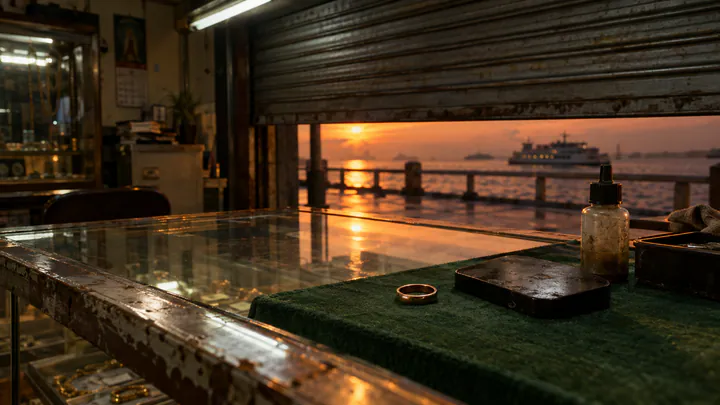
At ten to six by the clock above the safe, a boy ducked under the half-lowered shutter and put a ring on the counter as if it were hot. Perla had already capped her pen and squared the day's ledger against the edge of the glass. She uncapped the pen again.
"Sangla lang, Ma'am. Quick, please."
He was fifteen, maybe sixteen, in rubber slippers gone grey at the heels and a basketball jersey with the number picked off. He smelled of diesel and of the dried fish the porters hauled off the night boats from Mindanao. He kept one hand flat on the counter and the other hooked through the grille, as if either of them might be taken from him.
Out of habit she lifted the ring with the tweezers before she touched it. A plain band, wide, the yellow running a little toward red. Local gold, not the bright Saudi kind. She tilted it under the lamp to find the karat stamp and found instead, on the inside, three letters she had paid an old engraver on Colon Street forty pesos to cut in 1991: R.D.S. The S leaning slightly, because the old man's hand had shaken, and he had told her it was style.
The fluorescent tube above the counter buzzed, dimmed, came back. Down the street a vendor was shouting to anyone who would listen that the brownout schedule said six o'clock, six o'clock, buy your candles.
Perla laid the ring on the green felt. Her hand did not shake. She noted that it did not shake the way she would have noted a hairline crack in a stone.
Beside the window, curling at one corner, hung the owner's card in red marker: ENGRAVED ITEMS: VALID ID REQUIRED. SUSPECTED STOLEN: HOLD ITEM, CALL BARANGAY. The tanod outpost was two corners away. Manong Ciriaco would be there now with his radio and his rattan stick, eating banana cue, glad of something to do.
"You have ID, Dong?"
"School ID, Ma'am. Expired." He dug it out of his back pocket, laminate peeling. Jerome Ybañez, Night High School, SY 1997–98. The photo was of a rounder, younger boy.
"J.Y.," she said, and turned the card face down. "The ring says R.D.S."
His eyes went to the shutter. She watched them measure the gap, the forty centimetres of orange street light between steel and floor.
"Many rings are bought second-hand," Perla said, in the same voice she used for old women pawning their wedding bands. "Initials mean nothing. Sit. The stool is clean."
He did not sit, but his hand came off the grille.
5:52. She took the touchstone from the drawer, black and smooth as a river egg, and drew the ring across it once, firmly. A bright streak. Beside it, from the test needles, she laid down the fourteen and the eighteen. Her own breathing was loud to her, so she listened to the street instead: a jeepney conductor calling Carbon, Carbon, the long horn of a ferry backing off Pier 1.
Ramon had left on a boat like that. Nineteen years old, the semester's tuition spent on she still did not know what, a shouting match across the kitchen table that she could recite word for word if anyone ever asked, which no one did. He had taken the night boat to Cagayan de Oro with a duffel bag and this ring on his finger, the one she had made by melting down her mother's earrings for his high school graduation. That was June of 1993. No letter. No call to the neighbour's phone. Six Junes.
She uncapped the nitric. The smell came up sharp and she turned her face from it.
"Who gave it to you?" she asked, to the touchstone, not to him.
"It's mine."
A drop on the fourteen-karat streak: it fizzed and faded. A drop on the ring's streak. It held, bright and stubborn.
"It's eighteen," she said.
"He said eighteen." Then the boy shut his mouth hard, as if he could swallow the word back.
Perla wiped the stone with the cloth, slowly, in one direction, the way the owner had taught her twenty years ago. He. She did not look up. If she looked up, the boy would see her face, and she did not know what was on it.
"Whoever told you that knows gold," she said.
5:55. The digital scale took a moment to wake, its little green numbers flickering with the current. She set the ring in the pan. 4.1 grams. She checked it on the old beam balance too, sliding the brass weight with one fingernail, because if the power went she would need to be sure, and because doing something with her hands kept the questions behind her teeth.
There were so many questions. Is he thin. Is he married. Does he still sleep with one arm over his eyes. Does he hate me. She chose the smallest one.
"Why so fast? Shop closes at six. You could come tomorrow."
"The boat's at eight. Iligan."
"Your fare?"
He nodded.
"And he's not going with you, the one who said eighteen?"
"He's sick." Jerome's fingers drummed the glass. "Not very. Cough. He can't work the boats now, so I go. He cooks for the boarding house, he can still do that. Too much ginger in everything." He seemed to hear himself and stopped. "Ma'am, you're buying or not?"
Ramon at eight years old, fishing the ginger out of the tinola and eating it raw, crying from the heat and reaching for more.
"I'm appraising," Perla said. "That's different. Did he send you to this shop?"
"No. He said go to Colon Street, not the one by the pier. But Colon's closed already. This is the nearest."
The tube overhead dimmed again, longer this time, and the scale's numbers went to dashes and came back. Perla found the flashlight under the counter by feel and set it beside the ledger.
Not the one by the pier. She held that sentence in both hands. A man who knew which shop to avoid knew who stood behind its counter.
On the wall, the card: HOLD ITEM, CALL BARANGAY. She thought of Manong Ciriaco ducking under the shutter, the boy's slippers slapping away down M. J. Cuenco toward the pier, the ring locked in an evidence envelope, and then nothing, another six years of nothing, a boarding house somewhere across the sea where a man coughed over a pot of too much ginger and was told the boy had been arrested because of his mother.
5:57. "Four point one grams, eighteen karat," she said. "Loan value, one thousand and fifty."
He had clearly hoped for more. She saw him do the arithmetic of fare and food and something else he was not telling her. Then he nodded once.
Normally she would deduct the advance interest and the service charge. Sixty-three pesos and five. She counted the full thousand and fifty out of the drawer, then took her own coin purse from her bag and put sixty-eight pesos into the till so the ledger would balance in the morning. The boy watched her do it and did not understand, and she did not explain.
The lights went out.
The street outside groaned all at once, the way a whole city does when the fans stop. In the dark, Jerome's breathing quickened. Perla clicked on the flashlight and laid it on its side so the beam fell across the ticket book.
"Stay," she said. "One minute. You need the ticket or he can't redeem it."
She wrote in the small block letters the owner insisted on. One (1) gold ring, plain band, 18K, 4.1 g. Engraved R.D.S. The date. The maturity date, four months out, as the form required. She tore the customer copy free, turned it over, and on the back she wrote her name, her full name, and under it the address: the door behind the sari-sari store on the lane off M. J. Cuenco, the green gate, the house he had grown up in. The same address it had always been.
She folded the money inside the ticket and slid it through the slot in the grille.
"Listen, Dong. The interest is already paid. Whoever gave you this ring can redeem it for free. Not only in four months. Any time. Next year. Ten years. He brings the ticket, or he doesn't bring the ticket. It doesn't matter. Free."
Jerome held the folded ticket up into the flashlight beam and turned it over. She watched him read the back, his lips moving on her name. He looked at her face then, properly, for the first time since he had come under the shutter.
"Ma'am," he said. "You know him?"
Perla put the ring in a small brown envelope, wrote the ticket number on the flap, and sealed it.
"Tell him the appraiser said it was eighteen," she said. "Tell him she checked it twice."
The boy put the ticket in his front pocket, not his back one, and pressed his palm flat over it. Then he was gone under the shutter, his slippers slapping toward the pier, toward the eight o'clock boat.
6:00. The clock above the safe had stopped with the power, its second hand frozen just past the hour, which she would have to fix in the morning. She locked the envelope in the safe with the rest of the day's goods. She pulled the shutter down the last forty centimetres and padlocked it, and on the walk home along the dark lane she stopped at the vendor who was still shouting about candles and bought a dozen, more than she needed, enough to keep one lit in the front window every night until the power came back.