Snow Report from the Albula Pass
A short story about a Swiss road keeper, alone in his pass hut on a February night in 1974, who must decide whether to open the road for a coach of stranded schoolchildren.
Drafted with AI and published automatically. Our editors set the standards and fix reported errors — how we work.
Story Time is original short fiction. The characters, places and events in this story are invented.
The telephone on the wall of the hut rang at ten to five, and Corsin let it ring twice while he moved the coffee pot off the hot plate, because he already knew who it was.
"Corsin. Dosch, Chur." The line hissed like a pan of fat. "You have a coach at your lower barrier."
"I know. I've been talking to the driver for an hour."
"Thirty children from Samedan, two teachers, back from the swimming baths. The road behind them is drifting faster than Bergün can clear it. They can't go back down. I have the parents' committee ringing my wife at home."
"They're warm. The driver has diesel."
"For how long?" Dosch let that sit. "You have the plough. Three bends and the summit, and they're in La Punt by seven. The canton did not keep this pass open all winter to have it shut on the one night it matters."
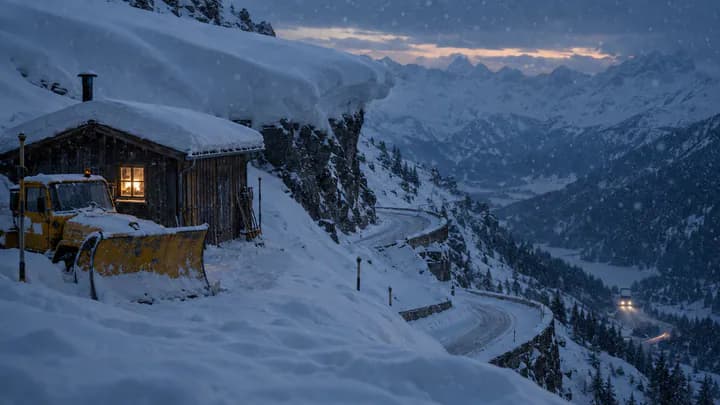
Corsin looked through the window. Above the third bend the ridge ran in a long white lip against a sky going the colour of skimmed milk. At noon the lip had been the length of a hay wagon. Now he could not see where it ended.
"The cornice is loading. Wind's been west since morning."
"Have you fired your charges?"
"Not yet."
"Then fire them. If it comes down, clear it and send them through. If it doesn't come down, send them through." A pause, papers moving. "I'll ring back at twenty to six. I need the road open, Corsin, or I need a reason I can put on paper."
The line clicked. The clock above the stove said 16:51.
The radio on the shelf crackled before he had sat down.
"Hütte, Hütte, Caduff." The driver's voice was younger than his own by thirty years and trying not to be. "Did Chur call you?"
"Chur called me."
"And?"
"And I'm going to look at the snow."
A sound on the line that might have been Caduff's hand coming down on the wheel. "One of the small ones has been sick twice. The teacher, Fräulein Tschudi, she's been on her feet since five this morning. I can run the engine maybe till midnight if I'm careful. Corsin. It's twenty minutes over the top. I've driven this road four hundred times."
"Not tonight you haven't."
He took his jacket from the hook and went out.
The thermometer screwed to the doorframe read minus three. At breakfast it had read minus eleven. The snow coming down was no longer the dry stuff that squeaked under a boot; it was heavy and grey-flaked, falling straight now that the wind had dropped, and it settled on his sleeves like wet flour. He pushed the shovel into the bank beside the plough shed and levered out a block. The top forty centimetres held together, dense and damp. Beneath it the old January snow poured off the blade like sugar.
He had seen that layering in 1951, the winter they dug the postman out at Preda with his bag still over his shoulder.
In the shed he took two charges from the box. He had kept them under a tarpaulin, but the roof leaked at the ridge beam and he had known it since autumn and written it in the requisition book three times. The fuse felt soft between his fingers. He walked to the edge of the turning area, where he could lob a charge onto the near slope as a test, struck the igniter, and watched the fuse spit, fizz along a finger's width, and die.
He tried the second. It did not even spit.
He stood with the dead charge in his glove. Then, from somewhere under his boots and also from the whole mountain at once, came a sound like a sack of grain dropped on a wooden floor, a soft, enormous whumpf, and the snow around him sank perhaps a centimetre. Nothing moved on the slope. The cornice hung where it was.
He went back inside and took off his gloves and found his hands were steady, which surprised him.
17:09.
On the table lay the logbook, the canton's grey binding gone soft at the corners. Twenty years of entries in his square pencil hand: snow depth, temperature, wind, road open, road closed, vehicles through. No one injured. He had imagined, more than once this winter, the last page in April, how he would rule a line under it and hand it to whoever came next, some lad from Filisur with a moustache, and walk down to Bergün where Mengia had already chosen the curtains for the flat by the station.
If he ploughed the bends and sent them over and the cornice held, Dosch would ring the newspaper in Chur, and there would be a photograph. If he kept the road shut and the cornice held all night, there would be thirty families who remembered the name of the old man who left their children in a cold bus for nothing. Dosch would put that on paper too. It would sit in the file next to twenty years of no one injured, and it would be the only thing anyone read.
And if he sent them over and it did not hold.
He found he could not finish that one, even in his head, and he understood that this was the answer, and he did not like how small it was. It was not a measurement. It was the feel of a shovelful of snow and a sound under his boots.
The radio again. This time a woman.
"Herr Corsin? Tschudi. I'm one of the teachers." She spoke very clearly, the way people speak to classrooms. "I don't need you to explain avalanches to me. I need to know what to tell them. Some of them think you're coming with a snowplough. Some of them think nobody is coming at all. I'd like to stop one of those groups from being wrong."
He looked at the stove, at the pot of barley soup he had made at midday and meant to eat for three days.
"Tell them somebody's coming," he said. "Not with the plough."
A silence. "I see."
"Do you? I'm not sure I do."
"Then that makes two of us, Herr Corsin, and at least we're honest." The line clicked off.
He filled both big thermoses with tea and put in more sugar than was decent. The soup he poured into the aluminium milk can, wrapped it in a towel and stood it in the bottom of the rucksack. He stripped the cot of its two army blankets and took the three from the cupboard, the ones that smelled of mothballs and the previous keeper's pipe. Candles, matches, the first-aid tin, a packet of zwieback, the half block of chocolate he had been saving. He laid it all on the small sled by the door and lashed it down. He put the logbook in the inside pocket of his jacket without quite deciding to.
17:31. The window had gone fully blue. The cornice was no longer a shape, only a darker place in the dark.
The telephone rang at 17:40 exactly. Dosch was a punctual man; Corsin would grant him that.
"Well?"
"The road stays shut."
"Your charges?"
"Damp. Both duds. The roof leaks; it's in the requisition book."
"So you have no test."
"I have a test. I stood on it. It sank."
Dosch breathed out through his nose, a long sound down eighty kilometres of wire. "Corsin, you are four months from your pension. Do you understand what I will have to write if those children spend the night on that bus and in the morning there is nothing on the road but snow?"
"Write it," Corsin said. "Spell my name right. It's with a C."
"Where will you be, if anyone asks?"
"On the bus."
He hung up before Dosch could answer, and then, because twenty years was twenty years, he wrote in the logbook: 17:41. Road closed. Keeper to lower barrier on foot.
He did not take the road. He strapped on the snowshoes and went out across the shoulder of the rib on the old mule path, well east of the gully, the sled bumping behind him and the headlamp making a small yellow room in the falling snow. It took him an hour and ten minutes. Twice he stopped to listen and heard only his own breathing and the faint hiss of flakes landing on his hood.
When he knocked on the coach door, thirty faces turned in the dim cabin light, and a small girl in a red hat near the front said, loudly and with deep disappointment, "He hasn't even got a plough."
By four in the morning most of them were asleep, folded against each other under the blankets and their parkas, a smell of wet wool and barley soup and diesel in the bus. Caduff ran the engine ten minutes in every hour, by the clock on the dashboard, and did not speak to Corsin much. Fräulein Tschudi had finally sat down, two rows back, with a boy's head in her lap. The girl in the red hat, whose name was Ladina, had stayed awake to ask him how you could tell what snow was going to do, and he had told her you mostly couldn't, and she had found that unsatisfactory and fallen asleep in the middle of saying so.
A little after six, with the windows just beginning to grey, it came.
It began as a sound like a train in a tunnel far off, and grew, and went on longer than seemed possible, a long tearing rush up above them in the dark, and then a deep settling thump that came through the floor of the coach and into their feet. The snow on the windscreen shivered and slid. Then nothing at all.
Nobody screamed. A few children sat up. Fräulein Tschudi turned and looked at him over the seat backs, and Caduff, at the wheel, took his hands slowly off it and put them in his lap.
"Third bend?" Caduff said.
"Third bend."
Corsin unscrewed the last thermos and poured what was left of the tea, lukewarm now, into the cup, and passed it forward to the driver. Then he took the logbook from his jacket, licked the pencil, and wrote the time. Under it, in the column where the canton asked for vehicles, he wrote: None on the road.