The Last Ferry Off Halcyon Reef
On an island where everyone is leaving, a teenage ferry mate has six hours to decide if she'll get on the boat with them.
Drafted with AI and published automatically. Our editors set the standards and fix reported errors — how we work.
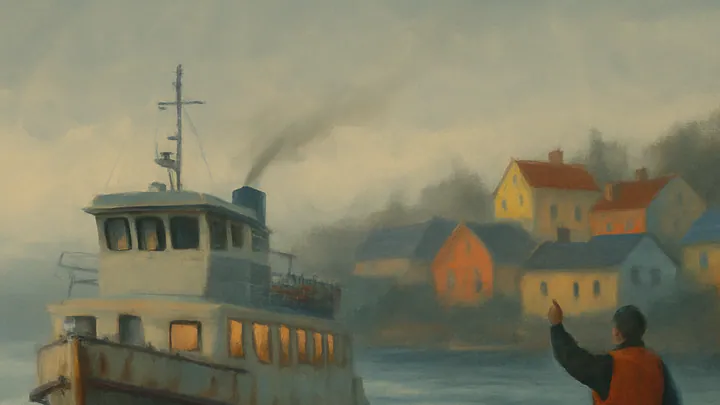
The morning the last ferry came, Wren tied her boots with the same double knot her father had taught her, and pretended this was any other Tuesday. It wasn't. The harbor bell had been ringing since four a.m., a wet, apologetic clang, and out past the breakwater the water sat high and gray as wet slate.
She walked down through the village with her duffel bag slung crosswise. The bag held two sweaters, a jar of her mother's blackberry preserves, the photograph of the three of them on the dock the summer the cormorants nested in the chapel roof, and nothing else. Forty pounds was the limit. The notice had been very polite about it.
"Wren! You're late." Old Peder waved her down outside his shop, which wasn't a shop anymore so much as a series of empty shelves and one stubborn man. "Take these. For the crossing." He pressed a paper sack into her hand. Inside: six hard rolls, still warm. The last bread Halcyon would ever bake.
"I can't pay you," she said.
"Did I ask?" He looked past her, toward the harbor. "Tell your father I said the oven kept its heat right up to the end. He'll like that."
She kept walking. She did not trust her voice.
Six Hours
At the harbor, the ferry was already tied up, a great rust-streaked thing with its name painted in faded blue: Marella. Wren had grown up watching this boat arrive twice a week with mail and flour and visitors who said the island was charming and then left before dark. Today the Marella would make four trips. The fourth would be the last. After that the channel would be left to the rising tide and the cormorants and whatever the sea decided to do next.
Her father was on the dock in his orange vest, clipboard in hand, doing what he had done for thirty-one years, which was to make sure everyone got safely onto a boat. He had refused, so far, to talk about which boat he himself was getting on.
"Ropes," he said, when he saw her. Not hello. Not good morning. Just: ropes. She moved to the bollard and worked the lines with him, and for a few minutes they were simply two people doing a job they knew, and the world was no bigger than the knot in her hands.
"First call's at seven," he said. "The Lindstroms. Then the school families. Then the elders. You and I are on the last one."
"You and I." She tested the words.
He didn't look up. "That was the deal."
It had not exactly been a deal. It had been a thing said once, in the kitchen, in November, when the storm took the south breakwater and the engineers came with their charts and their pitying faces. We'll go together, he'd said. When the time comes. Last off. Like the captain does. Her mother, who was already sick then, had laughed her dry laugh and said, You're not a captain, Henrik, you're a harbormaster of a harbor that's about to be a reef. They had all laughed. Then they had all cried. Her mother had been buried in the chapel yard in April, before the chapel yard started to flood at high tide.
So now it was her and him. And the deal.
The seven o'clock loaded. The Lindstrom twins wouldn't let go of their grandmother's coat. The nine o'clock loaded. Mrs. Aaby brought her cat in a picnic basket and apologized to everyone for the noise. The eleven o'clock loaded; Peder was on that one, his apron folded under his arm like a flag he hadn't decided whether to surrender.
Between sailings, Wren walked up to the chapel. The yard was soft underfoot. She crouched by the small flat stone with her mother's name and put one of Peder's rolls on top, which was foolish and she knew it. "He won't get on," she told the stone. "You knew he wouldn't."
The stone, reasonably, said nothing.
The Fourth Sailing
She found him in the harbor office, which was an office only in the sense that it had a door. He was looking at the tide chart he had kept by hand for three decades, page after page of careful pencil. He was not packing it.
"Dad."
"Mm."
"You're not coming."
He set the book down. He had his mother's eyes, people said, gray and slow to decide. "I'm going to see her loaded off," he said. "That's all I promised the company. Then I'll take the skiff over to Sten's place on the mainland. I'll be on dry land by dark, Wren. I swear it."
"You're lying."
He didn't answer, which was answer enough. The skiff had a cracked hull. Sten's place was twenty-two nautical miles in open water. He was sixty-three years old and he had buried his wife in April and he was going to stay until the lights went out, and she had known this, she thought, since November.
"Then I'm staying too," she said.
"No."
"You don't get to —"
"No." He stood up. He was not a tall man but he filled the small office. "Listen to me. I had forty years on this rock. You had seventeen. That's not the same arithmetic, child. That's not the same debt."
"It's still my home."
"It was. And it will be, in here." He touched her sternum, lightly, with two fingers, the way he used to when she was small and couldn't sleep. "A home you carry is still a home. A home you drown in is just a grave."
The bell rang for the fourth sailing.
She thought, for one long bright second, about refusing. About sitting down on the harbor office floor and making him drag her. She was strong enough now that he probably couldn't.
Instead she said, "Promise me the skiff. Promise me Sten's by dark."
He looked at her. She watched him weigh it — the lie he wanted to tell, the truth he owed her — and she watched the truth win, narrowly, the way it always had with him.
"I promise I'll try," he said. "That's the most honest thing I have, Wren. I will try."
It was not enough. It was what there was.
She walked the gangway with the last fourteen passengers. At the rail she turned. He was on the dock in his orange vest with his clipboard, and the wind was pulling his hair sideways, and behind him the village rose in its small bright colors against the gray, and she understood that she was looking at a painting now, not a place. The Marella's horn sounded, twice, the way it did for every departure, and then a third time, which was new, and which was for him.
He raised one hand. She raised hers.
The lines came up. The water widened between them, foot by foot, the way water does — patiently, without apology. She watched until the orange vest was a speck and the speck was a memory, and then she opened the paper sack and took out a roll and ate it slowly, tasting salt, tasting yeast, tasting the morning her father had taught her to tie a double knot.
The mainland came up out of the haze ahead, low and green and full of strangers. She kept her eyes on it. She also kept, in the pocket over her heart, the photograph from the summer of the cormorants — and she found that her father was right, in his quiet, infuriating way. The island was already inside her, and the sea could not have it.