The Astronomer Who Misplaced Orion
When a small-town observatory loses a constellation overnight, a tired astronomer must figure out where it went — and why a child in the village seems to know.
Drafted with AI and published automatically. Our editors set the standards and fix reported errors — how we work.
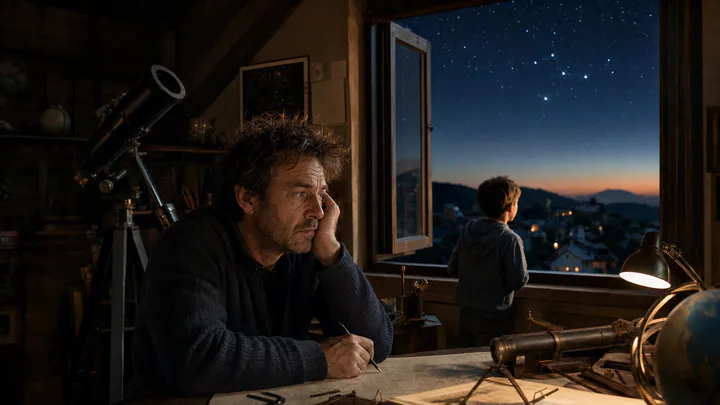
Yara noticed Orion was missing the way you notice a tooth is missing — first with the tongue, then with alarm. She had been logging the winter sky for nineteen years, and at 11:42 p.m. on a Tuesday in February, the Hunter was simply not where she had left him.
She lowered her eye from the telescope and stepped back onto the cold concrete of the observatory platform. Her breath ghosted in front of her. The dome's seam clicked softly as it cooled. Above her, the sky was the sky: Taurus where Taurus should be, Sirius blazing low in the southeast like a struck match. But between them, where three bright stars should have hung in a neat diagonal belt, there was only black.
"All right," she said, to nobody. "All right, all right."
She checked the lenses. She checked her glasses. She walked outside, away from the faint stray light of the warming room, and tilted her head back until her neck ached. Nothing. The shoulders of the Hunter — Betelgeuse, Bellatrix — gone. The sword, gone. The belt, gone. As if someone had reached up with a soft cloth and wiped a thumbprint off the dark.
She drove home slowly along the county road. The fields were striped with old snow. She kept glancing up through the windshield, half-convinced she had hallucinated it, that any second the stars would slide back into place, embarrassed. They did not.
The Note on the Door
At the observatory the next morning there was a folded square of paper tucked into the screen door. It was the kind of paper torn from a school notebook, with the fringe still attached. The handwriting was careful and round.
Dear Star Lady, it read. I think I have something of yours. Mom says I should give it back. We live at 14 Coulter Lane. Please come after school. — Pim, age 8.
Yara read it twice. She folded it again. She put it in the chest pocket of her coat, where she could feel the small weight of it against her ribs, and she went inside to write up her observation logs as if the world were still ordinary.
It was not, of course. By noon, three colleagues had emailed her. Are you seeing this? one wrote. Confirming with Cerro Tololo, wrote another. The third just sent a screenshot of a star chart with a question mark over the empty patch. Orion was missing from every observatory in the northern hemisphere. The story had not yet hit the news because nobody wanted to be the first scientist to say so out loud.
Yara left work at three.
14 Coulter Lane
The house was yellow, the porch slanted, the mailbox painted with sunflowers by a hand that had not yet learned about perspective. A woman in a wool cardigan opened the door before Yara could knock, as if she had been listening for the car.
"You came," the woman said. She had tired, kind eyes. "I'm Della. Pim's been beside herself."
"I got the note."
"She wrote it herself. I made her." Della stepped aside. "She's upstairs. I don't — look, I don't know what's happening. I just know my daughter has not slept properly in two nights, and last night she said she had to give the stars back, and I thought — well. Here you are. A star lady."
"I'm an astronomer," Yara said gently.
"Same thing, this week."
The stairs creaked. The hallway smelled of crayon wax and cinnamon toast. Pim's bedroom door had a paper sign on it that read OBSERVATORY (DO NOT ENTER WITHOUT KNOCKING), and Yara felt something turn over in her chest.
She knocked.
"Come in," said a small, serious voice.
The room was dim. The curtains were drawn against the late afternoon light. On the ceiling, a child had stuck dozens of glow-in-the-dark stars — the cheap plastic kind, sold in bags at the hardware store. They were scattered in the lazy, generous patterns of a kid who had not yet learned the real constellations and did not care to.
Except for one corner. In the corner above the bed, three stars had been arranged in a perfect diagonal, with four more around them — two for the shoulders, two for the feet — and a tiny cluster at the sword. They were not plastic. They were not stuck to the ceiling. They were hanging in the air about an inch below it, very small, very steady, and very, very bright.
Pim was sitting cross-legged on the bed in pajamas printed with whales. She looked up at Yara with the expression of a person who has been carrying something heavy for a long time and is about to be allowed to set it down.
"I wished on him," she said. "I didn't mean to take him. I just wished really, really hard."
Yara sat down slowly on the edge of the bed. The mattress sagged. Above them, Betelgeuse pulsed faintly red, the size of a grain of rice.
"What did you wish?" Yara asked.
Pim's chin trembled. "That my dad would come home for my birthday. He's a sailor," she added quickly, as if this were an important professional detail. "He uses the stars. So I thought if I asked the brightest one — the hunter one — he would help."
"And did he?"
"Dad called this morning," Pim whispered. "He's coming Friday."
Yara looked up at the small bright belt above the bed. She thought about nineteen years of cold concrete and careful logs, about the way she had once, at eight, lain in a field outside her grandmother's house and felt the sky lean down to her like a face. She thought about how rarely, as an adult, she had asked the sky for anything at all.
"Pim," she said, "I think we should give him back. Gently. Together. Is that all right?"
Pim nodded, then hesitated. "Will he be mad?"
"No," Yara said. "I think he liked being wished on. I think he had forgotten what that felt like."
They opened the window. The cold rushed in, smelling of snow and woodsmoke. Pim cupped her hands around the little hanging stars, and they lifted, weightless, into her palms — warm, Yara would say later, the way a sleeping bird is warm. Pim leaned out into the dusk and opened her hands.
The stars rose. Slowly at first, and then with a kind of relief, climbing past the bare branches of the maple, past the roofline, past the thin band of pink at the horizon, until they took their places again in the deepening east, exactly where they were supposed to be, exactly as bright as before.
Yara stood at the window a long time after Pim had gone downstairs for supper. She did not log it. She did not photograph it. She just looked up, with her hands in her coat pockets and her old, tired neck tilted back, and for the first time in a very long time she let herself want something from the sky without writing it down.
On Friday, she heard, a sailor came home. And on Friday night, from the observatory platform, Yara raised her eye to the lens and found the Hunter waiting for her — patient, ancient, and very faintly, she could have sworn, amused.