The Stationmaster of the Wrong Platform
When a freight clerk on her last shift wanders onto a platform that isn't on any timetable, she meets a stationmaster who insists her train is right on time.
Drafted with AI and published automatically. Our editors set the standards and fix reported errors — how we work.
The timetable on the wall said the last train left at 11:47, but the clock above it said 12:09, and Wren Halloway was the only person left to notice. She had been the only person left to notice a great many things at Calder Junction over the past nineteen years, and tonight, being her last night, felt no different except for the matter of her name being scratched off the duty roster in tidy blue pen.
She locked the freight office, jiggled the handle out of habit, and walked the long way down the concourse so she could say goodbye to the things rather than the people. The pigeon-stained skylight. The vending machine that only ever offered the third row. The bench where a man had once proposed to a woman who said, very kindly, that she'd think about it on the ride home.
At the far end of the concourse, past the chain that cordoned off Platforms Nine through Twelve, Wren noticed a light she had not noticed before.
It came from a doorway between Eleven and Twelve, where there had never been a doorway. The bricks she knew were instead a narrow archway, painted the soft green of old railway signs, and beyond it a sign in white enamel read: Platform 11¾ — All Other Destinations.
Wren had spent enough years around freight to know that fractions on a platform sign were a kind of joke nobody bothered to make. She ducked under the chain.
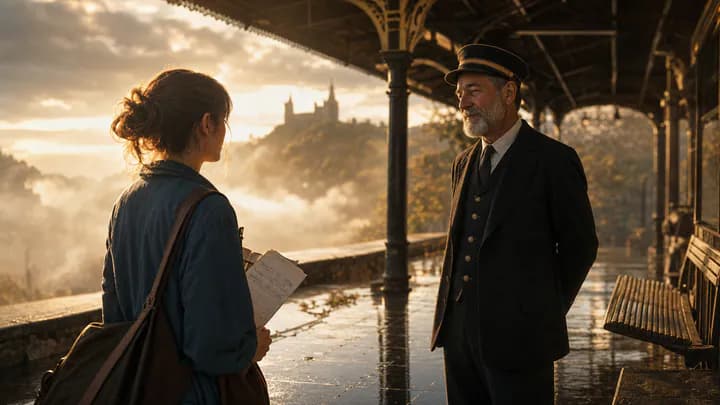
The platform on the other side was longer than any at Calder Junction, and the air smelled the way air smells when rain has just stopped falling somewhere you can't see. A single gas lamp burned at the far end. Beneath it stood a man in a stationmaster's coat the color of wet slate, holding a pocket watch and a paper ticket.
"You're cutting it close," he said, without looking up. "Three minutes, give or take a sigh."
"I'm not catching a train," Wren said. "I work here. I worked here. I was just locking up."
The stationmaster lifted his face. He had the kind of features that seemed assembled from several decades at once: young eyes, an old mouth, eyebrows from somewhere in between. He smiled as if he had been waiting a long time to do exactly that.
"Halloway, Wren M.," he read off the ticket. "Carriage three, window seat, facing forward. You requested forward, didn't you? Years ago."
"I never requested anything."
"You did. You were nineteen. You stood on Platform Four with a duffel bag and a letter from a school in Marenby, and you said, out loud, I would like to be the kind of person who sits facing forward." He held the ticket out. "We took the order. It only took us a while to fill it."
Wren did not take the ticket. She put her hands in her coat pockets instead, the way she did when freight drivers got mouthy.
"Who's we?" she asked.
"The line that runs the trains you almost caught," he said. "We don't advertise. We rely on people noticing doors that weren't there yesterday."
A bell rang somewhere down the track, the soft clang of brass against brass. Wren felt the platform tremble, very faintly, the way the freight dock trembled when the 4:15 came through without stopping.
"Where does it go?" she asked.
"Marenby, originally," the stationmaster said. "But the route's been amended. It goes wherever the version of you that boarded at nineteen would be by now. Adjusted for inflation, weather, and a few bad decisions on our part." He glanced at the watch. "Two minutes."
"I didn't board because my mother got sick," Wren said. The words came out before she could decide whether to say them. "And then she got better, and then I'd already taken the job here, and then it was a year, and then it was nine."
"I know," he said gently. "The ticket has been waiting in a drawer. We don't expire tickets. It's the one decent thing about us."
Wren looked down the platform. The gas lamp flickered. Beyond it, in the dark, she could just make out the shape of a train: not the brutal modern kind that hummed through Calder, but something older, with brass fittings and curtains in the windows. A porter leaned out of one carriage and waved, as if she were an old friend running late for dinner.
She felt something twist in her chest that had nothing to do with sentiment. It was closer to recognition. The way you recognize a song you've only ever heard once, in a kitchen, when you were small.
"What happens to the me who stays?" she asked.
The stationmaster considered this carefully. He was, she realized, a man who took questions seriously, which was rarer than magic.
"She locks up," he said. "She walks home. She wakes up tomorrow without a job and finds, after some weeks, that she is quite good at something she hasn't tried yet. She is not unhappy. She is also not on a train."
"And the me who goes?"
"She sits facing forward," he said. "That's all I can promise. We don't sell endings. Only directions."
The bell rang again. One minute, perhaps less. Wren thought of her apartment, of the lamp she had left on, of the cat who tolerated her with great patience, of her mother in the white house in Edenfield who still phoned every Sunday to report on the weather and the neighbors' hedges.
She thought of the letter from Marenby, folded twice in a shoebox under her bed, the creases gone soft.
"Can I send a postcard?" she asked.
"From every stop," the stationmaster said. "We deliver them backwards. Yours will arrive on the morning you first considered staying. It will say whatever you need it to say."
Wren took the ticket. It was warm, as if it had been kept in someone's pocket all this time, which, she supposed, it had.
She walked toward the lamp. Halfway down the platform she turned, because she had not been raised to leave without turning.
"Are you always here?" she called.
"Only on last shifts," the stationmaster called back. "And only for people who lock up properly."
She laughed, surprising herself, and stepped onto the train.
The carriage smelled of cedar and old paper. The porter tipped his cap and showed her to a window seat, facing forward, where someone had already laid out a blanket the color of the sea at dusk. Outside the glass, Calder Junction began, very slowly, to slide away — the freight office, the vending machine, the bench, the skylight — each thing kindly, each thing finished.
On the seat opposite hers lay a fresh blank postcard and a pen.
Wren picked up the pen, thought for a moment, and wrote, in her tidiest hand, to a girl of nineteen on a different platform: It's all right. You can choose either one. We both arrive.